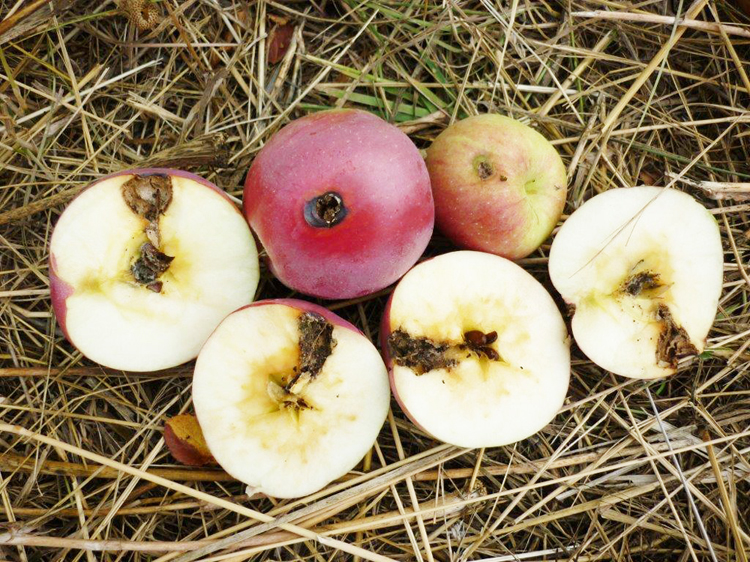

Shown here is codling moth damage in apples. But the Okanagan-Kootenay Sterile Insect Release program has been nominated for a prestigious award for preventing this crop damage.
Photo contributed
Apple and pear lovers in Osoyoos and Oliver will be happy to know that they won’t find a worm in their fruit or be ingesting pesticides either.
That’s primarily due to the Okanagan-Kootenay Sterile Insect Release (SIR) program that has been nominated for a prestigious international award.
The Integrated Pest Management Achievement Award will be presented in March at a symposium in Utah.
The SIR program, which has been successfully controlling codling moths in apples and pears for over 20 years, was nominated by the national Pesticide Risk Reduction program and Agri-food Canada in Ottawa.
SIR staff spend the spring and summer releasing sterile codling moths in apple and pear orchards. These sterile moths attract and mate with wild moths. Because the released moths have been sterilized, they can’t produce healthy eggs — the eggs can’t hatch, so the fruit is not damaged, and the moth population doesn’t increase.
Since the beginning of the program, the amount of pesticides used against codling moth has been reduced by 96 per cent, according to general manager Cara Nelson. In fact, many orchardists in the valley have not had to spray their trees for codling moth for the last 15 years.
“Our whole valley can be proud of the OKSIR program — not just for the amount of pesticides kept out of the environment because the program is in place, but also for the support it provides for our fruit growers, who are important to our local economy and our Okanagan way of life,” Nelson said.
The program has been garnering a lot of international interest from areas and companies looking to recreate its success with codling moths (USA, New Zealand, France), or looking to use its approaches with other pests (Switzerland, France).
Fred Steele, president of the BC Fruit Growers’ Association, said the unique program is an asset for both pome fruit growers and residents who live near and amongst the orchards.
“The success of the program has led to other local fruit industries, including cherry and grape growers, expressing interest in applying the area-wide approach to their own pests.”
Vice-president Pinder Dhaliwal recalled when there was a “push-back” from growers when the SIR program was first introduced.
“When you introduce anything new, there is always a push-back. But now that it has been successful, it’s part of doing environmentally healthy business right now.”
Dhaliwal said the amount of sprays being used for apples and pears have drastically declined.
Consumers also like the fact that fewer chemicals are being used on fruit, he pointed out.
Dhaliwal said the SIR program is now a model around the world.
Nelson admitted the road was bumpy in the beginning because they were introducing new technology. But after what has been achieved (reduction in fruit damage and pesticide use), the bumps have been smoothed out, she said.
But success comes with its own set of challenges.
Nelson said the difficulty they face now is funding the program because they don’t have a problem with codling moths anymore.
She pointed out that regional districts pay 60 per cent of the program, while growers pay 40 per cent ($140 per acre).
The cost to the average property owner in the Okanagan is $11.50 per year.
Nelson said they are trying to find ways to maximize the excess capacity at the facility in Osoyoos. She explained they are looking at the possibility of selling their expertise and excess sterile moths.
One has to wonder how the Central Kootenay Regional District is making out after it withdrew from the SIR program.
Nelson said the district opted out for political reasons after legal issues surfaced (concerns were raised about SIR staff entering private property).
Nelson said that region is back to using pesticides again to control the codling moth.
Lyonel Doherty
Oliver Chronicle