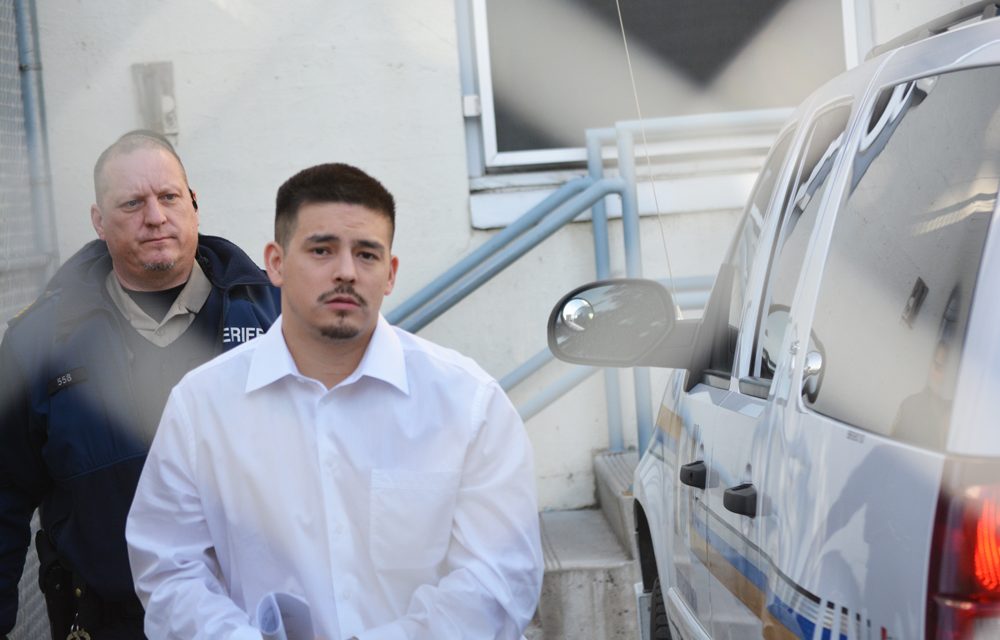

Kyle Louie is led out of the Penticton courthouse during his sentencing hearing on January 21.
The judge presiding over Kyle Louie’s sentencing has agreed with a joint submission to keep him behind bars for another six months.
In addition, the 26-year-old man will serve five-and-a-half years in the “long-term offender” supervision program.
Judge Austin Cullen agreed with much of what Crown counsel John Swanson and defence lawyer Tom Aborgast submitted yesterday (January 21) in the Penticton courthouse.
Louie was sentenced to 75 months in jail for manslaughter – killing his brother Reece Louie in a fight at their home on Black Sage Road on Feb. 19, 2011. Kyle pleaded guilty last spring.
But considering how long he has already spent in jail, he will only serve an additional six months.
Louie, dressed in a white shirt, smiled at family and friends as he was led into court.
Swanson said Kyle killed Reece by stabbing him a number of times with a knife. He told the court that Kyle (23 at the time) and Reece (21) lived with their father Clifford Louie.
The boys reportedly got into a fistfight that day at their workplace at Nk’Mip Campground in Osoyoos. Their supervisor subsequently fired them, and Kyle was heard threatening Reece’s life.
Swanson said Kyle accused Reece of owing $30 that he reportedly borrowed from Kyle’s girlfriend.
Back at home, another argument escalated between the boys, with Kyle subsequently grabbing a knife and started swinging it around, Swanson said.
Reece ran into a bedroom and locked the door, and Clifford ran to his mother’s house to call the police. Shortly after, Clifford saw Reece exit the house, stagger and fall on the driveway. Swanson said Reece suffered several large open wounds.
When paramedics arrived, the young man was still conscious and complained of difficulty breathing. When asked what happened, Reece stated, “I don’t know . . . I don’t know. I’m going to die . . . I can’t breathe.”
Reece was pronounced dead at 8:32 pm that evening. Police subsequently arrested Kyle without incident.
Swanson said the autopsy showed that Reece suffered multiple stab wounds, including two major ones (in the right lung and left renal vein).
The Crown told the court that police found the bloody knife 43 metres from the Louie property. (Kyle admitted throwing the knife on the ground.)
The court heard that Kyle and Reece consumed a large amount of alcohol (whiskey) earlier that day. According to Swanson, Kyle had 30 milligrams of alcohol in his body.
Following the facts of the case, both the Crown and the defence painted a depressing picture of Kyle’s troubled home life, which included alcohol and drug abuse.
Kyle told psychiatrists that he “blacked out” and couldn’t remember what happened at the time of Reece’s death.
Swanson said the brothers were generally quite close . . . “best friends most of the time.” But when they fought, it was very physical, he pointed out.
During discussion about Kyle’s psychiatric assessment, the court heard that he indulged in self-mutilation when he took to drinking.
Swanson’s portrayal of the boys’ home life was a mix of extremes. Living with their mother, they were given free reign to do whatever they wanted unsupervised. Swanson added that they rarely attended school, and their mother was unable to perform the functions of a mother because of her drug addiction.
Living with their “strict” father was a different story; he made them work on the farm.
Swanson said Kyle remembers his father instructing them how to deal with their emotions by channeling them into aggression and anger.
“They (the boys) were not allowed to cry,” Swanson told the court.
The Crown presented information that addressed risk assessment in terms of Kyle’s potential for future violence.
It was disclosed that his criminal record included two incidents of assault with a weapon.
Reading from a psychiatric report, Swanson said Kyle does not have a major mental disorder (he was deemed fit to stand trial).
“Without effective intervention, the likelihood of future violence is high,” Swanson said. But he noted it is reasonable to be optimistic about his treatability.
In interviews with a psychiatrist, Kyle stated the following: “I want whatever treatment they’ll give me, anything that will get me to a better place . . . I want to make something of myself . . . start again . . . going straight is the best tribute I can offer my brother.”
The court was told that he wants to get a tattoo in memory of his brother, and his desire is to go back to school to become a mechanic.
Kyle was described as a good candidate for rehabilitation. In fact, he has availed himself to all rehabilitation programs while in custody.
In his final submission, Swanson said there were several aggravating factors in the crime that Kyle committed: he took the time to arm himself with a deadly weapon; he stabbed his brother repeatedly; and there was a lack of provocation.
The mitigating factors were: he cooperated with police and pleaded guilty; there was no premeditation to kill his brother; and he has taken significant steps towards his own rehabilitation.
Arbogast painted a picture of an “intergenerational legacy” of alcohol abuse and neglect seen in aboriginal communities.
He said Kyle suffered a “total blackout” during the incident, adding that he had consumed a tremendous amount of alcohol and was deprived of sleep for 55 hours.
“He killed his best friend, essentially (in a blackout) . . . the amount of alcohol and drugs in his system were, frankly, staggering.”
When told about the murder charge, Kyle’s response was “who?” Once he was told that he killed his brother, his “entire world crumbled.”
Arbogast cited a history of drinking and drug abuse, noting that Kyle was smoking 26 marijuana joints per day by 2010.
The lawyer said the brothers were “inseparable but fought violently.”
Cullen acknowledged the factors leading up to the tragedy, including Kyle’s sleep deprivation and intoxication. He also agreed that the young man’s upbringing played a significant factor in what happened.
The judge expressed his belief that Kyle was remorseful for his actions.