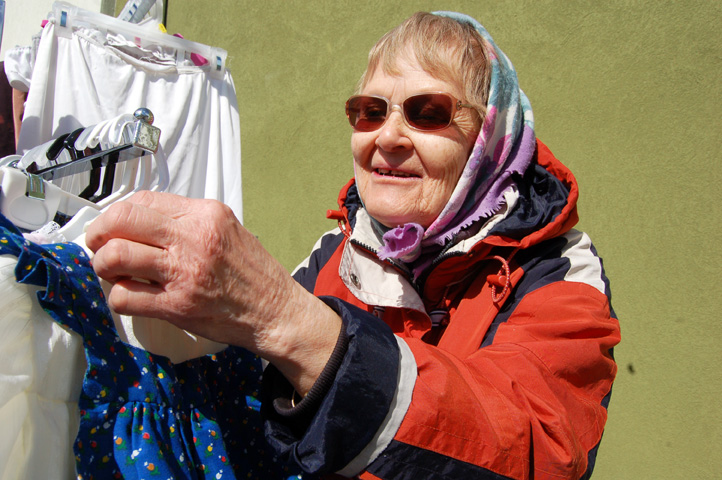

Shirley Roberts loves working outdoors and helping others find just what they need at the Oliver food bank every Wednesday. Here, she sorts through girls’ dresses on one of her clothing racks.
Lyonel Doherty photo
Shirley Roberts is a woman on a mission.
This is evident every Wednesday outside the Oliver food bank where she gives away clothing and housewares to people in need.
It’s the type of job where she gets to help others and the environment at the same time.
“I don’t have to go to Curves for exercise. I like it outside, and I’m keeping clothes out of the garbage.”
The former meter reader collects articles of clothing and various household items that people can take for free. These items are donated by groups such as the hospital auxiliary thrift shop and For the Least of These.
Roberts also receives cash donations, which she uses to buy socks, men’s shirts, and cutlery. She noted the demand for men’s work clothing.
Her mission began years ago when she became involved in the “Coats for Kids” program. As the program evolved, the leftover clothing was brought to the food bank.
“It’s like a full-time job now,” Roberts said, noting the last four years have been very busy. In fact, she’s hoping to get a little help unloading her vehicle at the food bank on Wednesday morning (at 6:30 am).
Roberts said she loves it when people take books and plates because those items are the heaviest to load and unload in her vehicle.
She makes it a point each week to have different items for the taking, from baby clothes to small appliances.
She reiterated her personal goal of keeping clothes out of the landfill, which she strives to do every week.
Roberts said she has definitely noticed the increase in food bank clients over the past few years. She noted the economy is still hurting from the recession in 2008.
She recalled one woman who visited the food bank recently and left with both arms full of clothing.
While Roberts has never lived in poverty, she was “almost there” at one point in her life. She was fresh out of high school in 1955 and was working in an accounting office. Her shoes were worn out and she didn’t have the money for a new pair (she was waiting for her next paycheque and didn’t want to ask for an advance).
“I was almost walking without shoes . . . but they lasted another week.”
Lyonel Doherty
Oliver Chronicle