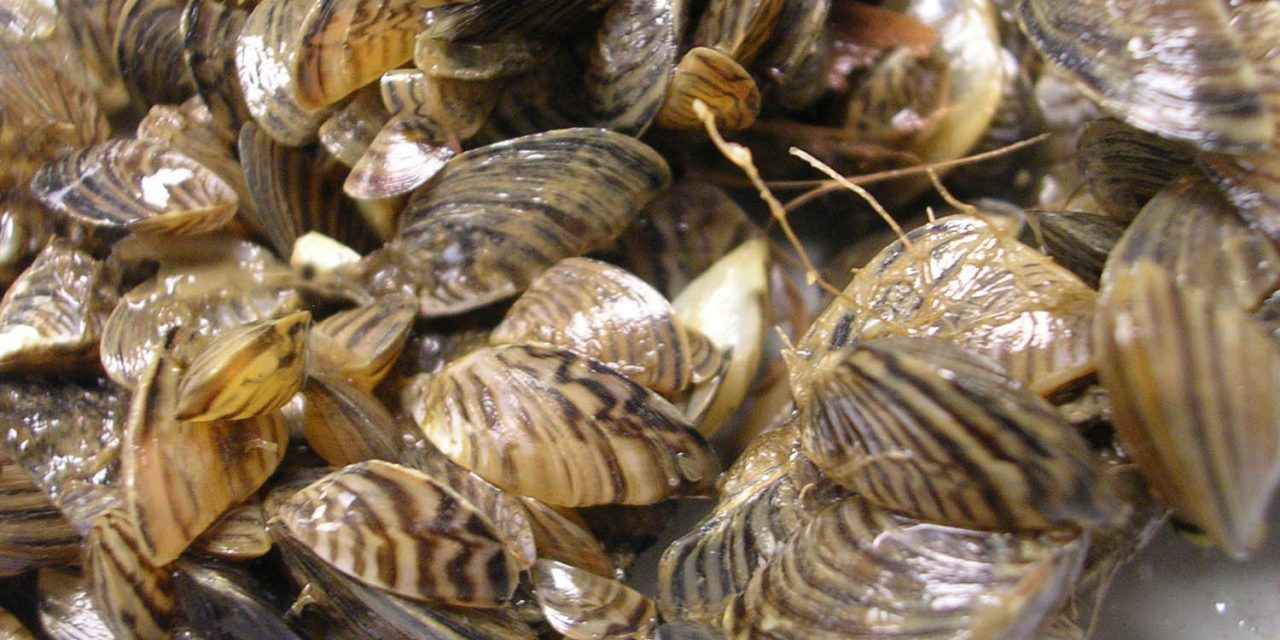
Zebra mussels (pictured here) have spread to Manitoba and quagga mussels have reached the Southwest United States. Now mussel larvae have been detected on reservoirs in Montana, the first time invasive mussels are known to have reached waterways in the Pacific Northwest. (U.S. Fish and Wildlife Service photo)
The Okanagan Basin Water Board (OBWB) is welcoming significant new measures announced recently by the province to address the threat of invasive mussels to B.C. waterways.
The B.C. government announced March 30 that it is adding two new inspection stations, expanding inspection hours, more than doubling the number of inspectors, increasing public education, expanding scientific lake monitoring and employing a mussel-sniffing dog.
OBWB Chair Tracy Gray expressed support for the new measures saying many of the new measures have been on the OBWB’s wish list.
Invasive zebra and quagga mussels have been spread across North America, mainly by recreational boaters who fail to properly clean, drain and dry their boats after using them in infested waters.
Until last fall, the U.S. Northwest and Canadian provinces west of Manitoba were free of mussels, but in November mussels were found in Montana, prompting a Natural Resource Emergency.
Once mussels become established in a waterway, they are almost impossible to eradicate and they spread prolifically, encrusting themselves over every surface, causing potentially billions of dollars in damage.
When the province announced eight permanent inspection stations for last year’s boating season, the OBWB expressed concern that operating hours weren’t long enough.
This year new inspection stations are being added at Midway and Yahk to join ones already established at Golden, Valemount and Dawson Creek, along with mobile stations at Cranbrook, Invermere, Nelson, the Lower Mainland and Penticton.
Nine of the stations will expand to daylight hours from the previous eight to 10-hour days. Golden, the busiest, is going to 24 hours a day.
This year the stations are operating from April 1 to Oct. 31, but the province said it plans to expand service to mid-March to mid-November in future years.
The season this year begins with 33 auxiliary conservation officers, the same as 2016, but the province is hiring and training an additional 35 to start in June.
While $2 million in funding will continue to be provided by power utilities and the Columbia Basin Trust, new this year is a stepped up provincial funding contribution.
The province is committing $3 million, primarily for increased staffing, but also including funds for lake monitoring and equipment.
A German shepherd dog named Kilo is being trained as a multi-purpose dog that will include mussel detection among his duties. It is expected he’ll start work July 1 at high-volume stations on a rotating basis.
One gap the OBWB is still hoping to resolve is the problem of boaters entering the province when inspection stations are closed.
Currently it is mandatory for motorists with watercraft to report to an inspection station during operating hours and failing to do so can result in a $345 fine.
But there is nothing to catch motorists outside of inspection hours.
The OBWB is calling for legislative changes to require all watercraft entering B.C. to report to an inspection station before launching in provincial waters.
In the recent announcement, the government said it would direct motorists to report information about where they are coming from, their destination in B.C. and the steps they’ve taken to ensure they are not transporting invasive mussels.
Gray said her board is continuing to work with the federal government to step up mussel protection measures.
In particular, they are calling for increased training and funding for Canada Border Services Agency (CBSA) officers to intercept mussels coming to Canada from the United States.
They also want federal funding for containment to provinces that are already infested – Quebec, Ontario and Manitoba – and funding to mussel-free provinces for prevention.
The OBWB cites a 2013 study that estimated the cost each year to the Okanagan alone of a mussel infestation would be $43 million.
RICHARD McGUIRE
Osoyoos Times