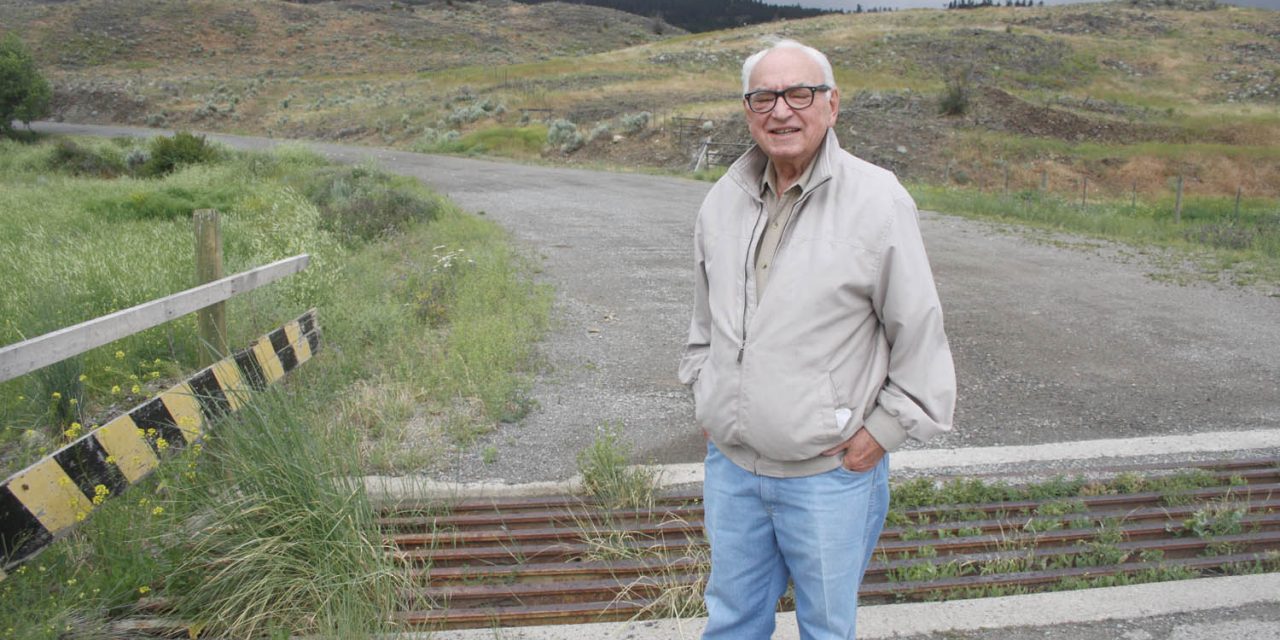
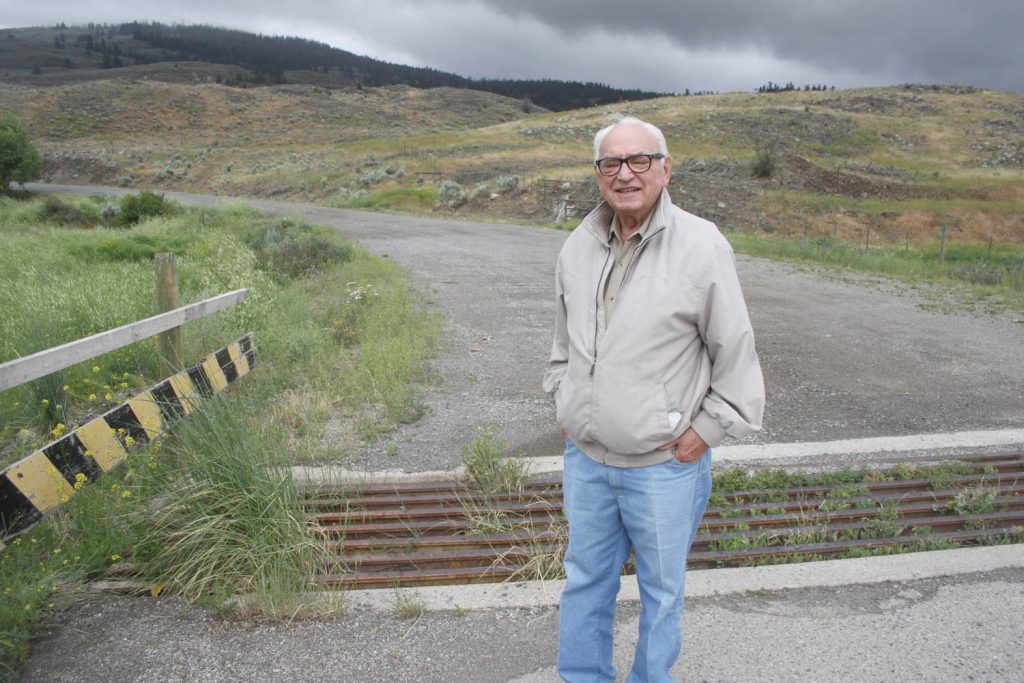
Walter Cook, the engineer in charge of building a road 50 years ago that would have led to Canada’s largest astronomical observatory on Mount Kobau, is still upset that the project was cancelled. Pictured here, he stands at the base of the road up the mountain. Despite the disappointment, he and his wife Virginia ended up staying in Osoyoos. (Keith Lacey photo)
The man in charge of building the road leading to what would have been Canada’s largest astronomical scientific observatory near Osoyoos is still upset 50 years after the project was cancelled.
Walter Cook and his wife Virginia moved to Osoyoos back in 1966 after he was hired to be the field construction engineer in charge of building the road on Mount Kobau, the site of the originally proposed Queen Elizabeth II Observatory.
The road to Mount Kobau is located less than 10 minutes from downtown Osoyoos up Hwy. 3, about a kilometre west of Spotted Lake.
The size and scope of this project was also astronomical for its time with the original cost of the telescope originally set in 1964 at $9.6 million, but that had risen to $12 million a year later.
“In today’s dollars, you would probably have to take those figures and multiply by 10,” he said.
The road developed by Cook and a large crew of construction workers was estimated at $1.6 million back in 1966. The final bill was just over $2 million 50 years ago.
Because they loved the area so much, Cook and his wife decided to settle in Osoyoos and have never left.
They raised their three daughters in this community and Virginia became a well-known school trustee who fought valiantly to ensure Osoyoos Secondary School would be built back in the late 1970s, while Walter quit his engineering career to open up what would become one of this town’s most successful real estate development companies.
Cook said it still bothers him that the Mount Kobau observatory was never developed and he still blames legendary Canadian Prime Minister Pierre Elliot Trudeau and his Liberal government of the day, who cancelled the project back in 1967.
In a letter written back in early 1996, Cook voiced his displeasure at the project being cancelled 30 years earlier to Bill Barlee, then the Minister of Small Business, Tourism and Culture in British Columbia.
“This is to re-state and emphasize my proposal that the Mt. Kobau site be developed to its full potential as a combined tourist attraction and scientific observatory and training facility,” wrote Cook. “Approximately 32 years ago, the Government of Canada acquired the physical land site at the top of Mt. Kobau, plus a right-of-way from Hwy. 3 for approximately 12 miles of highway access to the site.
“This was to be Canada’s No. 1 astronomical scientific laboratory. In 1965, the road construction contract was awarded and the road was completed (except for paving) in 1966. I was the field construction engineer for the consulting engineers representing the federal government at that time, and, therefore, am quite familiar with this site.
“At the same time, the huge lens for the main telescope for this site was being ground at the University of British Columbia and contracts were being readied for the facility’s buildings and structures and viewing dome.
“After the election of Mr. Trudeau as Prime Minister in 1967, the entire project was cancelled, the lens was sold to another country and later on, I believe ownership of the site was turned over to the B.C. government.”
Cook still believes that Mount Kobau presents the best site in this country to open a scientific observatory that would attract tourists and scientists from around the world.
In his 1996 letter, Cook wrote further, “What I am proposing is that the Mt. Kobau site be developed by private industry, by the way of invitational bid proposals, at no cost to the provincial government. I am suggesting the establishment of a telescope viewing facility as a tourist attraction, on a user-pay basis, combined with a food and lodging facility at the site.
“Ownership of the land would remain public on a long-term basis to the developer. This could become a major tourist attraction for the South Okanagan and the province in general. It could also generate revenues for the province by way of lease fees, sales taxes on user fee and income taxes on profits. Facilities such as I am suggesting do exist elsewhere in the world.
“In closing, I should point out that both professional and amateur astronomers still gather and camp out at the site during the summer for star viewing and many are still disappointed that the originally-planned observatory was never completed as what they consider to be Canada’s best site for star gazing. Perhaps some B.C. universities could be involved in utilizing the new facility for part of their students’ practical training. I truly feel that your government should give serious consideration toward promoting the development of this site as soon as possible.”
Cook shares the same opinion today as he did back when building the road in 1966 and writing his letter in 1996.
“The road to Mt. Kobau just needs paving,” he said. “With all the tourists who pour into Osoyoos and the South Okanagan every summer, I’m convinced that a world-class observatory would be a huge success.
“The model to run the place would have to involve a private-public partnership because I fully realize the government would not be willing to pay for the whole thing, but I do think there would be many interested business partners that would still be willing to invest in a world-class observatory facility at Mt. Kobau.”
Cook, who hails from Wainwright, Alberta, worked on service crews for the provincial Department of Highways in B.C. as a young man and end up in Penticton at age 20.
“My father had worked in the Okanagan during The Great Depression and loved it … I had always wanted to visit myself and I was blessed to land here as a very young man,” he said.
He helped build several major highways and bridges in B.C. during 12 years with the Department of Highways before accepting the challenge to move to Osoyoos and accept the job as field construction engineer on the Mt. Kobau road project.
It took an incredible team of engineers and road construction workers to build the 12-mile road up the steep incline of Mount Kobau to the proposed observatory site at the peak of the mountain, he said.
“We had to clear thousands of trees and excavate millions of pounds of dirt and solid rock,” he said. He still struggles with the fact so much time, effort and money was wasted after Trudeau announced the project had been cancelled.
“It was a real blow … probably the most disappointing thing that ever happened during my engineering career,” he said. “Trudeau cited the federal economy and said the project simply wasn’t viable.
“I disagreed then and disagree 50 years later. I believe a world-class observatory would have become one of the biggest tourist attractions in this part of B.C. and would have attracted scientists and university students from around the world.
“In retrospect, what a giant waste of time and waste of money … and what an insult to Queen Elizabeth. It’s very sad that politics ruined what could have been something very special for this area and our country.”
A good friend convinced him that he could make a much more lucrative career in real estate, so Cook studied at UBC for five years in between engineering project and obtained his real estate and appraisal degree.
He and his wife purchased Fraser Realty in 1972 and ran a successful real estate and development company for more than 40 years.
When he looks back on his life, Cook said he’s thrilled his engineering career brought him to Osoyoos because he and his family have loved living here.
But he remains deeply disappointed the Mt. Kobau observatory was never built as it would have provided a lasting legacy to this community and province for generations.
KEITH LACEY
Osoyoos Times
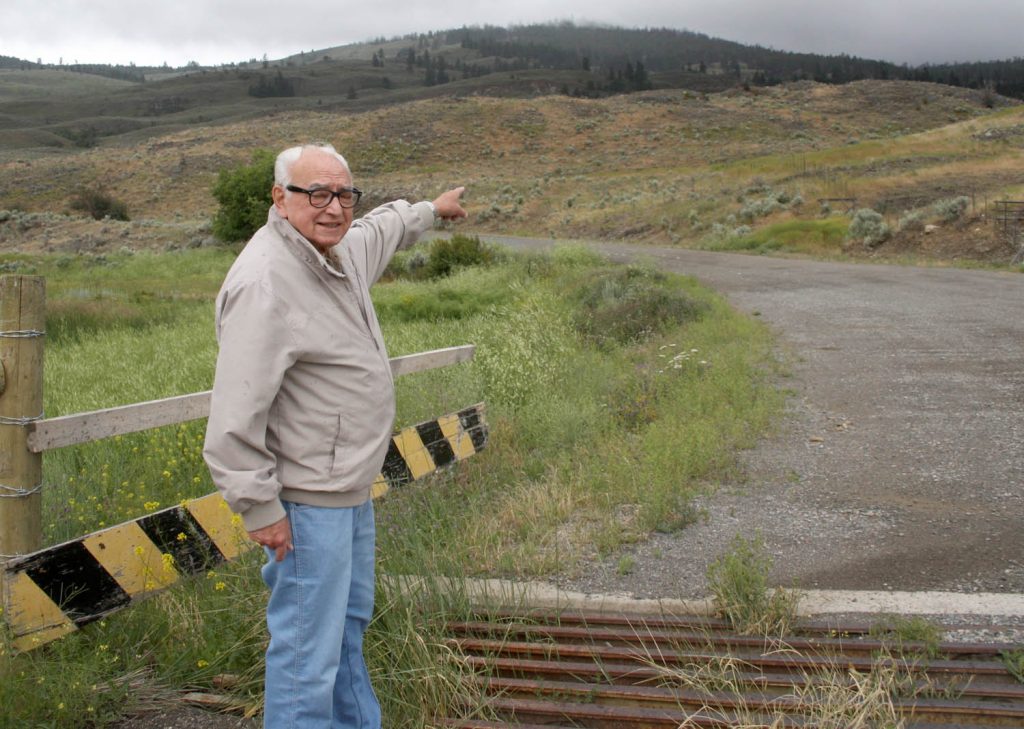
Walter Cook points in the direction of the observatory on Mount Kobau that was cancelled nearly 50 years ago. He’s still upset about the decision. (Keith Lacey photo)