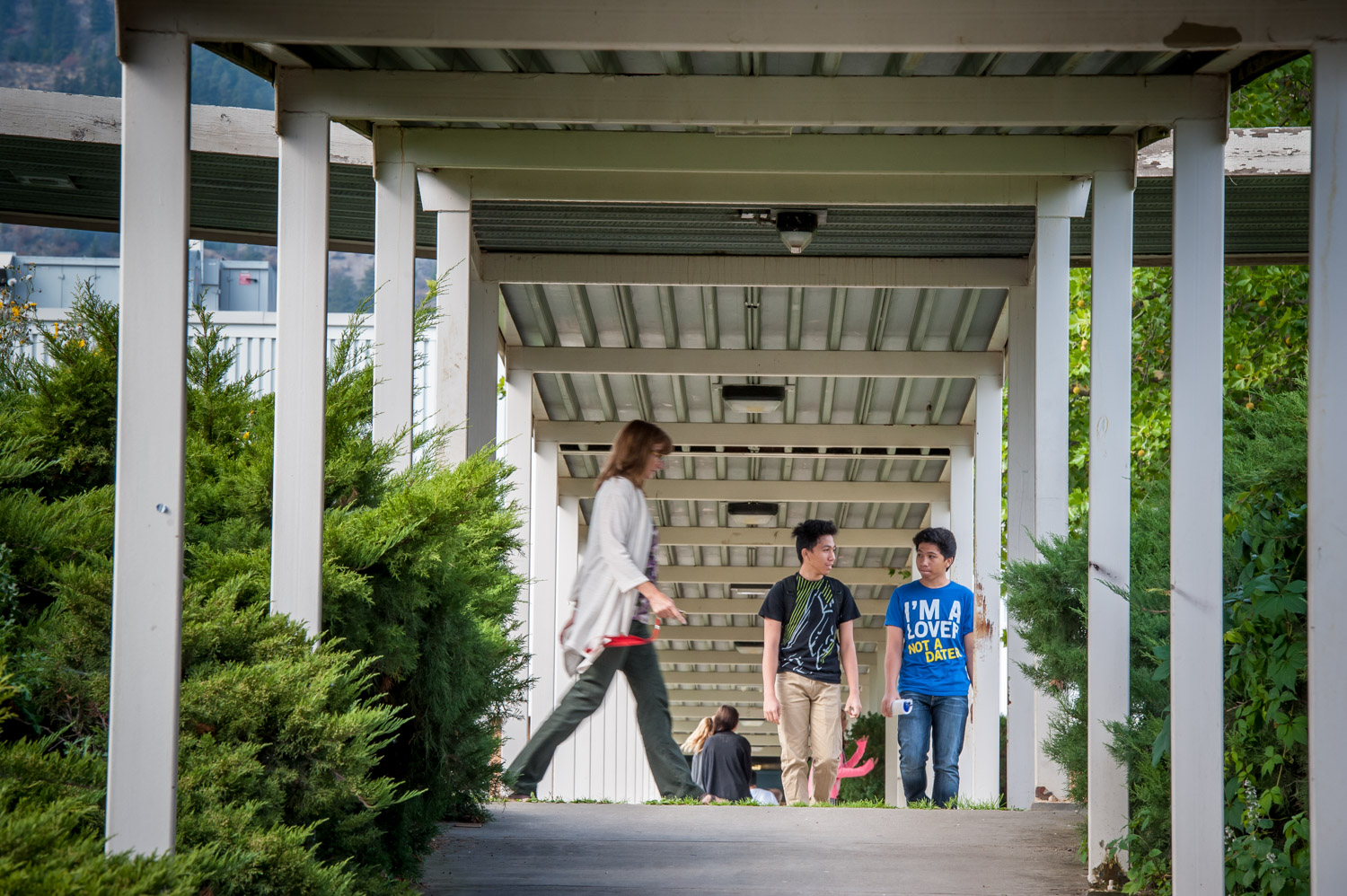
Osoyoos Secondary School. (Richard McGuire photo)
The decision to close Osoyoos Secondary School (OSS) was in the best interests of its current and future students and at no time did trustees with the Okanagan Similkameen (School District 53) breach any of its responsibilities during the consultation process leading to the decision to close the school.
As part of a 45-page response prepared for the B.C. Supreme Court by Vancouver law firm Harris & Company, the School District vehemently denies all allegations that it engaged in inappropriate and unlawful actions during the consultation process that led to the ultimate decision to close the high school in Osoyoos.
“The board reviewed and considered the verbal and written submissions and concerns, and then ultimately concluded that the closure of OSS was in the best interests of its students,” said the written response, filed May 31 in response to the legal action commenced by the town and four residents in early May.
“The board has thus afforded the affected parties, including the petitioners, a meaningful opportunity to fully and fairly present their case in an effort to influence the board’s decision. It has not breached its duty of procedural fairness.
“Based on the above (45 pages), the board submits that the petition should be dismissed with costs to the petition respondent.”
In presenting their case, lawyers with Harris & Company used material provided by School District 53 board chair Marieze Tarr and senior administrators with the district.
“The board denies each and every statement of fact in the petition except where expressly admitted in this response to the petition,” said the court document. “The enactment of the school closure bylaw was the culmination of a lengthy process of strategic planning and consultation in which members of the public, including the petitioners, were actively engaged and had a meaningful opportunity to influence the board’s decision.”
The document states that in 2011, Southern Okanagan Secondary School in Oliver experienced a devastating fire while undergoing renovations and most of the school was destroyed.
“The school was rebuilt and SOSS reopened for students in September of 2013,” states the document. “SOSS has a new gymnasium, science labs and multi-purpose room. Technology is hard wired into the building, The school also has a performing arts theatre that has seating for 400 people.
“SOSS has a capacity of 700. During the 2015-16 academic year, SOSS had 445 students enrolled, including 19 who had an Osoyoos mailing address.
“OSS was built in 1979. OSS’s building and land are owned by the government of B.C. The physical condition of OSS was inspected by the Ministry of Education in 2011 and was assessed a rating of “poor” because of the mechanical, electrical, structural and pluming upgrades required for the school. The cost of fixing or replacing the school’s aging assets is expected to cost in the millions of dollars.”
OSS currently has 230 students for a school with a capacity of 325 “and the board understands that the government … will only financially contribute to a school’s required upgrades when the number of enrolled students meets or exceeds the student capacity for the school.
“As OSS’s student enrolment does not meet or exceed its capacity, it has been the board’s understanding that it would not receive any money from the government to address the required upgrades.”
Between 2005 and 2016, the board experienced a decline of 651 students in its school, which consisted of 23 per cent of its student population, states the document.
“During the 2015-16 academic year, the secondary schools of the board operated 70 classes with 18 students or less, which resulted in high staffing costs for each class. The board has projected enrolment through to 2024 and anticipates an enrolment decline of 248 students, or a further 11. 5 per cent of its current student population through that period.”
The board receives $7,000 per student from the Ministry of Education “and a decline in student enrolment thus has a direct impact on the board’s revenue.
“Since 2009, the board has assumed a number of initiatives, which have resulted in over $1 million of annual operational cost savings.”
The board project a $600,000 operating deficit during this school year due to declining enrolment, but must face its obligations to present a balanced budget, so uses almost $620,000 from reserves from its $1.43 million surplus to balance the current school year budget, said the document.
The board has projected a further $900,000 operational deficit for the 2016-17 school year, which would require it to use “the remaining $800,000 from its surplus” and face another $100,000 operating deficit.
The small cohorts at SOSS and OSS has resulted in some students having to take required courses through distance learning and a lack of elective courses, said the document.
As far back as 2010, school district staff reviewed enrolment trends and budgetary constraints and explained fewer students was “making it a challenge to offer a wide variety of courses. The board also stated it was looking at a number of options, including the closure of schools.”
In late 2012, the board held community engagement forums across the district to inform the public about “the board’s enrolment trends, finances, facilities and direction in education and to seek feedback concerning these issues.”
In April of 2015, the board met with RDOS officials as well as the mayors and councillors members in several towns, including Osoyoos, to share the board’s concerns over enrolment decline and budget challenges, says the document.
“On Dec. 2, 2015, the board’s chair Marieze Tarr, informed the Mayor of Osoyoos Sue McKortoff, that the board was updating its Facilities Plan,” says the document. “Tarr explained to McKortoff that the district staff would complete the updates facilities plan in December 2015 and that it was possible that the update would include recommended school closures.”
District staff presented the updated facilities plan to the board on Dec. 9, 2015 at an in-camera meeting.
A motion from that meeting stated that a special board of education meeting be held on Jan. 13, 2016 after which the board will decide whether it will consider any, all or some of the staff recommendations brought forward in the updated Facilities Plan.
At that open public meeting on Jan. 13, Superintendent of Education Bev Young raised the recommendations in the 2015 Facilities Report and consider closing either OSS or Osoyoos Elementary School.
That information was given to all media outlets across the South Okanagan, said the document.
“The board did not receive any complaints about the adequacy of the notice for the meetings,” states the document.
The first of two public consultation meeting was held at OSS with more than 1,000 people in attendance on Feb. 9. A second meeting attracted about 800 to the Sonora Community Centre on March 7.
Young and Deborah Sansome, the director of facilities, presented in great detail the financial challenges facing the school district due to declining enrolment and the subsequent reduction in funding from the provincial government, as well as detailing the heavy costs involved in repairing OSS.
The board did receive an offer of $352,000 for three years from the Town of Osoyoos to keep OSS open, but Tarr voiced her concerns with the offer “as these concerns were substantiated by B.C.’s Deputy Minister of Education, Dave Byng.”
The board considered all of the financial and academic consequences presented to them before the majority of trustees voted 4-3 on April 26 to close OSS, said the document.
“As a result of the School Closure Bylaw, there are larger cohorts of students at SOSS. As a consequence, the school is able to offer 21 courses that were previously not offered …and 17 are also new to OSS students. In addition, the school can now run required courses more frequently.”
The trustees concluded financial and academic consequences of closing OSS outweigh the implications of busing students from Osoyoos to Oliver, said the document.
The consultation process took place within a compressed time frame, but there is no minimum statutory timeline for school closures.
“Prior to making its decision to close OSS, the board reviewed and considered all of the verbal and written feedback that it received during the consultation process,” said the document. “In summary, there is no merit to any of the petitioners’ submissions concerning the adequacy of the board’s consultation process.”
KEITH LACEY
Osoyoos Times