By Richard McGuire
Osoyoos Times
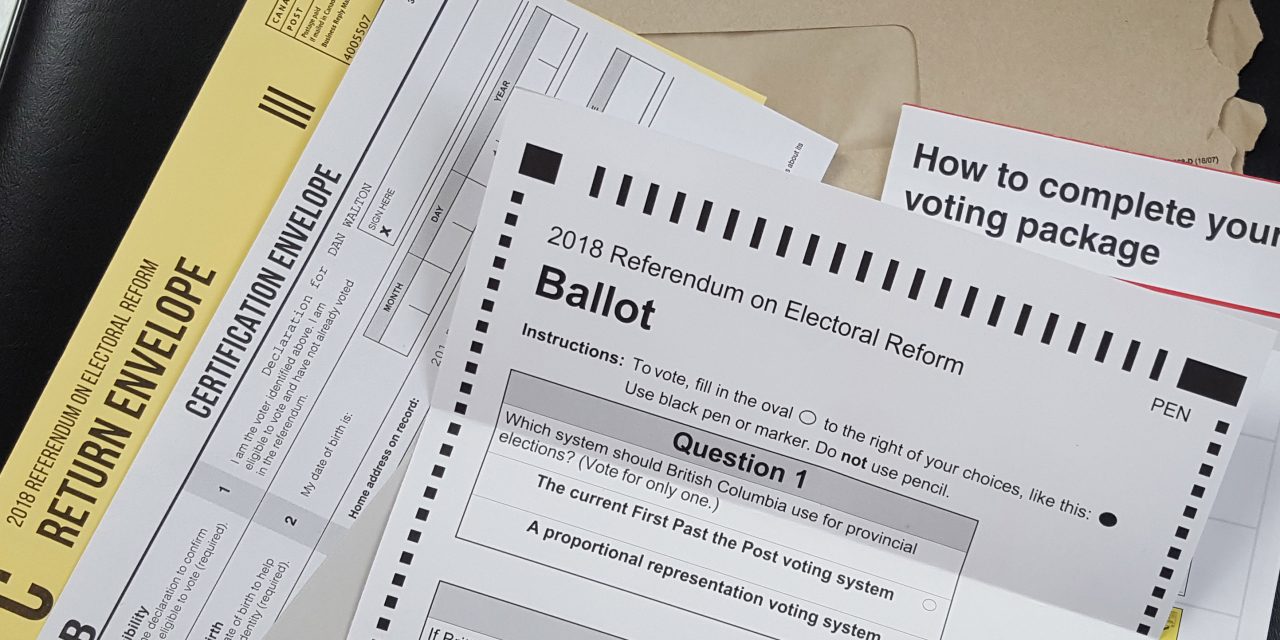
A new voting system could be imposed on British Columbians with only a small minority casting their ballots unless there is a large influx of votes in the coming days.
Nov. 30 is the deadline by which ballots must be received by Elections BC in order to be counted.
But as of Friday, Nov. 16 – two weeks before the deadline – only about 18 per cent of the voting packages had been returned.
Nonetheless, the return rate in Boundary-Similkameen is higher than in most of the province’s electoral districts.
The referendum was called by the B.C. NDP government to fulfill an agreement reached with the B.C. Green Party in which the Greens allow the NDP to govern with a minority by supporting them on confidence and supply votes.
The two parties are seeking to replace the current electoral system where the candidate with the most votes in each electoral district becomes the MLA.
They would replace it with one of three “proportional representation” systems in which MLAs would represent political parties in proportion to the parties’ province-wide popular vote.
Elections BC released an “interim ballot package return report” Friday indicating that an estimated 597,300 packages have been received by Elections BC from across the province.
The report also provides a tally of returned ballot packages that have now been screened by Elections BC along with a breakdown of returned and screened packages by electoral district.
Province-wide a total of 260,978 ballot packages have been screened, representing just 7.9 per cent of the estimated 3,294,183 million registered voters. The number of registered voters could increase if more voters register and request a package before the Nov. 23 deadline.
Boundary-Similkameen, the electoral district that includes Osoyoos and Oliver, has a higher rate of return than most electoral districts.
As of Friday, 5,659 screened packages had been returned from Boundary-Similkameen, representing 16 per cent of the 35,388 registered voters.
Only Courtenay-Comox has a higher return rate at 16.6 per cent, but Kamloops-South Thompson also has a 16 per cent return rate.
The districts with higher return rates tend to be rural, while districts with low return rates tend to be urban.
The lowest rate of return is in Delta North where only 643 ballot packages have been screened by Elections BC, representing just 1.8 per cent of the 36,473 registered voters.
Because urban electoral districts tend to have larger populations than rural districts, a system of representation by province-wide popular vote will increase the weight of urban representation at the expense of rural areas.
The figures cited in the Elections BC report do not include packages currently in the postal system that have not yet been received by Elections BC.
The referendum can be won with a simple majority and there is no minimum threshold for the number of votes that must be received.