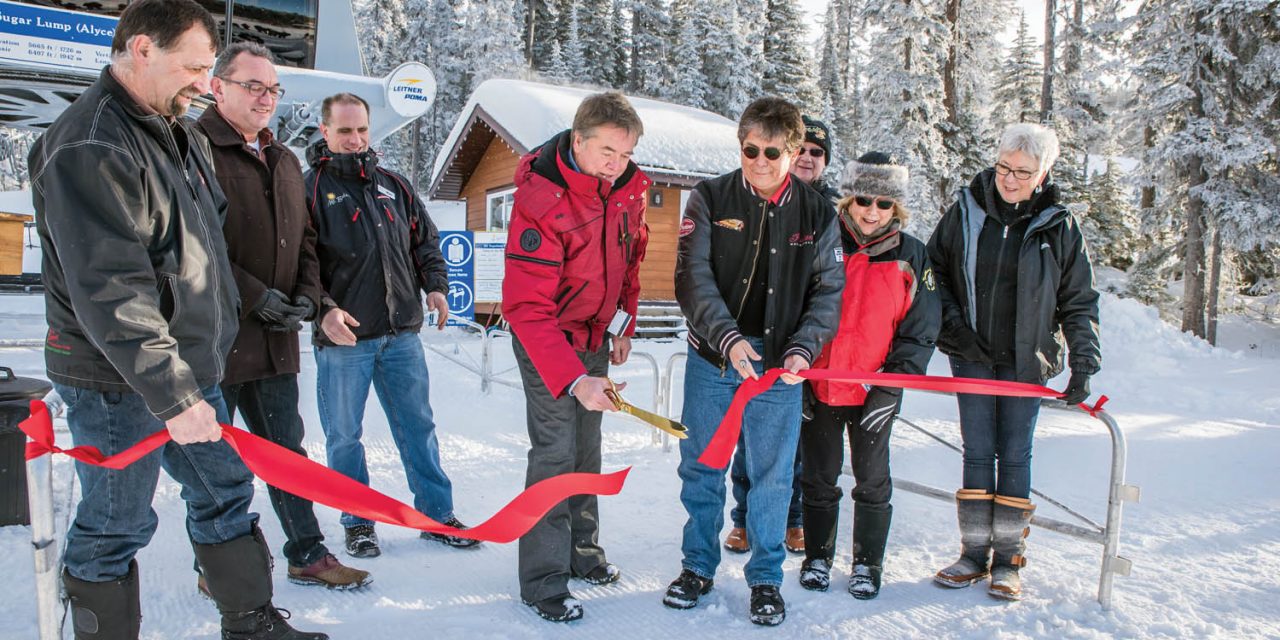

Fred Johnston, president of Baldy Capital Corporation, cut the ribbon to officially open Mount Baldy Ski Resort to the public last January. He was helped by Chief Clarence Louie, of the Osoyoos Indian Band. From left are Mark Pendergraft, chair, Regional District of Okanagan-Similkameen; Oliver Mayor Ron Hovanes; Mountain Manager Matt Koenig; Johnston; Louie; Myers Bennett, president of the South Okanagan Chamber of Commerce; Judy Miller-Bennett, president of Rotary Club of Osoyoos and wife of Bennett; and Gail Scott, managing director of Destination Osoyoos. (Richard McGuire photo)
The reopening of the Mount Baldy Ski Area and a plea to reopen the Osoyoos Airport made headlines last January.
Fred Johnston, the president of Baldy Capital Corporation, was all smiles early last January when the Mount Baldy ski resort opened for the first time in more than a year.
Surrounded by several local dignitaries, Johnston cut the ceremonial ribbon to open officially the ski resort that has been closed since early 2013.
The facility was closed during the 2013-14 season after its American owners ran into financial difficulties,
For Johnston, who had run numerous other business ventures in software, diagnostic imaging and real estate, running a ski resort is something new. What background does he have?
“None whatsoever,” he replied. “Except having skied a few mountains.”
With skilled staff handling the day-to-day operation of the resort, Johnston saw his role as largely administrative and financial and giving the staff the support they need to do what they already can do.
“The business aspects are the same whether it’s selling cars or widgets or snowmobiles or ski lifts or whatever,” said Johnston, 66, who had lived most of his life in Calgary with a stint in Kelowna.
The enthusiasm in the community needed to be captured and taken advantage of immediately, he said, rather than allowing it to subside by waiting another year.
“The second thing was that the sooner we got our hands dirty and had our hands on the wheel of the machine, the sooner we could start making improvements,” he said. “We will obviously lose money this season and it will be a lower ridership than if we had the time to plan ahead, but it will benefit us next year sooner.”
Many of the staff members returned, including Koenig as mountain manager.
“There is absolutely no doubt that Matt Koenig was instrumental in the decision to go forward,” said Johnston. “Matt is superhuman. He can do everything. He’s a one-man band here and without him this hill would not have opened.”
Also in early January, three volunteers with the Osoyoos Airport Development Committee urged members of Town of Osoyoos council to consider upgrading and expanding the facility and asked that at least one member of council to join a steering committee to review all options.
Glen Harris, the developer who helped build the Watermark Beach Resort in downtown Osoyoos five years ago, Rob Rausch, a veteran pilot with Air Canada, and Diana Thomas, a former employee with Destination Osoyoos, made a presentation to town council saying expansion plans include spending roughly $1.5 million to bring the airport to standards that would allow it to handle regular charter flights.
Mayor Sue McKortoff had stated two months earlier that council was looking at a proposal to close the Osoyoos Airport and use that land at the current site to expand the town’s industrial base.
Members of the Osoyoos Airport Development Committee – which includes Rausch, Thomas, Harris, Osoyoos dentist Jason Bartsch and Alberta business owner Tom McHale – went public with their opposition to the plan several weeks later and announced their plans to try and work with town council and senior administration to keep the airport open and consider several expansion projects.
A detailed engineering report indicated there is great potential for expansion of the current airport lands and a second report suggests there is a solid business case to make the airport profitable if expansion takes place, said Harris.
“There are now two reports in hand that say it’s viable and worth taking it to the next level,” he said.
McHale owns a company called Gemstone Logistics, which transports employees from across Canada to the oil and resource industry in Alberta and he remains convinced the Osoyoos Airport could act as a hub to bring workers from across the South Okanagan to Alberta if airport expansion takes place, said Harris.
Expansion plans would include purchasing 25 acres of land at the existing airport site and using seven acres to expand the runway and using 13 acres to expand the town’s current industrial land base, said Harris.
Much of the revenue needed for airport expansion would come from the sale of “airport homes” which would be sold to people who own airplanes and would love easy access to the airport and hangars, he said.
Having a member of town council on the steering committee would be very much appreciated, said Harris.
“We don’t want to pursue this alone,” he said.
Any suggestion it would cost $4 to $5 million to upgrade Osoyoos Airport, as was stated in a report to town council, is “pie in the sky” and the more appropriate figure is in the neighbourhood of $1.5 million, said Rausch.
The current facility simply doesn’t allow for regular traffic by private airplane owners, said Rausch.
“You have to look at it as an asset that we will never get back … I’m asking you to have a 50 to 70-year vision of this community,” said Rausch. “It’s worth exploring. Give us the time to develop a detailed business plan.”
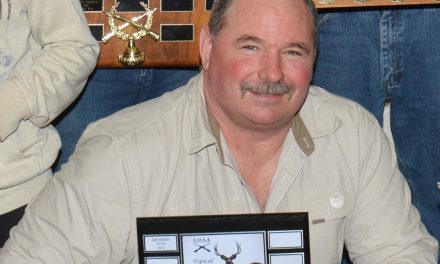
Meanwhile, local outdoor enthusiasts packed into the Oliver branch of the Royal Canadian Legion to hear that hunters who reside in British Columbia are being victimized by one of the most unfair hunting allocation policies in North America, says the wildlife committee co-chair with the B.C. Wildlife Federation (BCWF).
Jesse Zeman said the provincial government has constantly changed the rules over the past 20 years making it more and more difficult for resident hunters to receive hunting permits, while allowing guide outfitters and hunters from other provinces and countries far easier access to this province’s treasured wildlife resources.
Speaking before a packed house of more than 100 avid hunters, Zeman pleaded with hunters to write their local MLA, Linda Larson, and to write letters to the editor of area newspapers to voice their displeasure with the current allocation system.
“We’re being treated as second-class citizens here in our own province,” said Zeman. “Things have to change.”
Across the province in the last couple of years, resident hunters have received 5,000 fewer hunting licenses, said Zeman.
Steve Thompson, province’s Minister of Natural Resources, will have no choice but to change policy and legislation if enough hunters speak out, said Zeman. The provincial government had good intentions to try and attract significant foreign dollars through its hunting allocation policies enacted 20 years ago, said Zeman.
However, the policies adopted over the past two decades now greatly favour the Guide Outfitters Association of British Columbia (GOABC) – and many of those outfitters are owned by non-Canadians who have been granted significant increases in permit allocations, while resident hunters have to deal with decreasing access, he said.
KEITH LACEY
Osoyoos Times
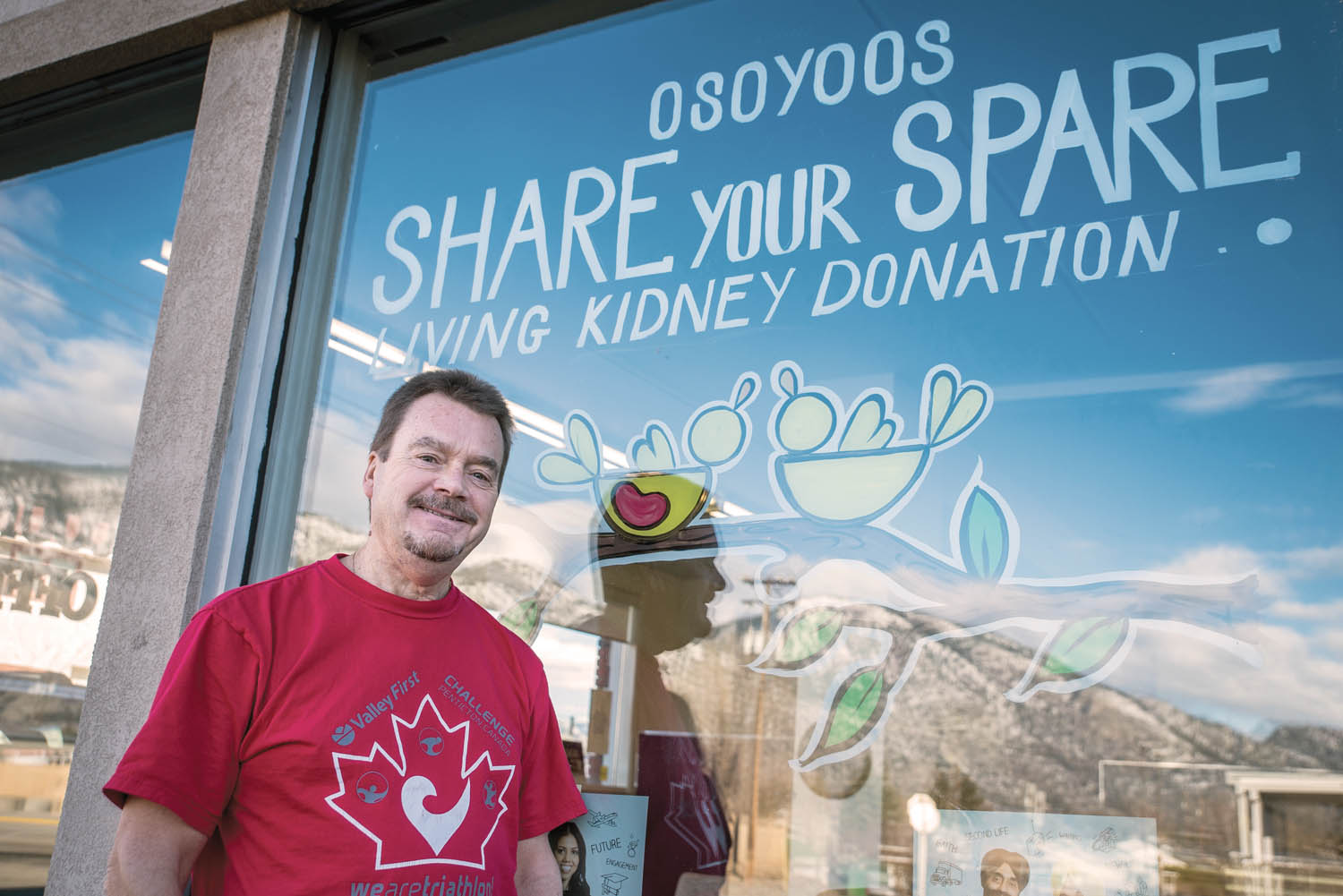
Brian Rawlings got ready to donate one of his kidneys to help an Osoyoos woman, Julie Wolter, who needed to replace one that was transplanted 36 years ago. The successful transplant took place in March, a day before World Kidney Day. (Richard McGuire photo)