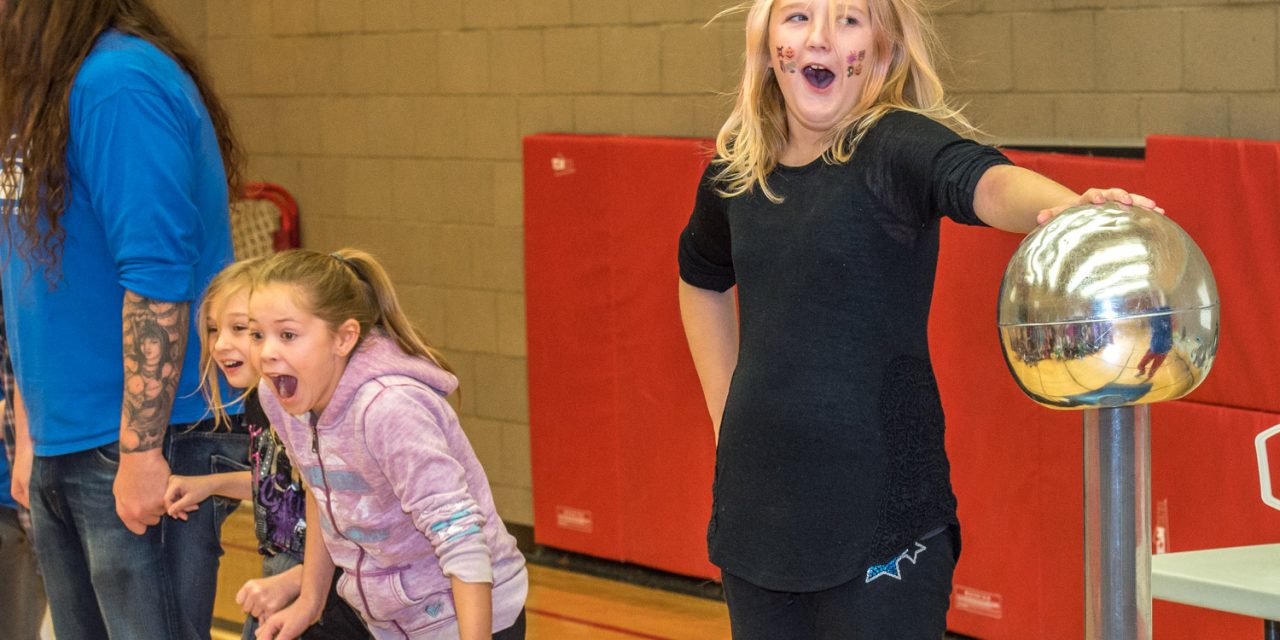
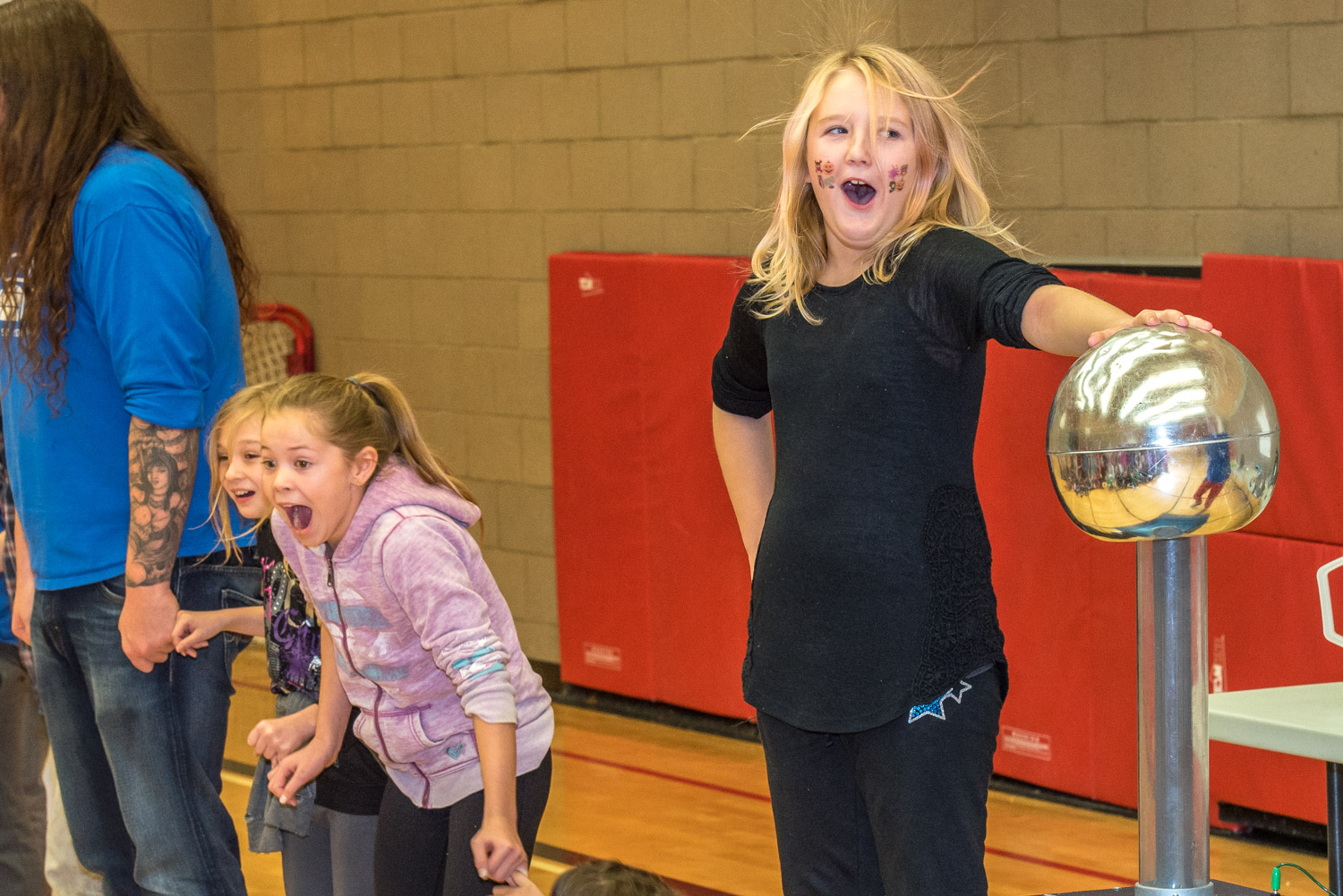
Hair rises on Emma Palmateer’s head as she touches a Van de Graaf generator, which produces a low-voltage electric current. She’s just sent a shock down a chain of students with linked arms. Alesia Dortman and Paige Hanson react to their shocks. (Richard McGuire photo)
Students at Osoyoos Elementary School were enthralled on Friday as two members of Science World’s On the Road team strutted around the gymnasium like a pair of mad scientists.
Stephan Adamus and Charlotte Swanson brought student Prabhnoor Samra to the front and asked her to blow into a tube. Suddenly a flaming mushroom cloud shot into the air and Samra was transformed into a fire-breathing dragon girl.
Of course, proper safety precautions were taken.
Then they brought up Emma Palmateer and asked her to put her hand on the metal sphere of a Van de Graaf generator until her hair stood on end and she felt the tingle of an electric shock.
Moments later, she sent shocks down a chain of about seven fellow students, who linked arms.
“We do these epic science shows where we try and get them excited about science and try to make them a little more science literate,” said Adamus. “So they don’t find science intimidating. It’s not all about lab reports and taking notes. It’s about discovering the world all around.”
Adamus and Swanson were making a stop in Osoyoos on a tour that also stopped at Oliver, Cawston, Grand Forks, Greenwood and Christina Lake last week.
This particular show is called Earth, Wind and Science and is geared to students in Grades four to seven. Earlier that morning they did a show called How to Science geared to Kindergarten to Grade 3.
Another show, Fantastic Forces, is given at smaller schools where all grades watch it together.
Earth, Wind and Science has a weather theme, and Adamus and Swanson asked the children what key ingredients are needed for weather.
Children soon guessed that atmosphere, water and the heat of the sun were those ingredients.
They then asked children to suggest different weather conditions, which they immediately produced a demonstration to illustrate, turning these into games.
In one demonstration they shuffled three metal cups around on a table, one containing water, and they asked the children to keep track of which one has the water. The children don’t lose track.
Then a twist – the children guess one cup after the other until none of the three is found to contain water. The water has apparently disappeared.
“That provides what we like to call discrepant events for children,” said Adamus. “All of a sudden the water is missing and they don’t know how or why and we try to get their gears turning in their heads to think a little bit about what might have happened.”
Some children guess that the water has turned to ice and is stuck in the cup. They’re not too far wrong.
In fact, there’s a chemical called sodium polyacrylate in one of the cups – a chemical used in absorbent baby diapers – and it has turned the water into a gel that clings to the cup so that nothing spills when the cup is overturned.
Adamus and Swanson bring up Ash Kosaka and Puneet Cheema to have a race forcing air into beakers of a blue liquid. Kosaka blows into a tube and Cheema pumps air with a bicycle pump.
Cheema’s liquid stays blue, but Kosaka’s starts turning green. That is because the liquid is bromothymol blue, an acid indicator. The carbon dioxide in Kosaka’s breath mixes with the water to create carbonic acid, while the bike pump does nothing, Adamus explains.
The mushroom cloud of fire created by Samra was caused by lycopodium, a club moss spore that is very fine and forms a highly flammable powder.
“Just like when the weather gets dry outside and everything becomes extremely flammable from the sun shining down, that’s what the moss is like,” said Adamus. “When that mixes with heat from a candle and oxygen from the air, it makes a nice, big fireball.”
The children seemed genuinely excited by the science demonstrations, so much so that Adamum and Swanson had to raise their arms a few times, the school’s signal to children to settle down.
“Science World’s mission is to get kids excited about learning,” said Adamus. “We’re hoping we can visit almost every school in the entire province over the next five years.”
The On the Road program ran from 2005 to 2012, but it was cancelled three years ago for lack of funding, Adamus said.
This year the program is back, using revenue from Science World at Telus World of Science in Vancouver so that the program can be offered free to schools.
Science World is a non-profit charitable organization.
RICHARD McGUIRE
Osoyoos Times
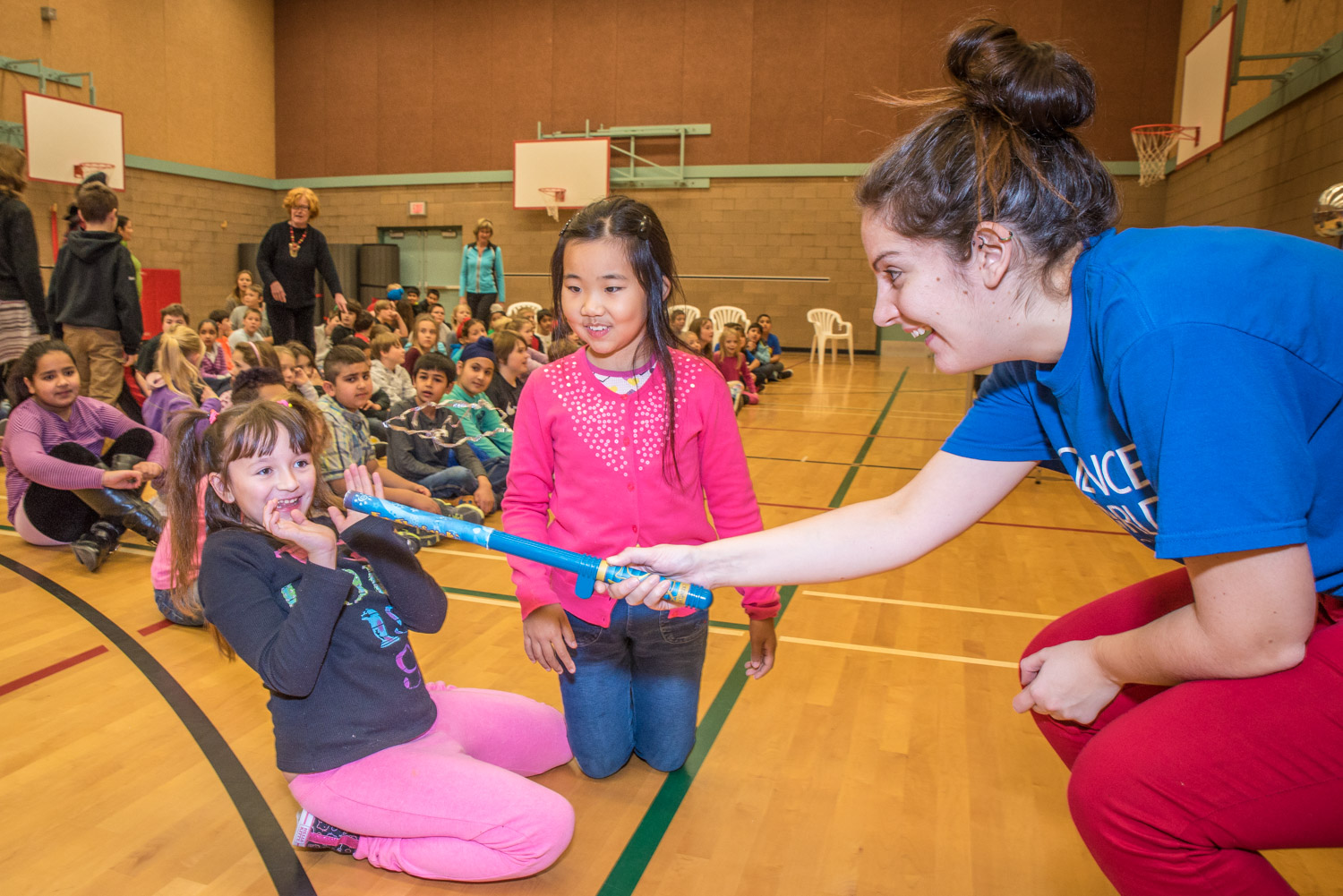
Charlotte Swanson (right) shows Kaylie Lino and Cindy Jia how a floating loop of foil is attracted to people by static electricity, but is repelled by her rod. (Richard McGuire photo)
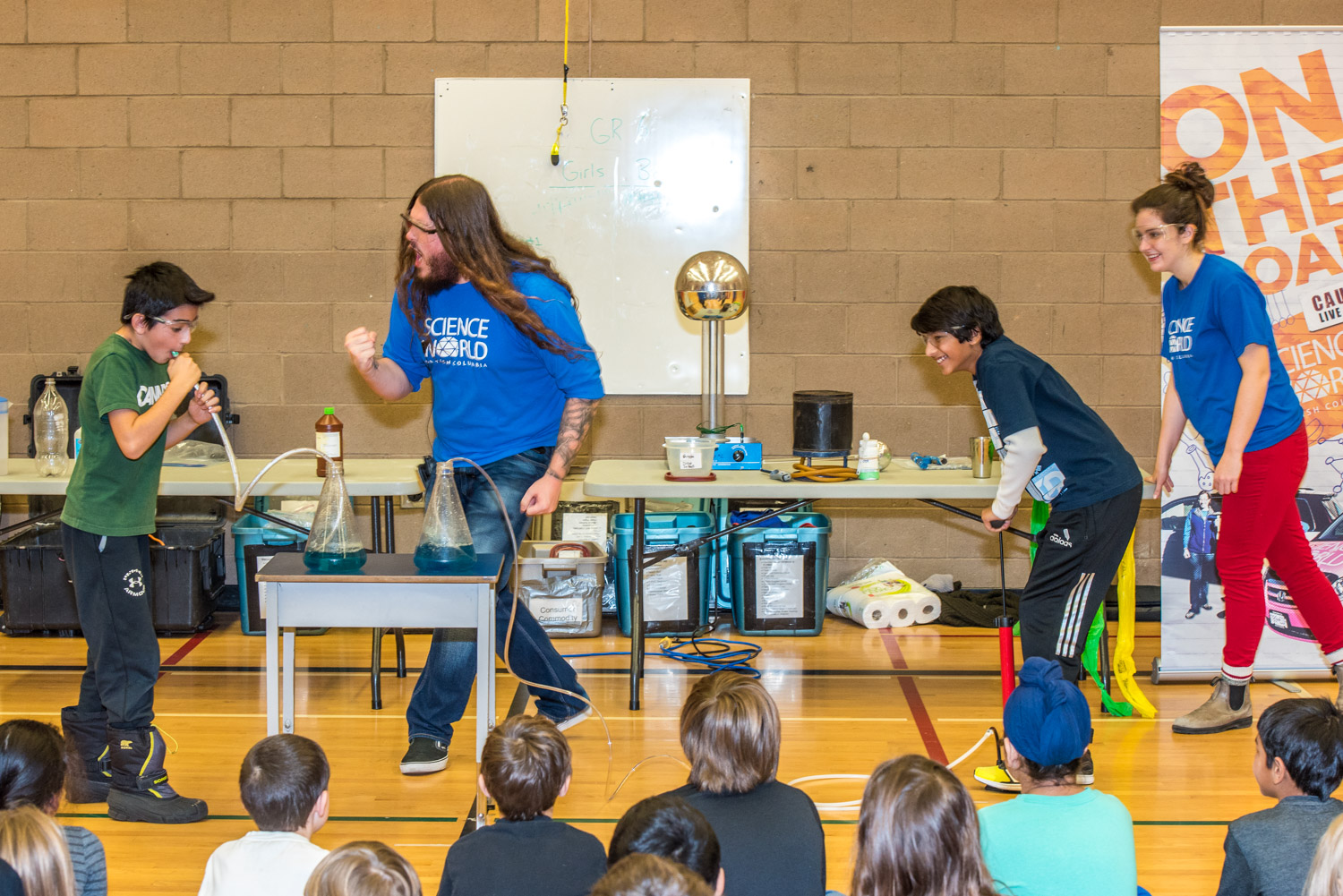
Stephan Adamus encourages Ash Kosaka to blow harder while Charlotte Swanson encourages Puneet Cheema to pump harder as the two students race to force air into beakers of bromothymol blue. Only Kosaka’s liquid turns green because the carbon dioxide in his breath makes the water acidic. (Richard McGuire photo)
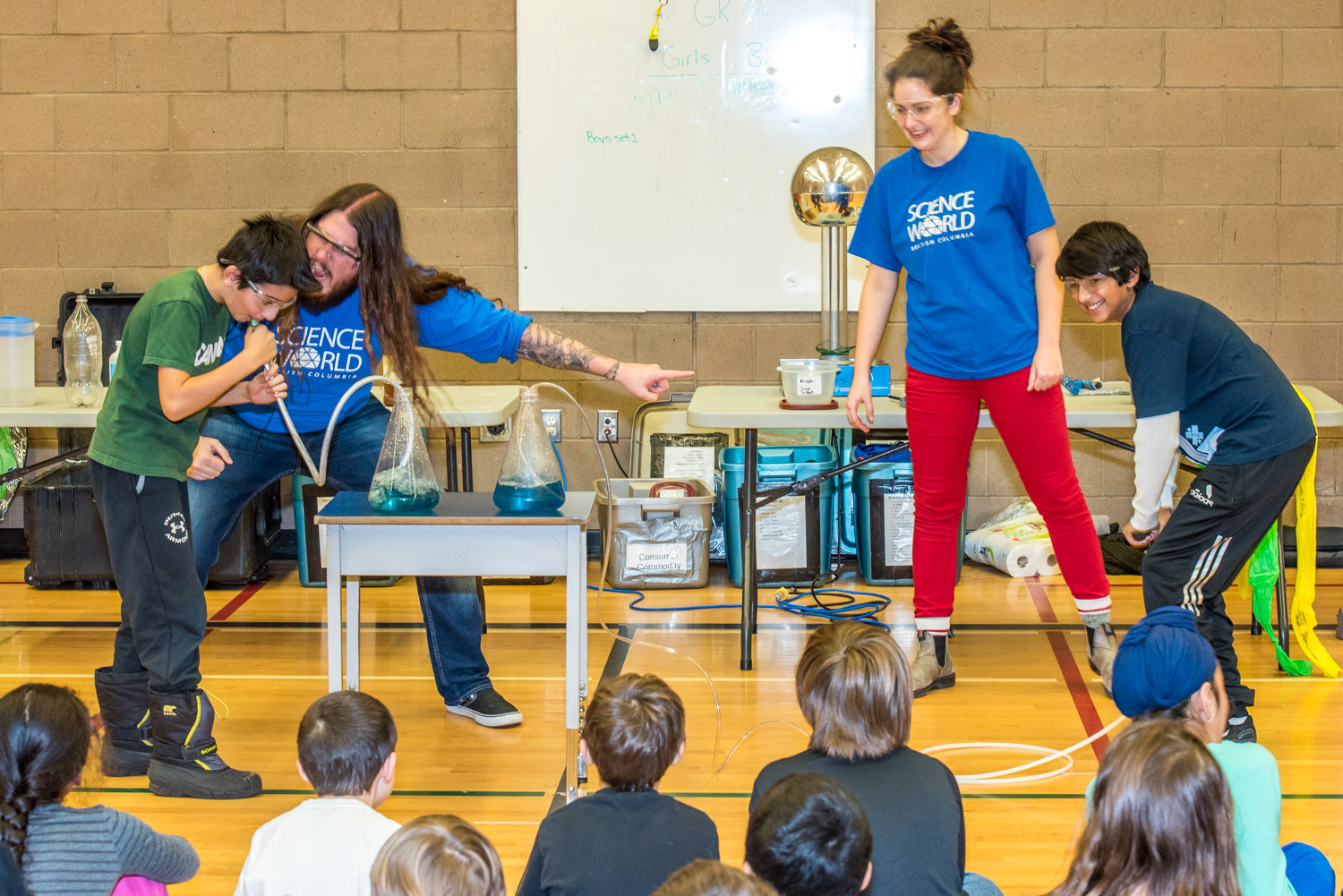
Stephan Adamus encourages Ash Kosaka to blow harder while Charlotte Swanson encourages Puneet Cheema to pump harder as the two students race to force air into beakers of bromothymol blue. Only Kosaka’s liquid turns green because the carbon dioxide in his breath makes the water acidic. (Richard McGuire photo)
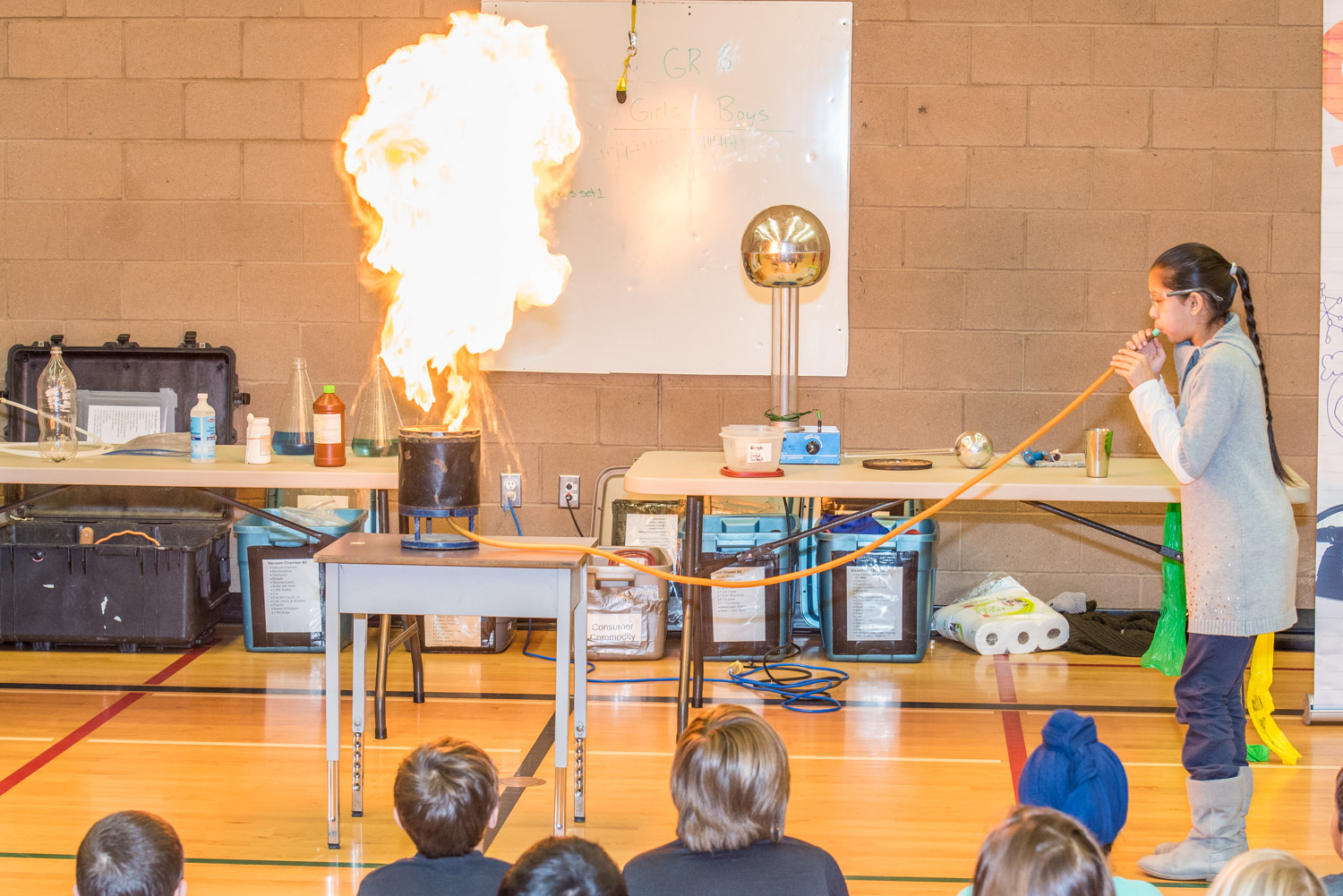
Prabhnoor Samra blows into a tube causing a fiery mushroom cloud as lycopodium ignites. The demonstration led to comparisons of how the dry weather and sun’s heat made vegetation flammable last summer. (Richard McGuire photo)
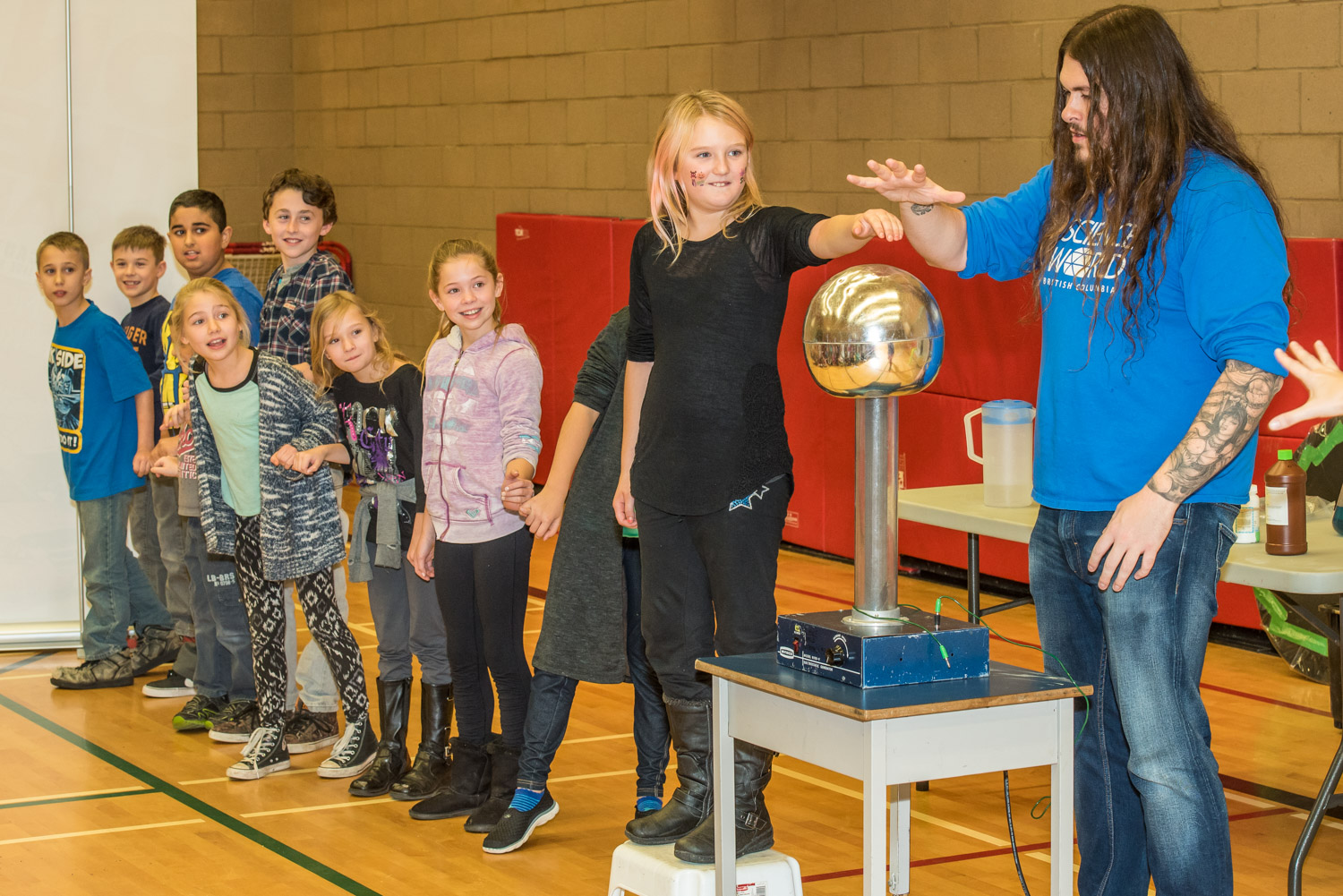
Stephan Adamus (right) encourages Emma Palmateer to put her hand on a Van de Graaf generator, which produces a low-voltage electricity current. She then links arms with other children, as her hair stands on end, sending the current down the chain of children. Also pictured are Rhune Gilbertson, Sehajvir Dhaliwal, Bryce Ogilvy, Paige Kaminski, Alesia Dortman and Paige Hanson. (Richard McGuire photo)