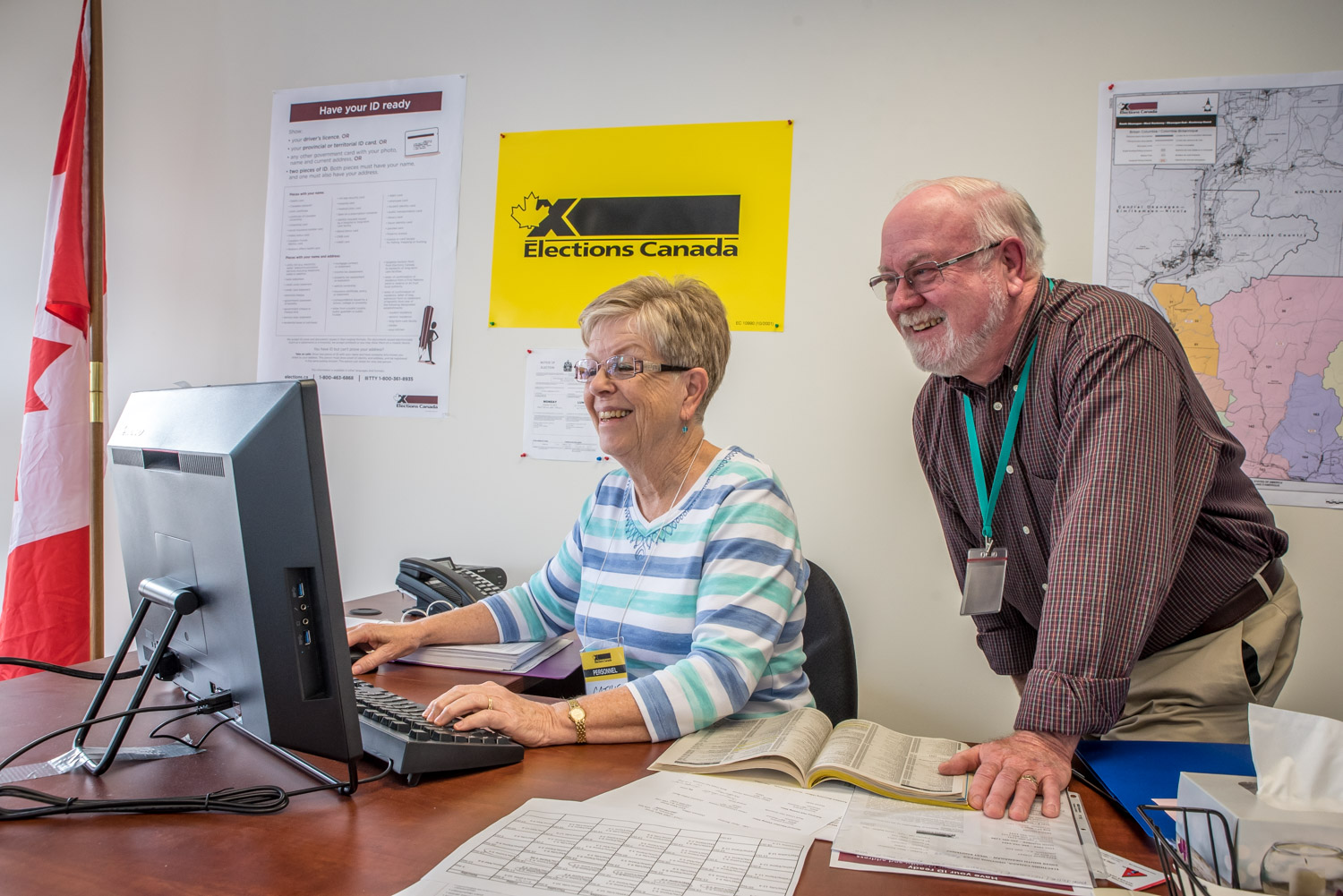
Peter Beckett, assistant returning officer with Elections Canada (right) discusses the voter registration system with Cathie Paton, a revision agent, at the Elections Canada office at 8322 Main Street. (Richard McGuire photo)
Are you on the voters’ list for the Oct. 19 federal election? Have you moved recently?
Perhaps you are temporarily staying in Osoyoos, but your main residence is somewhere else in Canada. Or maybe you’ll be gone south before the advanced poll.
These are just some of the queries and issues that an Elections Canada office on Main Street in Osoyoos can help you address.
As of last week, the office at 8322 Main Street is now open seven days a week, said Peter Beckett, assistant returning officer.
The office is one of three in the new federal electoral district of South Okanagan-West Kootenay (SOWK).
The main office, where returning officer Roberta Post is based, is in Penticton and there’s another office in Trail.
People can visit the office to check that they are on the voters’ list, to change their address, or to report a change in their name, said Beckett. They will need to bring documentation and identification, he added.
People can also vote if they will be away for the advanced poll, which is over the Thanksgiving weekend, and Election Day.
They can also vote at the office by special ballot if they are away from their primary residence anywhere else in Canada.
The deadline for voting by special ballot is Oct. 13, Beckett said.
Because nominations haven’t yet closed and won’t until three weeks before the election, ballots have not yet been printed. This means that anyone voting in advance at the office, or by special ballot for another riding, will have to use a write-in ballot, writing the name of the candidate on the ballot.
“That’s the issue,” said Beckett. “They must know who they want to vote for and they have to be able to spell the name.”
However, as long as the intent of the voter is clear, a minor error in the name won’t disqualify the ballot.
Beckett cautions advance voters that things can change between now and when the candidates are accepted.
“Parties can change their mind about the candidate,” said Beckett. “Or indeed a candidate can decide that they’re going to run as an independent.”
All three major parties have lost candidates in recent weeks as a result of embarrassing incidents – mainly social media gaffes from the past that have returned to embarrass them, but most recently the Conservatives dismissed a Toronto candidate caught on video urinating into a customer’s coffee cup.
If a candidate switches to become an independent or to run for another party, an advance write-in ballot would still go to the individual candidate despite the switch of party.
“You’re not voting for a party,” said Beckett. “You’re voting for an individual and it’s the individual’s name that goes on the ballot.”
Beckett said some people coming into the office are not aware of the new electoral boundaries that differ with SOWK from the former riding of B.C. Southern Interior.
“In particular, voters who have come from Cawston or Keremeos, because our electoral district now ends at the top of Richter Pass,” said Beckett. “It used to go as far as Princeton and Manning Park. So that’s a big difference.”
People in Cawston and Keremeos are now in the new riding of Central Okanagan-Similkameen-Nicola, which stretches to West Kelowna and Merritt and beyond.
The rules for proof of identity and address have been tightened for those wishing to vote. The full list of eligible identification can be found at the Elections Canada office or on the website at www.elections.ca.
A driver’s license, provincial ID card or other government card is acceptable if it has your photo, name and current address.
Otherwise, two pieces of ID can be shown to prove your identify and your current address. A voter registration card, however, is not on the list.
Rules on vouching have been tightened. A person can vouch for your address, but you must still provide two pieces of ID, and the person vouching must be registered in the same polling division and they can only attest for one person.
Beckett also noted that people get confused about differences between provincial and federal voting regulations.
In a federal election, if you’re not going to be home during the voting period, but are somewhere else in Canada, you can vote at an Elections Canada office or get a mail-in ballot. You can only do this until Oct. 13, however.
This differs from provincial elections where you can vote at any polling station in B.C. on Election Day if you happen to be away from home. That isn’t possible in a federal election.
Beckett said people who are going to be away have a larger than ever window in which to vote.
“Quite a number of voters who have come in are saying they’ve appreciated the extra time to be able to vote because they are leaving right away,” said Beckett.
RICHARD McGUIRE
Osoyoos Times