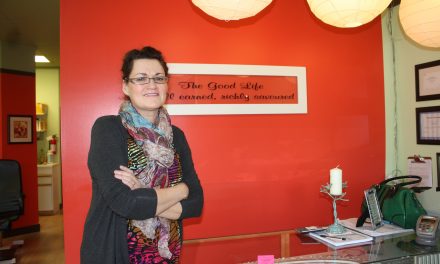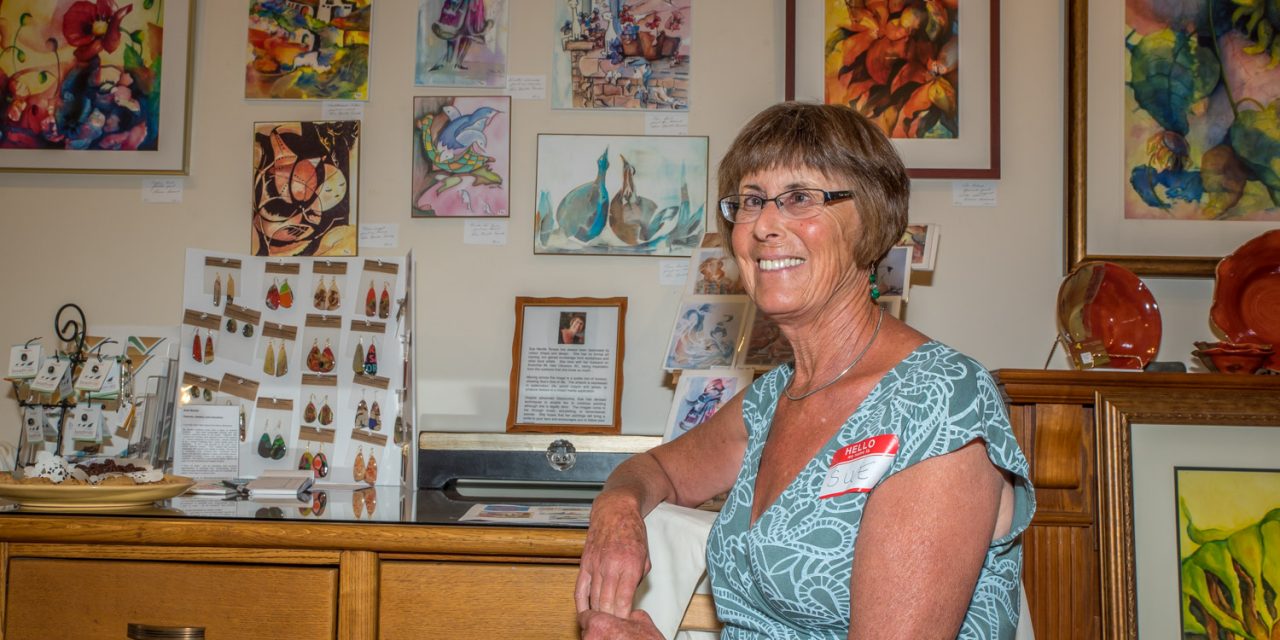
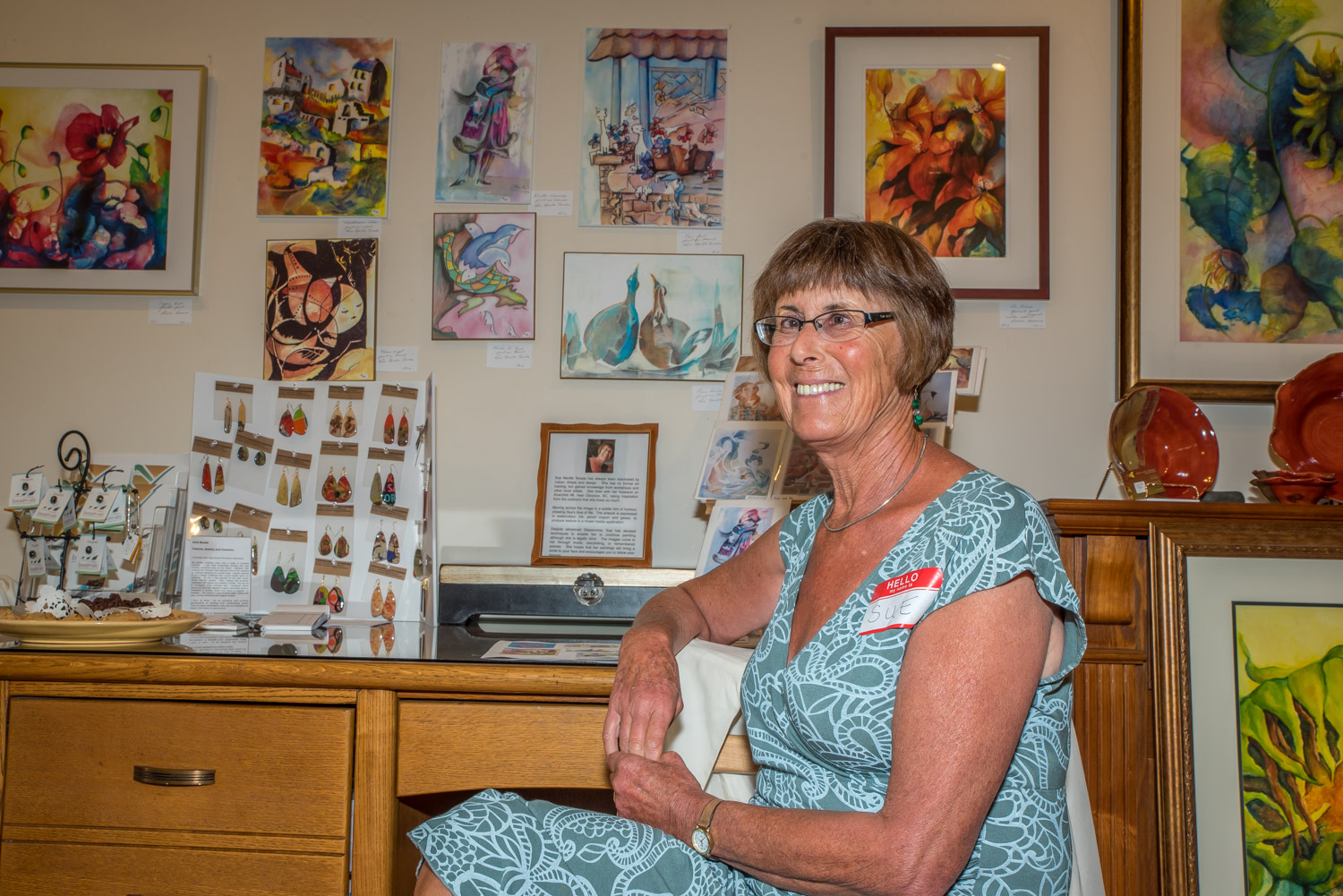
Artist Sue Neville Terada is legally blind and can barely see to paint, but she creates wonderful abstract work nonetheless. Her paintings were shown in artist Sharon Leonard’s studio during the recent Art in the Garden, where they were surrounded by some of Leonard’s paintings. Neville Terada is able to see the high-contrast shapes of dark and light, but she gets help from her husband, Naga Terada, with adding colours. (Richard McGuire photo)
Some artists paint from photographs, live models or at an easel in the midst of a beautiful landscape.
Sue Neville Terada, however, paints from her imagination and her heart.
Her eyesight, never good, has been deteriorating throughout her life with glaucoma and she is now legally blind, barely able to make out the dark areas she draws with a black felt pen.
Neville Terada has been passionate about art her entire life, ever since she did colouring as a young girl. Recently, for the first time, she participated in Art in the Garden, a two-day show featuring the work of about 18 local artists for the fifth year in a row.
Her abstract work was featured in a section of artist Sharon Leonard’s studio, sandwiched between Leonard’s colourful paintings of flowers and local landscapes.
“If Sharon hadn’t persuaded me, I wouldn’t have been here,” Neville Terada said. “But she looked at my stuff and she said, ‘Come on, you can do it,’ so I’m here. That’s given me a huge boost.”
While some of the artists participating in the weekend event are more prolific, offering discounts on some of their work to clear out space in their studios, Neville Terada works more slowly and typically finds time to work on a few pieces in the winter months when the light is right for her.
She’s now unable to see the colours in the paintings she produces, so she draws the dark outlines and seeks the help of her husband, Naga Terada, when it comes to laying out the colours.
“I have enough knowledge as to the colour wheel and the different types of colours that blend and that type of thing,” she said. “I know by the names of the colours what is going to blend with what.”
So she tells her husband what colours to put where.
As her eyesight has deteriorated, she’s used more and more black because it makes a good contrast that she can see.
“The image is always in my heart and in my head,” she said. “I just have to go for it. You just take the pen and you go to the paper and you try it. You go for it.”
Neville Terada was born in Glasgow, Scotland, but her accent sounds more like one from the south of England, where she moved to at a young age.
She came to Canada with her two children in 1975, living in Nelson before moving to Osoyoos in 1990.
She was born very myopic, or short sighted, but wasn’t diagnosed with glaucoma until she was in her mid-40s. Glaucoma takes different forms, but it typically damages optic nerves and leads to loss of peripheral vision and can ultimately lead to blindness.
It has been called a “silent thief of sight” because vision loss happens gradually over a long time, often undetected at first.
When Neville Terada graduated from high school, she entered a textile designing course, but she had to leave in the middle of it because her vision made it impossible to continue.
“That was very devastating for me,” she said. “That’s when I went into physiotherapy because it was a hands-on profession.”
When she raised children, she encouraged them to draw and to colour, and she found her own love of art was still there.
“When I finally retired and came to Osoyoos, my husband and I ran an orchard,” she said, adding she had more time to pursue her passion.
That’s when she met a woman named Linda Anderson, who has developed techniques for teaching art to blind and visually impaired students.
“She encouraged me to the point where I got my FCA accreditation,” she said, referring to the Federation of Canadian Artists, which only accredits artists that are juried by a panel.
Neville Terada said her vision was better then, in the 1990s, but she still was unable to drive and she had a guide dog at that point.
“She (Anderson) continued to encourage me and I’ve evolved my style to accommodate my vision,” she said.
What is it like to create beautiful artistic works, but not be able to see them?
Neville Terada said she has friends who provide constructive criticism, telling her if something isn’t balanced or the painting is muddied.
“They will explain it to me so then I’ll either get frustrated or I’ll try again,” she said. “If I stormed out of my art studio because I’m upset, by the next morning I’m back in there. I can’t stop myself. I love it.”
She disagrees with the suggestion that what she loves most has, in part, been taken from her with the loss of her vision.
“I would disagree,” she said. “I think I’ve been given a gift. A lot of artists need images, maybe photographs or they need to sit on site and paint. I can’t do that. I can’t look at an illustration in a book, so it actually comes from my heart. It’s not what you’ve lost, it’s what you’ve still got that’s important to me.”
If anyone really wants to do something, they need to go out and do it, she said.
“I hope my work inspires those who are disadvantaged in some way to try what’s in their passion, because it’s in all of us,” she said. “We have to look at the cup half full rather than half empty. That’s my message with my art. If I can give some pleasure and joy and encouragement to someone else, that’s all I’m asking really.”
RICHARD McGUIRE
Osoyoos Times