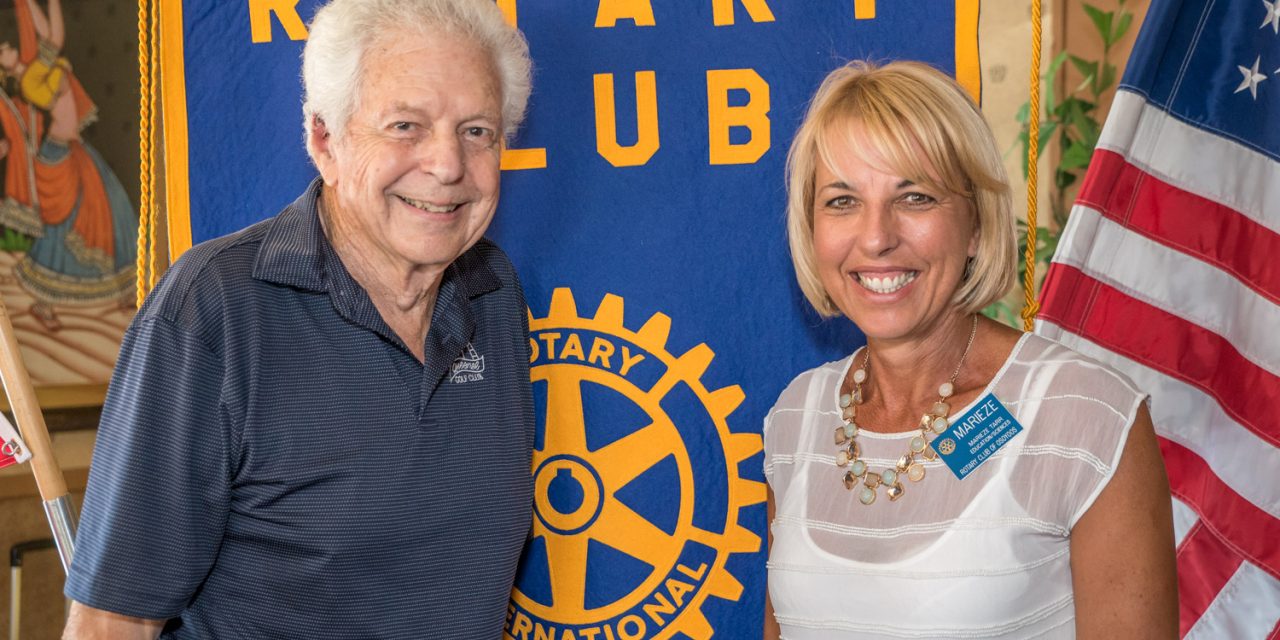
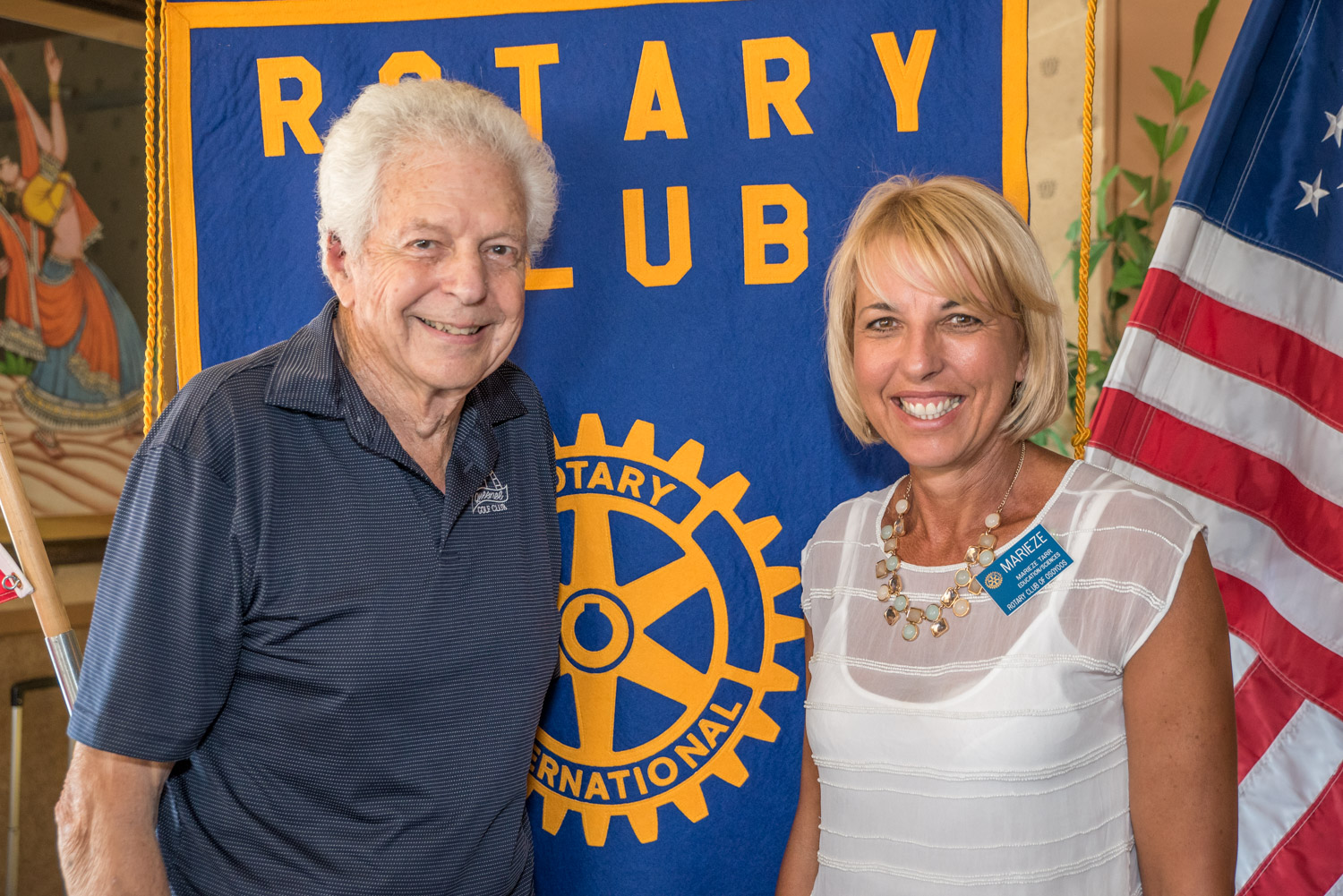
George Fraser, whose family was among the early settlers in Osoyoos, spoke recently at the Rotary Club of Osoyoos about what it was like growing up in a much smaller town. (Richard McGuire photo)
Osoyoos was an ideal place to grow up as a child in the 1930s and ‘40s, long-time resident George Fraser told the Rotary Club of Osoyoos recently.
“If I sound a bit nostalgic, it’s because I am,” he said. “I grew up in an era that was simply fantastic for children.”
Fraser spoke of having the freedom to hike, ride his bike and wander without today’s tendency to have parents worrying or feeling they had to supervise all their children’s activities.
Fraser was a teacher at several area schools and was vice principal at Southern Okanagan Secondary School in Oliver.
Though born in Vancouver after his parents married in 1934, Fraser said his own memories start around 1945.
“I don’t remember much of my first 10 years,” he said.
When the Fraser family first arrived in Osoyoos in 1917, Fraser jokes that the population jumped by 30 per cent.
“My grandfather, grandmother, father and aunt added four to the total,” he said. “That brought it up to 17.”
With a current population of close to 5,000 people, that means the Fraser family witnessed a lot of changes over the last 98 years.
He began by asking the Rotarians a few questions that none were able to answer:
- Does anyone know the current street number of what was once known as Saskatchewan Avenue?
- Does anyone remember the water towers and where they were?
- Was anyone here when the railway arrived?
- Does anyone remember the Sunland Theatre?
- After the questions drew blank faces, Fraser passed around photos of Osoyoos from the 1920s, ‘40s and slightly more recent.
While the mountains looked just like today, there were few buildings and hotel row was only a spit of land with a small bridge.
Fraser rhymed off names of businesses that have come and gone: Hochsteiner’s Meat Market, Kalten’s Photography, Hunt’s Café, English’s Café, Dawson and Plaskett, the M&H Grocery, Thaller’s Shoe Repair.
“These now exist only in the memories of a rapidly diminishing number of us,” he said.
When his family arrived in 1917, many houses had no plumbing and electricity didn’t arrive until around 1936.
Instead of using refrigerators, families cut one-foot ice cubes from the lake by hand and stored them in crude icehouses until needed, Fraser said.
The Fraser family lived in the old Haynes House on Lakeshore Drive and when the grader was unable to clear the roads, people would drive to town across the lake.
“It’s been many years since either of these activities would have been possible,” said Fraser, suggesting that winters were much colder in those days.
Children played hockey and skated on the lake until it snowed and then they cleared the ice with sawdust shovels and scrapers made from scrap wood.
“The booming sound of thick ice cracking at night is a sound that once heard is never forgotten,” Fraser said.
In the summer, he would borrow his father’s small boat with 2.5 horsepower Briggs and Stratton engine, which he believes was the third powerboat on the lake. He visited a friend across the lake, leaving late at night. He was 14 at the time.
“I would simply head out into the middle of the lake, look for the little red light on the transformer in front of our house, head towards it, and by the time I was close to shore, there was always enough light to land safely,” he said.
“Can you imagine letting your 14-year-old son do that now?” he asked.
When Fraser went to school in Oliver for Grades 7 to 12, he normally had to take a boat to get to town. Before that, school was in a four-room building where the town hall is today.
“The playground was undeveloped, but we didn’t know how underprivileged we were,” said Fraser. “We played softball, marbles, rode the swing and the girls skipped and bounced balls.”
This was an improvement over the schooling his father put up with – a one-room school in Osoyoos until Grade 8 and then boarding with a family in Oliver during the week.
His father often had to walk home to Osoyoos from Oliver on Fridays because there was no school bus and very few cars going in that direction.
His little AM mantle radio could pick up signals from WWL in New Orleans, CBK in Watrous, Saskatchewan and Saturday night hockey with Foster Hewitt broadcasting the Toronto Maple Leafs games.
“We grew up being responsible, confident and independent,” said Fraser. “We could walk down the street and would know everyone we met. Today? I can go to town and return home without seeing a familiar face.”
Answers to Fraser’s questions:
- Saskatchewan Avenue was not an official name, but that was what the locals called 87th Street about 65 or 70 years ago because a few families living on it had moved from Saskatchewan. “It was a little unfair on my part,” Fraser admits about the question that even stumped staff and volunteers at the Osoyoos Museum and Archives.
- The water towers were at the intersection of Highway 97 and 74th Avenue.
- The railway spur to Osoyoos from the Kettle Valley Railway arrived in 1923, so anyone who remembers its arrival is approaching 100.
- The Sunland Theatre was a true movie theatre with a sloping floor that was still operating into the 1950s, but Fraser can’t remember when it shut down. Appropriately, the building on Main Street is now used by Yore Movie Store.
RICHARD McGUIRE
Osoyoos Times