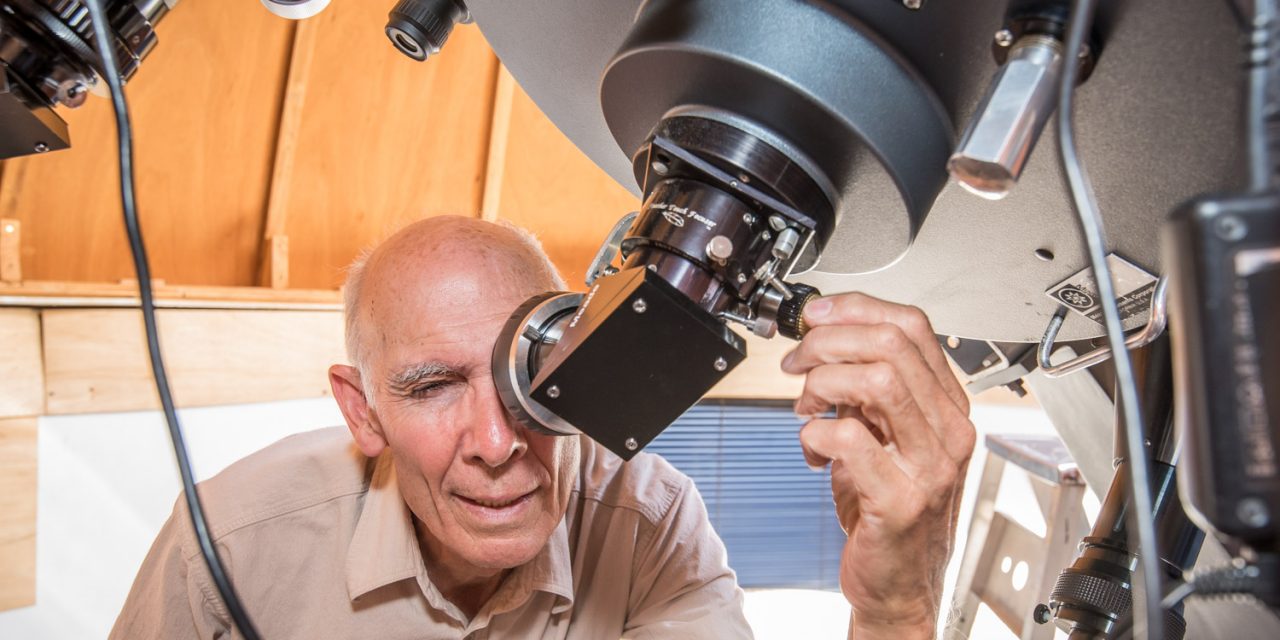
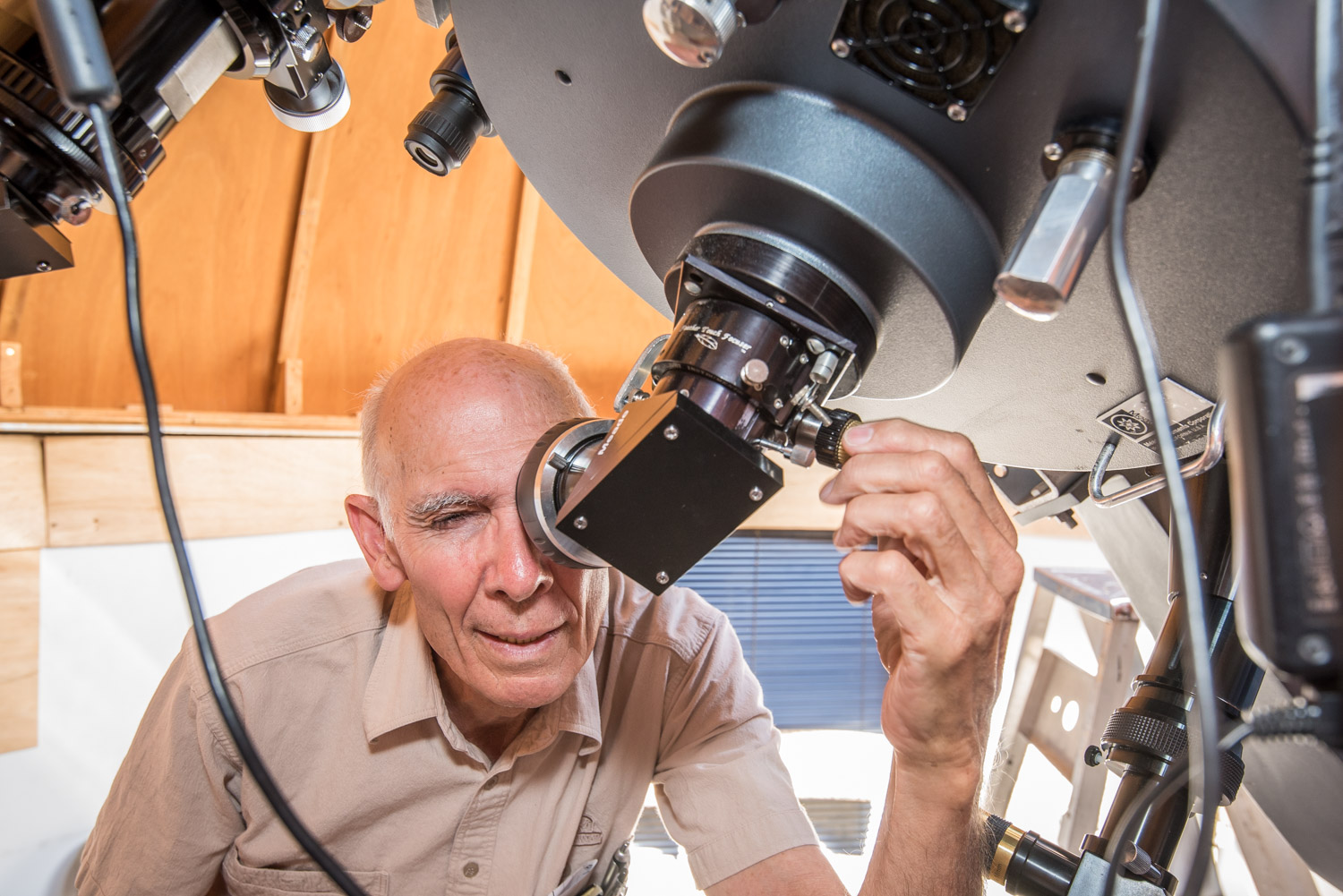
Amateur astronomer Jack Newton adjusts the telescope in his observatory to bring Venus into focus. Newton was the guest speaker last week at the Rotary Club of Osoyoos where he covered such topics as the origins of the universe and our galaxy and travel in space and time. (Richard McGuire photo)
One day, the sun will swell up in size, swallow Mercury, Venus and the Earth and then collapse into a little dwarf star the size of Earth.
The good news is it probably won’t happen for billions of years – long after all of us are gone.
That little note about our constantly changing universe was just one of many tidbits that amateur astronomer Jack B. Newton spoke about last Thursday at the lunch meeting of the Rotary Club of Osoyoos.
Newton, born in 1942, has always just been an amateur astronomer since getting his first telescope around age 11, finding Saturn in the sky and getting “hooked.”
But the word “amateur” grossly understates his many accomplishments.
His photograph of the sun was published alongside some of the greatest news photography of the 20th century in LIFE magazine’s 70th anniversary commemorative book.
Other photos he has taken have been published in National Geographic, numerous astronomy publications and even by NASA.
For many years he photographed the sky for stock photography agencies and Canon pays him good money to use his photographs in their advertising.
His stargazing isn’t so much aimed at astronomy research.
“No, I’m just taking pretty pictures,” he said.
Newton has also written six books about amateur astronomy and astrophotography, the first when he was in his 20s. Three of them were published through the prestigious Cambridge University Press.
He has received numerous recognitions – including having Asteroid 30840 named Jackalice to honour him and his wife Alice.
Newton chose the location of his home on the side of Anarchist Mountain with astronomy in mind. When he and Alice moved here from Vancouver Island in 1999, they built an observatory on an upper floor in their house and opened a bed and breakfast business aptly named the Observatory B&B.
Guests are treated to a comfortable room, gourmet breakfast prepared by Alice and sessions of space observation at night and the next morning.
“We spend a lot of time with our guests,” said Newton, who even has a small theatre in his home, complete with model aliens, where he does an alternate presentation when the weather in Osoyoos doesn’t co-operate.
The alternate presentation may include looking remotely through telescopes at the Newtons’ other home in Arizona. Those telescopes can be controlled by remote control from Osoyoos.
The B&B fills up very quickly when the Newtons start taking reservations around Christmastime.
“In six weeks, all the weekends are gone,” he said. “It’s very popular.”
The idea for the bed and breakfast came about when the Newtons were living on Vancouver Island and Jack was managing a flagship Marks and Spencer store.
When the store chain decided to pull out of Canada, Newton needed something else to do.
He looked at the guestbook for his home where he had an observatory and realized that in four years, 5,000 guests had come through.
“We had a lot of people going through the house,” he said. “We thought maybe we should make them pay for it. Maybe I can make a living at it.”
Many guests bring their children, who are fascinated by the gadgets, props and the view of distant skies. But many adults are just as much in awe.
“A lot of times it’s a life-changing experience,” he said. “I get people writing me all the time saying. ‘You changed my life.’”
Many people have no idea where they came from, something he explained briefly to the Osoyoos Rotarians when he talked about “The Big Bang.”
In that theory, the universe was formed from a subatomic object that expanded in trillionths of trillionths of a second into the size of a watermelon, causing physics to take over with a resulting explosion.
This caused various fields such as gravity and electromagnetic fields to form and permeate the universe.
As the universe expanded, elements formed – first hydrogen, the simplest element, which later fused into helium and eventually other elements.
“Everything in your body was created inside a star,” Newton told the Rotarians as he described the formation of our own galaxy. “We coalesced out of a cloud 4.5 billion years ago that was 93 per cent hydrogen, six per cent helium and one per cent the stuff we’re made of.”
People are shocked to learn how the universe was formed and many people don’t know about it, he said.
“Yes, 72 per cent of people in the U.S. think the world is only 5,000 years old,” said Newton. “That’s the trouble when you’re trying to get funding.”
While Newton said there is no way to know for sure if there is life in other galaxies, and he can only speculate, he believes it’s probable.
Especially since the Earth is teeming with life – some of it here billions of years – and since conditions for these “extremophile” life forms exist on other planets in our solar system, let alone in billions of other galaxies out in space, many with planets with similar temperatures to our own.
“The chicken doesn’t lay one egg,” said Newton. “We’re here. You can’t get rid of life on this planet. We’ve been hammered so many times and it just keeps coming back.”
Other galaxies are billions of years older than the 4.5 billion years on Earth, so it makes sense that intelligent life could have evolved elsewhere, he suggests.
Rotarians asked Newton a number of questions, including about the likelihood that people will travel to Mars in our lifetime.
Inventor Elon Musk, founder of PayPal and Tesla Motors, has been working to build suitable rockets to take people to Mars, Newton said, adding that he expects people to get there sometime around 2025 or 2030.
The trip will cost $500,000 each and will be one-way, Newton explained. That’s because radiation from the sun will cause space travellers to lose a third of their life expectancy.
“If you come back, you’re going to lose another third of your life, so you might as well stay,” said Newton. “That’s the shocking fact.”
Most space travel, however, will be difficult because of vast distances and the fact that humans are symbiotically tied to this planet through the organisms in our bodies that we depend on, the oxygen we need and the amount of gravity to walk upright.
“We don’t live long enough (for space travel),” he said. “You’ve got to live two or three centuries, or 10 or 20 centuries to travel in space. You just can’t do it. And who’s going to fund a spaceship that takes 100 years to get there and then 100 years to get back. Nobody’s going to invest that kind of money. They want a return in their own lifetime. So until we learn how to fold space, we’re not going anywhere.”
But Newton believes humans may one day unlock the secrets of time travel, folding space like in Star Trek.
“There are two words that aren’t in my vocabulary,” he said. “One is ‘can’t’ and the other is ‘impossible.’ They don’t exist.”
Newton travels back in time whenever he looks through his telescope at objects in space many light-years away, viewing celestial events that may have taken place millions of years ago.
But physically going back in time is another question.
According to Einstein, and later proven, the faster you go in space, the more time slows down.
“There’s nothing in physics that says you can’t go back in time,” Newton told the Rotarians. “You just have to figure out how to do it.”
RICHARD McGUIRE
Osoyoos Times