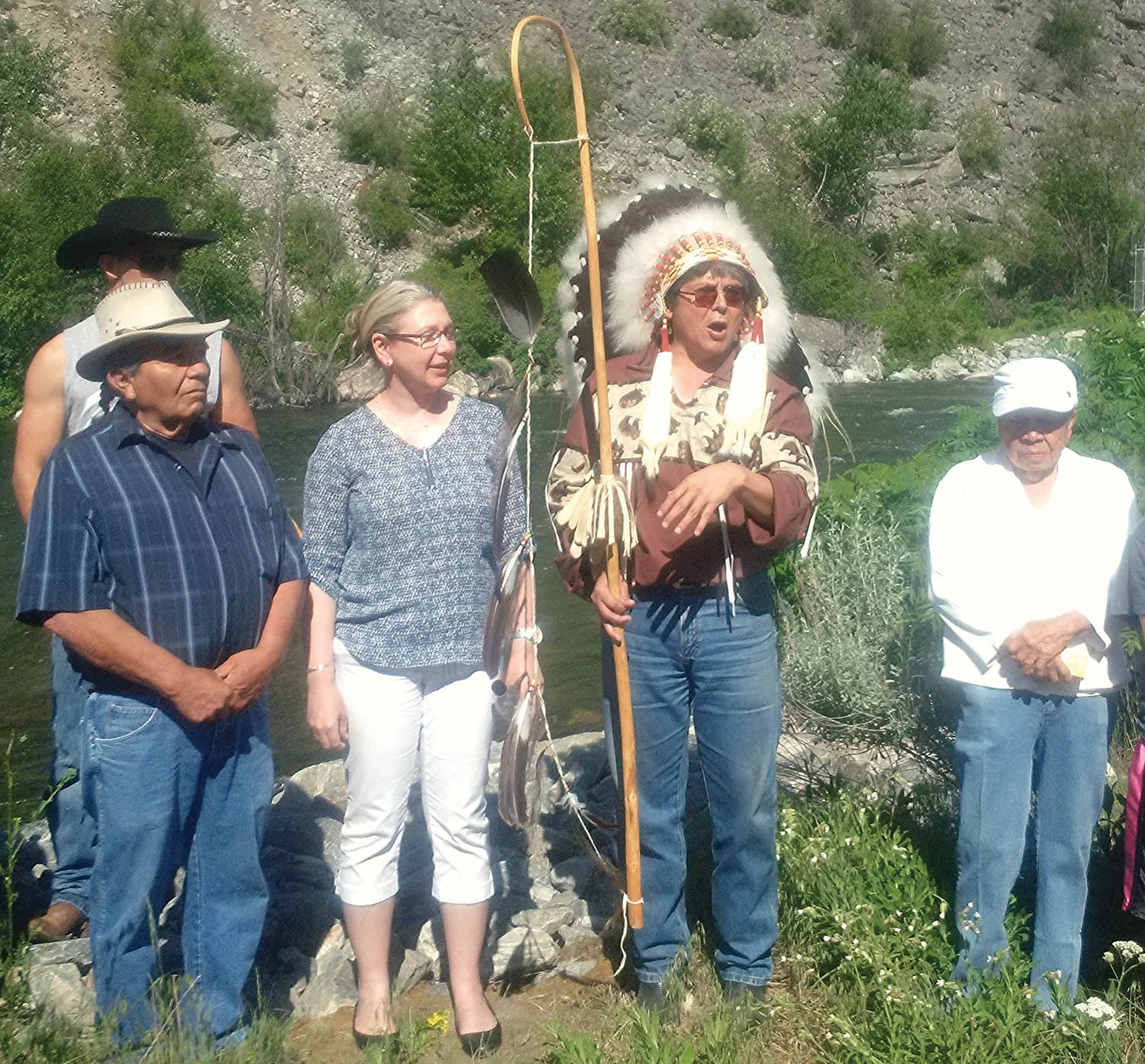
Environment Minister Mary Polak (second from left) and Chief Clarence Louis were at a ceremony to formally announce the nsyilxcen language names that will replace the English language names at the former Haynes Point and Okanagan Falls provincial parks. (Government of B.C. photo)
The signs have already been up for a month, but on Friday afternoon the provincial government officially announced the renaming of Haynes Point and Okanagan Falls provincial parks and McIntyre Bluff.
The name changes result from an agreement between the province and the Osoyoos Indian Band (OIB) that also sees the band managing the two parks.
Haynes Point Provincial Park is now officially known as “sw̓iw̓s park,” pronounced as “swee-yous.” The name means place where it is shallow or narrow in the middle of the lake and it explains how the Okanagan ancestors of the OIB used the area to cross from one side of Osoyoos Lake to another.
The name is also the word from which “Osoyoos” was derived.
The agreement between the province and the OIB follows the discovery in April 2014 of ancestral remains that were radiocarbon dated to about 1,224 years ago.
Environment Minister Mary Polak said the agreement ensures that visitors from around the world can continue to enjoy these parks and at the same time protection is provided to important archeological sites and areas of significant cultural values.
“Thank you to Chief (Clarence) Louie and the Osoyoos Indian Band for working with us to develop this agreement, strengthening our government-to-government relationship,” Polak said in a news release issued Friday afternoon.
Okanagan Falls Provincial Park has been renamed to “sx̌ʷəx̌ʷnitkʷ park,” pronounced “s-wuh-wuneet-kw.” The name means “little falls” and signifies a connection to Kettle Falls, which is known as “big falls” in the nsylixcen language.
McIntyre Bluff is in the process of being renamed to “nʕaylintn,” which is pronounced “Ny-lin-tn.”
“Language and place names are of utmost importance to the historical and cultural identity of people from any region or country,” said Chief Louie in the news release.
“These are historic names that have stood for thousands of years,” Louie said, adding that they represent the culture and tribal territory of the Okanagan Nation. “First Nation language and place names deserve the same respect as English names – not just in a historical context, but in a contemporary context as well.”
Boundary-Similkameen MLA Linda Larson also spoke in support of the agreement.
“The Osoyoos Indian Band has had years of experience operating campsites at their resort in Osoyoos,” said Larson. “This agreement gives the OIB more involvement in park management and operations that supports long-term protection of important cultural values, while allowing for continued public use and enjoyment.”
During the transition to the nsyilxcen names, the English names for both parks will be included in local signage, the Ministry of Environment said.
After the discovery of the ancestral remains last year, the archeological excavation was halted so that the park could remain open last summer. The park was then closed to the public throughout October while the archeological survey resumed. It reopened to pedestrian traffic on the roadway at the beginning of November.
In February this year, an agreement was announced to allow the OIB to manage the parks and to rename them.
The OIB already owns and operates Nk’Mip RV Campground on the east shore of Osoyoos Lake.
The camping season at the former Haynes Point Provincial Park opened on schedule in March. Reservations for the 2015 season can still be made through the BC Parks Discover Camping website.
The agreement between the OIB and the province has been controversial because of the park closure last fall and cultural sensitivities among both aboriginal and non-aboriginal residents of the area about the significance of the discovery of the ancestral remains.
A blunt speech by Chief Louie to the Rotary Club of Osoyoos in March that defended the renaming of Haynes Point also triggered a backlash.
Governments and corporations traditionally use Friday afternoons to make announcements that may be controversial or unpopular because media outlets reduce staff on the weekends and readers are less likely to pay attention.
RICHARD McGUIRE
Osoyoos Times

A sign erected in April gives the new name, sw’w’s at Haynes Point. During a transition period, English names will also appear on signs.. (Richard McGuire photo)