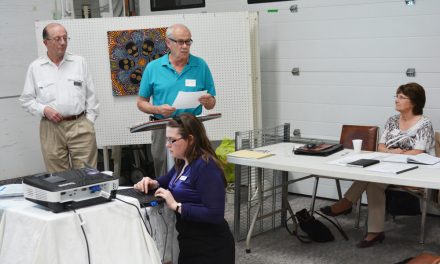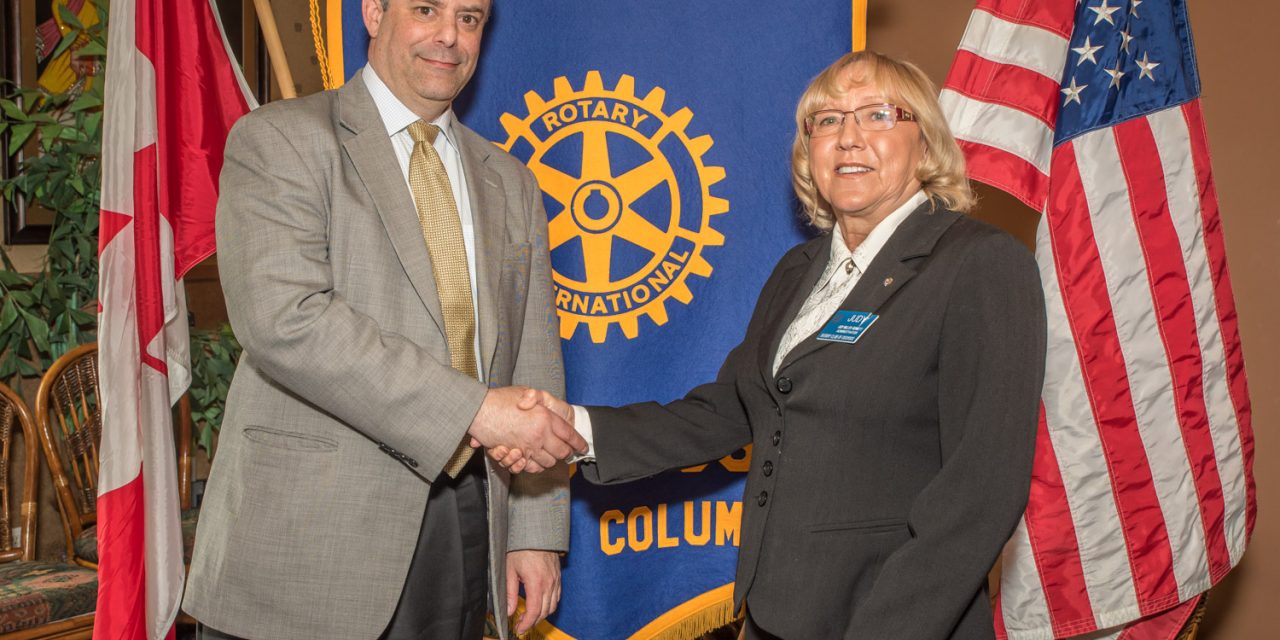
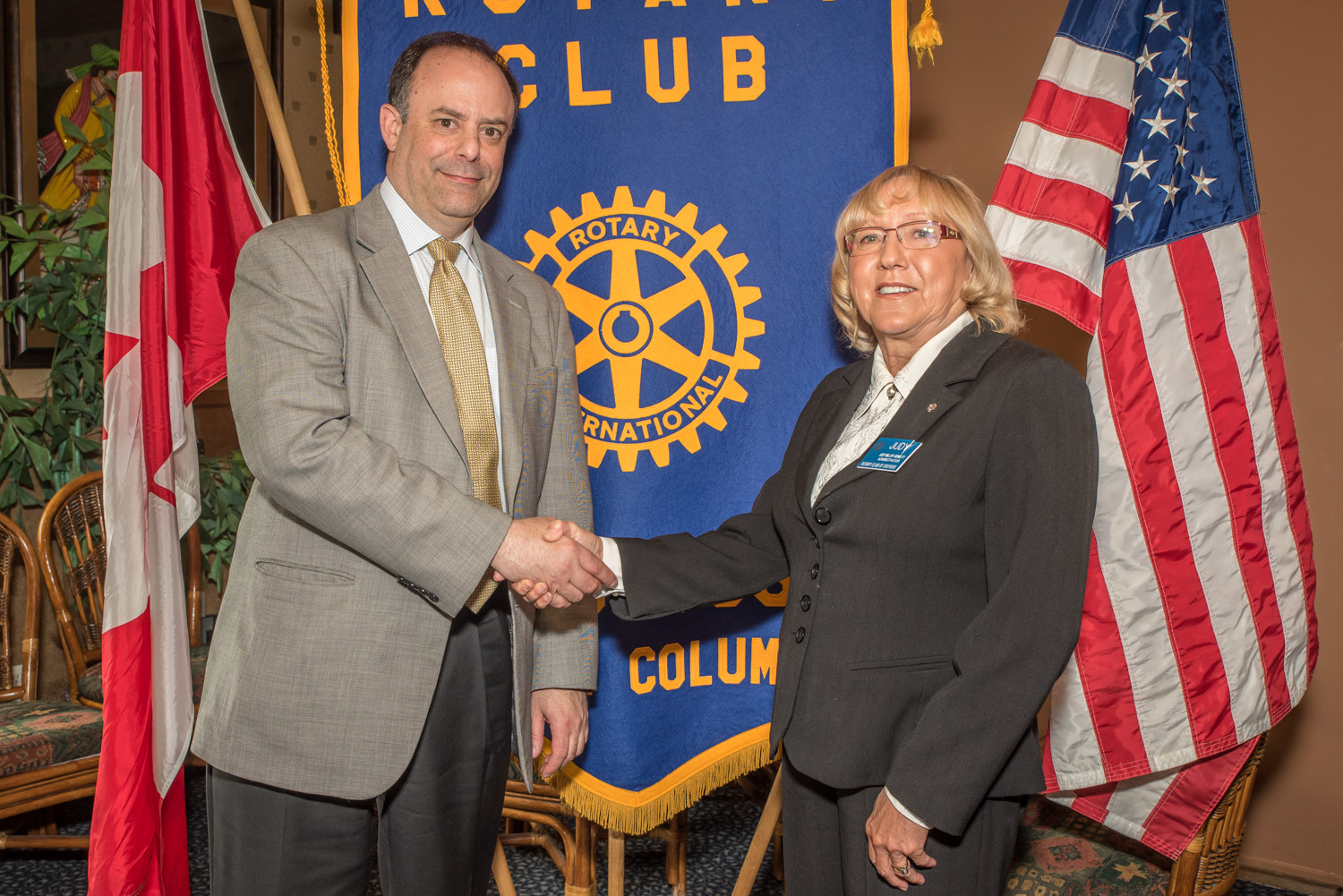
Richard Rosenthal, chief civilian director of the Independent Investigations Office (IIO), spoke to Osoyoos Rotarians last week about the role of his office. Thanking him is Judy Miller-Bennett, president of the Rotary Club of Osoyoos. The IIO investigates cases where a police officer, whether on or off duty, kills or seriously injures someone. When he is not able to exonerate the officer, he refers cases to the Crown for possible charges. (Richard McGuire photo)
Hardly a day had passed since Richard Rosenthal spoke to the Rotary Club of Osoyoos when his office was called to investigate an RCMP shooting of a man in Burnaby.
Police shot the distressed and armed man after he allegedly threatened himself and then threatened the officers. The injured man was taken to hospital.
Rosenthal is the chief civilian director of the Independent Investigations Office (IIO) of B.C., which investigates incidents where a police officer kills or seriously injures someone.
Rosenthal, the guest speaker at last Thursday’s Rotary lunch meeting, told Osoyoos Rotarians about the role and background of his agency.
It’s a new agency, launched in September 2012. There are few similar agencies anywhere in the world and in some respects it is unique. Ontario has had a Special Investigations Unit (SIU) since 1990, but unlike Ontario, B.C.’s IIO investigates incidents involving off-duty officers as well as officers on duty.
Similar agencies exist in Northern Ireland and England, but in other Canadian provinces such as Alberta, Manitoba and Nova Scotia, investigative units are overseen by seconded police officers rather than by civilians.
Looking for a local angle, a couple of Rotarians asked Rosenthal whether his office would have played a role in a 2013 incident in which an RCMP officer was suspended after two vehicles were reported stolen and were set on fire. They also wanted to know why he was in Osoyoos.
Rosenthal said his office would not have been involved in the Osoyoos vehicle incident because its mandate is limited to incidents resulting in death or serious injury.
He explained that he was in Osoyoos as part of his regular outreach to communities where he meets with police detachments and community leaders to explain the role of his office.
Prior to coming to B.C., Rosenthal set up civilian oversight programs in Portland, Oregon and Denver, Colorado. He also worked as a prosecutor in Los Angeles where he was responsible for prosecuting corrupt judges, police officers and public officials.
“I was very popular,” he joked.
When B.C. set up its program, they were looking for a real outsider, he said. They wanted someone who did not have connections to the RCMP or other police in the province, but who knew law enforcement and had investigative experience.
In Rosenthal, they found that person and he began setting up operations in January 2012.
The impetus for starting the IIO came from two different cases in which civilians died following actions taken by police.
In December 1998, Frank Paul, an aboriginal man, died of hypothermia in a Vancouver alley after being dropped off by police on a cold night.
The original police investigation treated the incident more as a case of hypothermia than a potential criminal investigation involving police, Rosenthal said.
A subsequent inquiry recommended the creation of an independent investigations office, but only for municipal police.
The second case was the 2007 death of Polish immigrant Robert Dziekanski at Vancouver International Airport after he was repeatedly Tasered by RCMP.
Police made false statements about the incident that were contradicted by a video made by a civilian witness. Two of the officers have subsequently been convicted of perjury.
The inquiry into that incident also led to a recommendation of an independent investigations office, but this time one also looking into the RCMP.
“It was kind of a perfect storm in B.C. because at the same time the RCMP and B.C. Association of Chiefs of Police both came out in favour of the creation of an independent investigations officer,” Rosenthal said.
Police were concerned that when they investigate themselves, people are suspicious of the investigation even if they do a good job. If they make a mistake, people believe it was intentional.
With an independent agency, police don’t need to investigate themselves and the findings are more credible if the IIO exonerates an officer, he said.
Rosenthal said he has two teams of Surrey-based investigators with roughly an even mix of specially trained civilians and former or seconded police officers.
He personally reviews the evidence gathered in each investigation. If he concludes there was no wrongdoing on the part of the officer, he issues a public report exonerating the officer and explaining his reasons.
If he believes there may have been wrongdoing, or the result of the investigation is inconclusive, he refers the matter to the Crown prosecutor. This has happened in about a third of cases.
Although police refer a case to the Crown when they are recommending charges, Rosenthal said his referrals meet a lower threshold – they simply mean he cannot exonerate the officer – not that he recommends charges.
“With me, I’m required to send it to the Crown as long as I believe an officer may have committed an offence,” said Rosenthal. “So I will send cases to the Crown where I know there’s no chance of conviction because I’m required to if I cannot exonerate the officer.”
Several cases have, however, resulted in criminal charges against officers including one charge of second-degree murder. That case is still pending.
RICHARD McGUIRE
Osoyoos Times
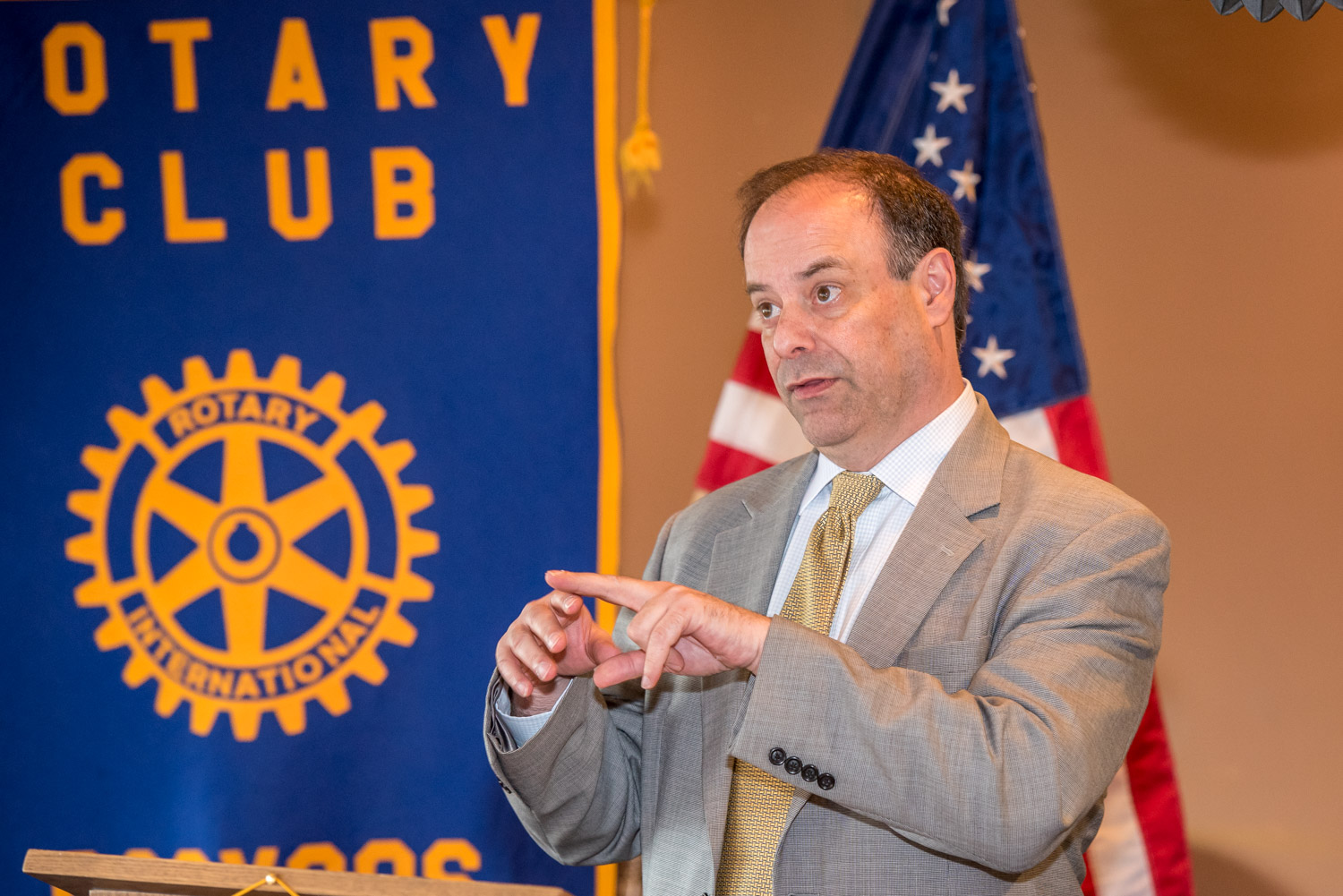
Richard Rosenthal, chief civilian director of the Independent Investigations Office (IIO), spoke to Osoyoos Rotarians last week about the role of his office. The IIO investigates cases where a police officer, whether on or off duty, kills or seriously injures someone. When he is not able to exonerate the officer, he refers cases to the Crown for possible charges. (Richard McGuire photo)