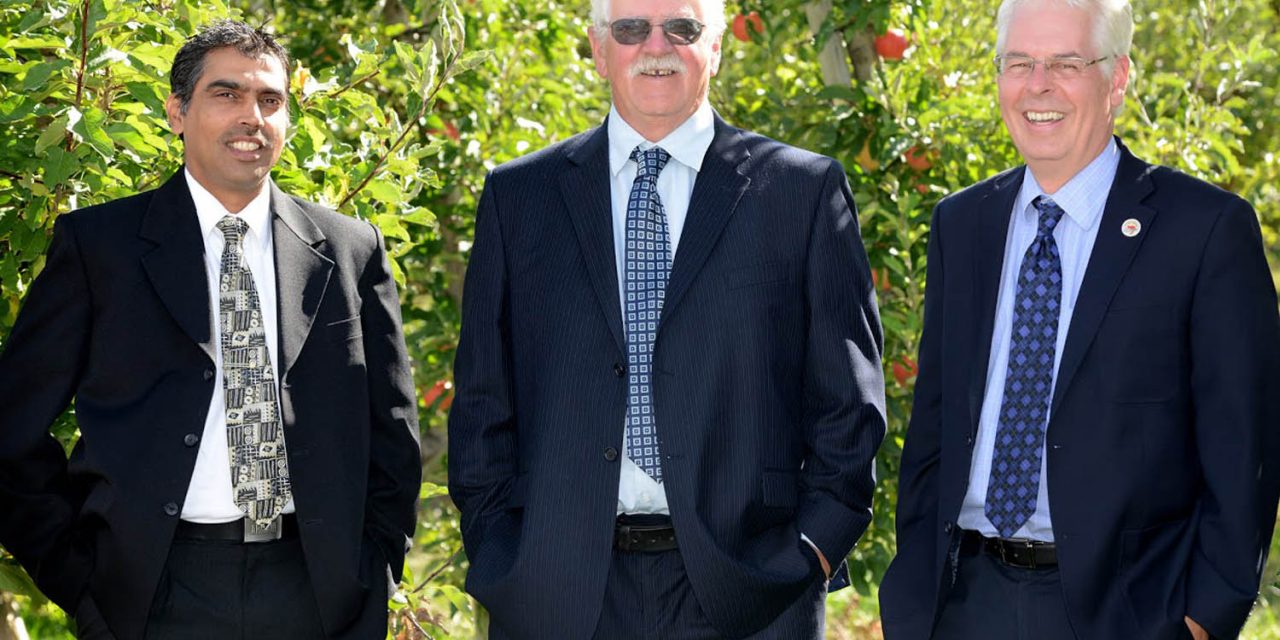
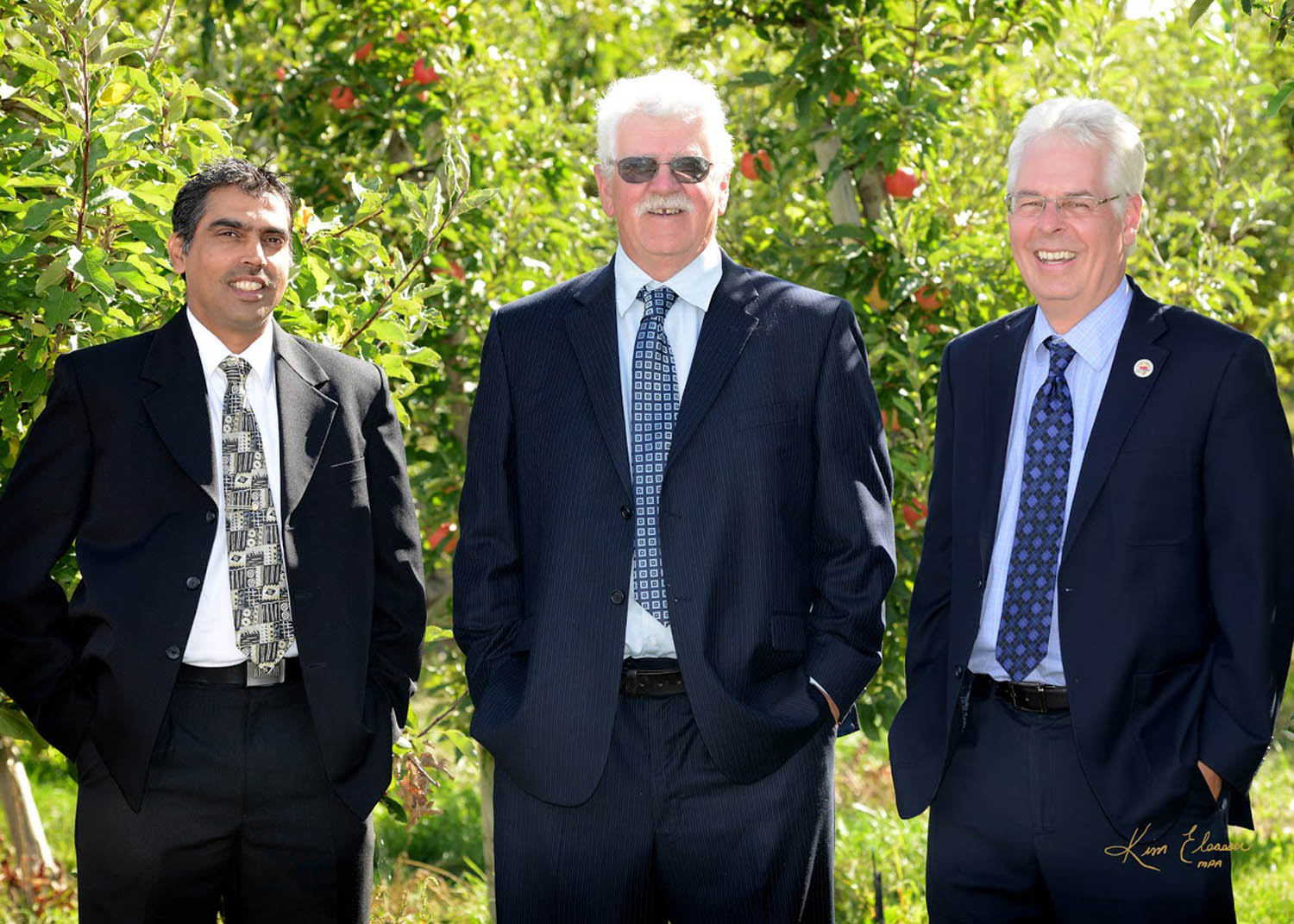
The BCFGA is concerned about the lack of information being provided to Canadian consumers after the Health Canada and the Canadian Food Inspection Agency approved the controversial Arctic Apple for sale in Canada. BCFGA president Fred Steele (centre) is shown with vice-president Pinder Dhaliwal (left) and general manager Glen Lucas. (Photo supplied)
The British Columbia Fruit Growers’ Association (BCFGA) remains concerned about the lack of information available to the general public after confirming the federal government has approved the controversial, genetically modified Arctic Apple can be grown and sold in Canada.
The Canadian Food Inspection Agency and Health Canada approved non-browning Arctic Apples for commercial sale in Canada last Friday.
In a letter sent to Okanagan Specialty Fruits Inc. on Friday, the CFIA said Arctic Apples “are as safe and nutritious as traditional apple varieties.”
Health Canada said they have concluded the Arctic Apple “is safe for consumption, still has all its nutritional value and therefore does not differ from other apples available on the market.”
The approvals come after three years of review by Canadian authorities and follow U.S. deregulation by the U.S. Department of Agriculture last month.
The American Food and Drug Administration also approved the genetically engineered apples along with six varieties of potatoes that won’t bruise by Boise, Idaho-based J. R. Simplot Co.
“We are pleased that the FDA has completed their consultative review of our first two Arctic Apple varieties, and their conclusion that they are as safe and nutritious as their conventional counterparts is gratifying and should give consumers full confidence in the healthfulness of Arctic Apples,” Neal Carter, founder of the Summerland, B.C., company, said Friday in a release.
Okanagan is trying to make apples a more convenient snack with its non-browning version. The company says bagged apples wouldn’t have to be washed in antioxidants as they are now, a process that can affect taste.
Carter says they want to see bagged apples become as prolific as bagged baby carrots.
“We know that in a convenience-driven world, a whole apple is too big of a commitment,” Carter said.
The first two varieties of Arctic Apples to get the non-browning treatment will be Granny Smith and Golden Delicious, and Carter says there won’t be significant plantings until 2017.
The BCFGA isn’t necessarily opposed to Arctic Apples, but the lack of information being presented to consumers across Canada, said BCFGA president Fred Steele.
“The government has always used the saying that the market will decide, but at present there is no distinction in the marketplace between genetically modified or genetically engineered food and conventional food,” said Steele on Monday.
“The market should have a reference point to make a choice and to protect conventional producers from possible harm.”
There has also been great concern expressed that the approval of the Arctic Apple will impact farmers who grow fruits and vegetables organically, said Steele.
“The government needs to ensure consumers can make good decisions and if there is to be choice on purchasing genetically modified foods, then the choice should be apparent,” he said.
The BCFGA represents 520 commercial tree fruit growers in the Okanagan Valley, with farmgate value of apples estimated at $45.3 million annually.
The BCFGA has opposed the approval of the Arctic Apple in Canada due to the possible backlash that could impact the apple industry as a whole, said Steele.
“The reality is there are a lot of people who will refuse to eat genetically modified apples and if they’re not given the proper information about the differences, then they will stop eating apples altogether,” he said. “That is our major concern.”
The Arctic Granny Smith and Golden Delicious breeds have been genetically engineered to modify the gene, which controls the browning of the apples. When cut, the apple does not brown, mainly resulting in a cosmetic benefit and enhancing the efficiency of fresh cut apple processors.
Other apples on the market are naturally slow to oxidize, or brown, when cut, said Steele.
The lack of information provided by the federal government about genetically modified food and its impact on human health is the biggest concern in this debate, said Steele.
“Unlike in the United States, there has been very little scientific studies released to the public,” he said. “We’re at an uncertain crossroads because of the lack of information that is out there.
“At no time has our industry or our association ever suggested that growing these Arctic apples is going to result in people growing a third eye or third arm, but we do want to make sure that consumers know what they are eating and have all of the scientific data available to them so they can make good decisions.”
If consumers are informed, then the marketplace will clearly indicate if the Canadians are ready and eager to introduce Arctic apples into their diet, said Steele.
“We don’t know what the reaction is going to be from the consumer … that’s the problem,” he said. “If consumers are informed and they say nothing and start buying these apples, we wouldn’t have a problem with that at all because the marketplace will again have spoken, but it’s the lack of information that concerns us the most.”
The BCFGA believes it will take up to four years before any significant volume of Arctic apples is available in the Canadian marketplace and even then the volume would be very limited, said Steele.
“It’s going to take several years to see any kind of significant production as these trees have to be planted and grown on a large scale,” he said.
The fact only two varieties have been approved at this time is also encouraging, he said.
KEITH LACEY
Osoyoos Times