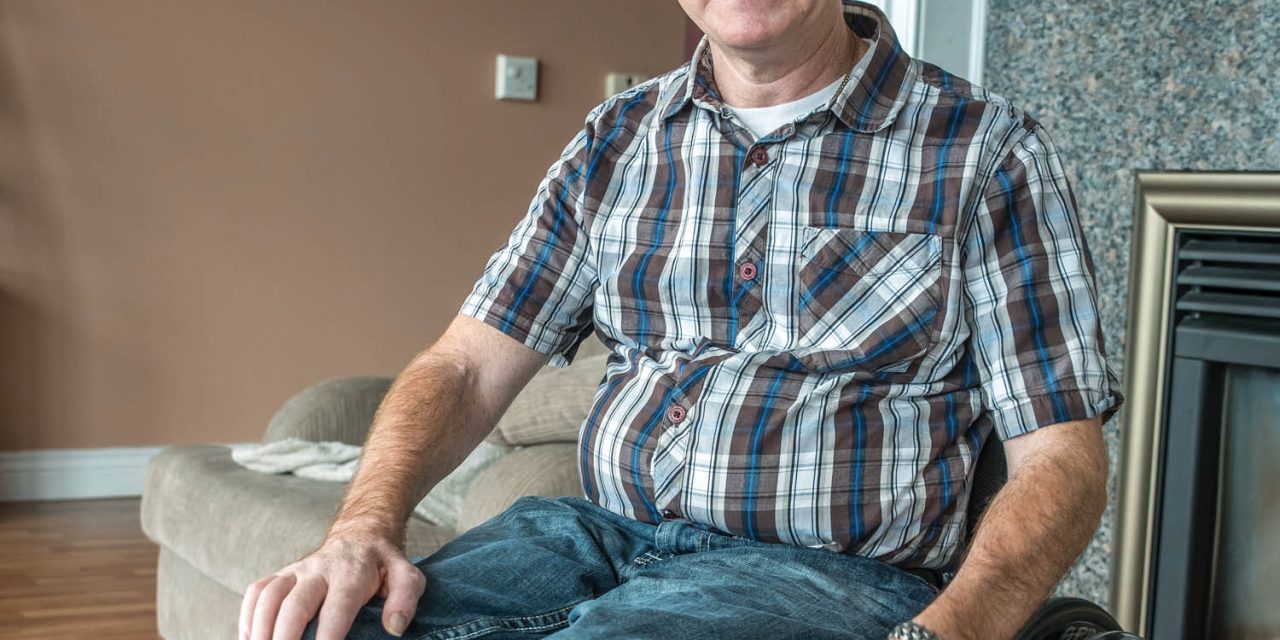
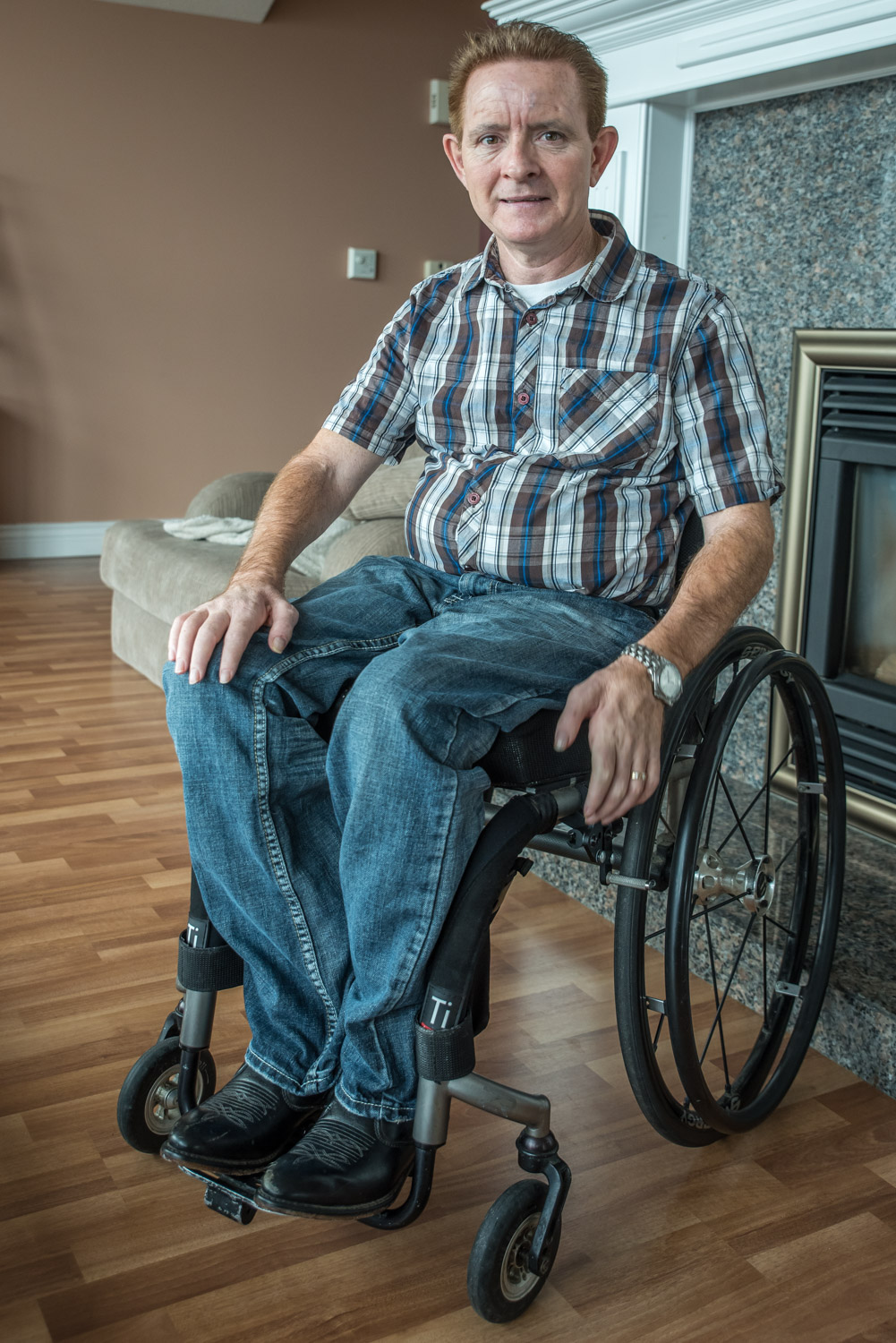
Mike Stiles has been using a wheelchair ever since a horse riding accident 30 years ago that left him a quadriplegic. Although he doesn’t consider himself an advocate for people with disabilities, his experience has given him insights into how to improve accessibility. (Richard McGuire photo)
Mike Stiles says he’s never considered himself as an advocate for people with disabilities, but his 30 years in a wheelchair as a quadriplegic have given him insights about the challenges many people face.
And the Osoyoos resident hasn’t hesitated to offer his advice on disability issues to local politicians and businesses.
He recently started a consulting company to do audits and offer advice on making businesses more accessible.
Stiles, who came to Osoyoos from Vancouver in 2001, was a jockey in his former life.
Just over 30 years ago, on Dec. 7, 1984, he was breaking in a colt on an icy track. The horse ran and slipped on the ice. Stiles’ right foot caught in the stirrup and he was catapulted to the ground, snapping his neck.
Since then he’s been a quadriplegic with no use of his legs and only limited use of his hands, with no functional grip.
His accident and disability haven’t stopped him from leading an active life. When weather is dry, on a good day he’s able to wheel twice around Haynes Point in a manual wheelchair.
In Vancouver, he was involved with quadriplegic Sam Sullivan in forming groups making it possible for people with disabilities to enjoy outdoor activities.
These included Disabled Ultralighters of Vancouver, a short-lived flying club, Disabled Sailing Association of Vancouver and the British Columbia Mobility Opportunities Society (BCMOS).
Sullivan went on to become Vancouver mayor in 2005 and is now a Liberal MLA.
The BCMOS developed the TrailRider, a cross between a rickshaw and a wheelbarrow that allows people with disabilities to explore back country trails with the help of two able-bodied people.
In Osoyoos, Stiles hasn’t hesitated to speak out about situations that impede those with disabilities from leading normal lives.
When the Shell gas station recently announced it would offer twice weekly full service aimed at seniors, Stiles sent a letter to the Osoyoos Times arguing that 10 hours a week wasn’t enough.
“For a person with a disability like myself, and many seniors, a full service gas station is an essential service,” Stiles wrote in a letter published Nov. 26.
He was pleased when a few days later the gas station posted a sign with a phone number offering assistance to those with physical disabilities.
When the Town of Osoyoos completed the new marina in 2013, it had five steps and no wheelchair accessible ramp. Stiles spoke up, again in a letter published in the Osoyoos Times.
“…Please excuse my frustration, but it has been over 25 years since Rick Hansen wheeled around the world trying to raise awareness regarding accessibility and still today it’s a problem,” Stiles wrote. “… As I look at the sign above the gates to the new boat slips … saying ‘Canada’s Warmest Welcome,’ I always then look at the five stairs to the gate and think to myself, ‘Yes maybe, but not if you’re in a wheelchair.’”
The town ended up spending almost $25,000 to remedy the oversight.
Not only could this cost have been avoided if it was done right in the first place, Stiles argues, but the change will also benefit some able-bodied people, for example those who might be carrying a big cooler down to their boats.
Just how many people in Osoyoos can benefit from improved access for those with disabilities?
Stiles said he learned from SPARC BC, the organization that operates the parking permit program, that more than 400 people in Osoyoos have disabled placards.
Add to that the out-of-province snowbirds, who also include some people with disabilities who come here because they can’t afford out-of-Canada health insurance.
And take into consideration that there are some people in Osoyoos with limited mobility who don’t drive and, therefore, don’t have a parking placard.
With an aging population, some projections suggest that by 2030, one in five people will be disabled.
That’s not to suggest that all disabilities are the same. And because the needs of a quadriplegic in a wheelchair may be quite different from those of a visually impaired person, there may need to be a rethinking of the idea that one solution fits all, said Stiles.
Even a person in an electric wheelchair faces different challenges from one in a manual wheelchair, Stiles points out.
Despite a growing number of disabled parking spaces, Stiles argues that the parking situation has actually become worse because the criteria for a placard has broadened and more people are using these spaces.
“It’s getting worse to find a spot, especially in the Christmas season,” he said, noting that in his case he needs a wider stall to unload his wheelchair.
The condition of sidewalks is also a challenge and Stiles isn’t just speaking about the lack of ramps at many corners.
“Even the quality of the sidewalks is a problem,” he said. “Some of the areas are rough for somebody with a visual impairment. I can see and I’m careful when I bounce over a spot that’s not maintained, but a senior maybe can’t see that and can fall and break a hip and could have really severe health implications. It wouldn’t be the first senior who’s fallen and died from this kind of stuff. It’s a serious situation.”
Hotels have gotten better at offering rooms designed for those with disabilities, but sometimes details are overlooked. Often beds have raised mattresses making them harder to get onto.
One of the challenges in a town like Osoyoos is that many business buildings were constructed in an earlier time when there was less awareness of the need to accommodate those with disabilities.
Osoyoos Home Hardware, for example, has a number of stairs in the store. While staff there have tried to accommodate those in wheelchairs, giving them access to the lower level through back doors, the building simply wasn’t designed with wheelchairs in mind.
In other cases, businesses may have display items that impede wheelchair access.
New construction and renovations, however, should be looked at from an accessibility point of view, Stiles argues. While some adaptations such as providing a ramp may be obvious, sometimes little things that make a difference are overlooked.
“Disability is hard to understand if you don’t have one,” says Stiles. “It just takes asking somebody about the issues when you’re building something or doing a renovation.”
Stiles said he’s found local politicians increasingly receptive.
“Past mayor Stu Wells said that he wanted to see us as one of the most accessible (communities) in Canada,” said Stiles, adding that he has briefly discussed the issue with new mayor Sue McKortoff and she too was positive.
He has also had a number of conversations with MLA Linda Larson, who is the Parliamentary Secretary for Accessibility to the Minister of Social Development and Social Innovation.
Still, Stiles thinks more change needs to come at the top in the form of legislation and building standards.
“Rick Hansen wheeled around the world 28 years ago and still accessibility is an issue,” said Stiles. “We should get all politicians and stick them in a chair for a week so they understand. I really thought we were beyond that and some of these issues would have already been addressed.”
RICHARD McGUIRE
Osoyoos Times
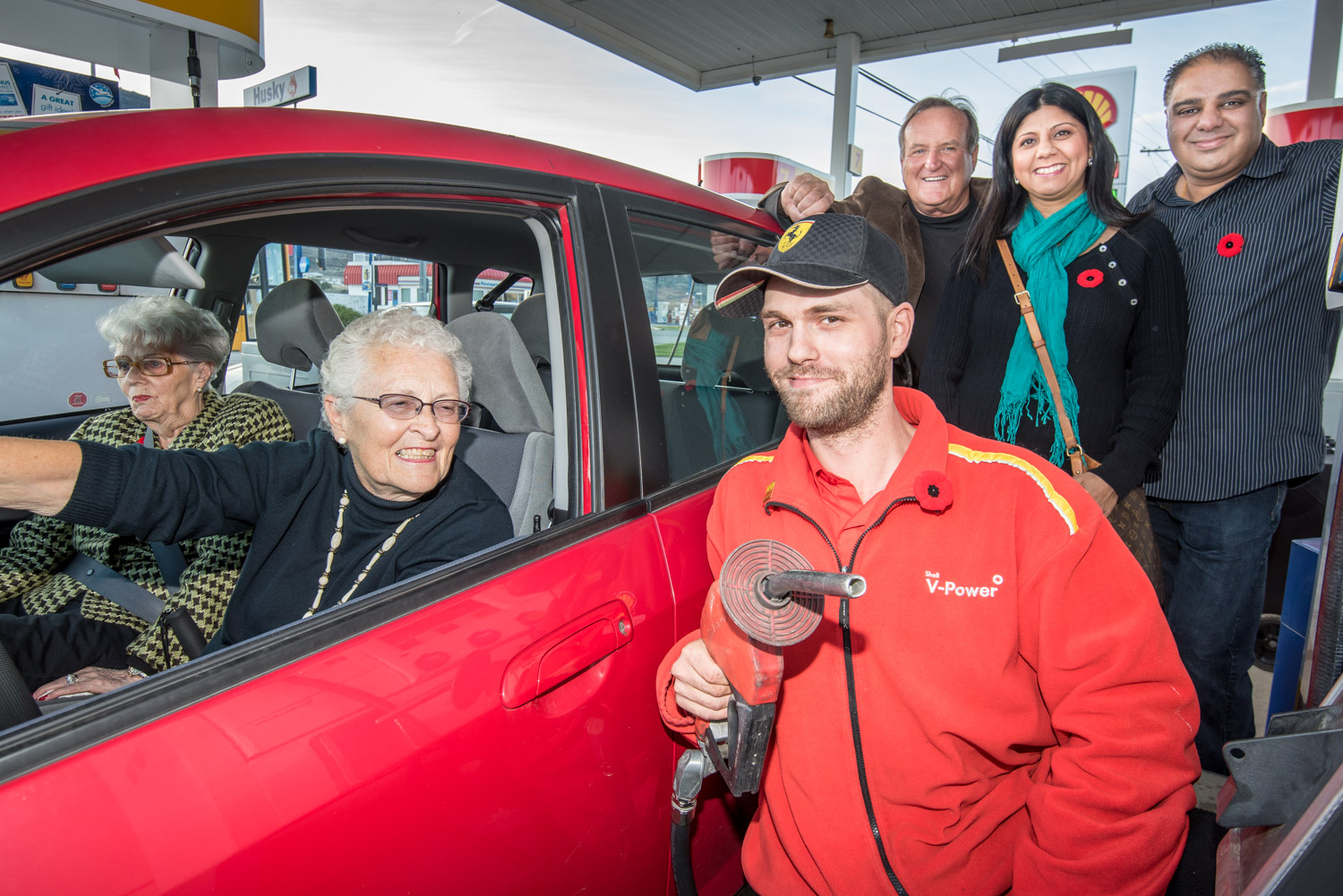
The Shell service station recently announced it is providing full service two days a week to help seniors and others with difficulty using self serve. After Stiles wrote about it, he was pleased that the station responded by providing a phone number for those with disabilities who need help. (Richard McGuire file photo)