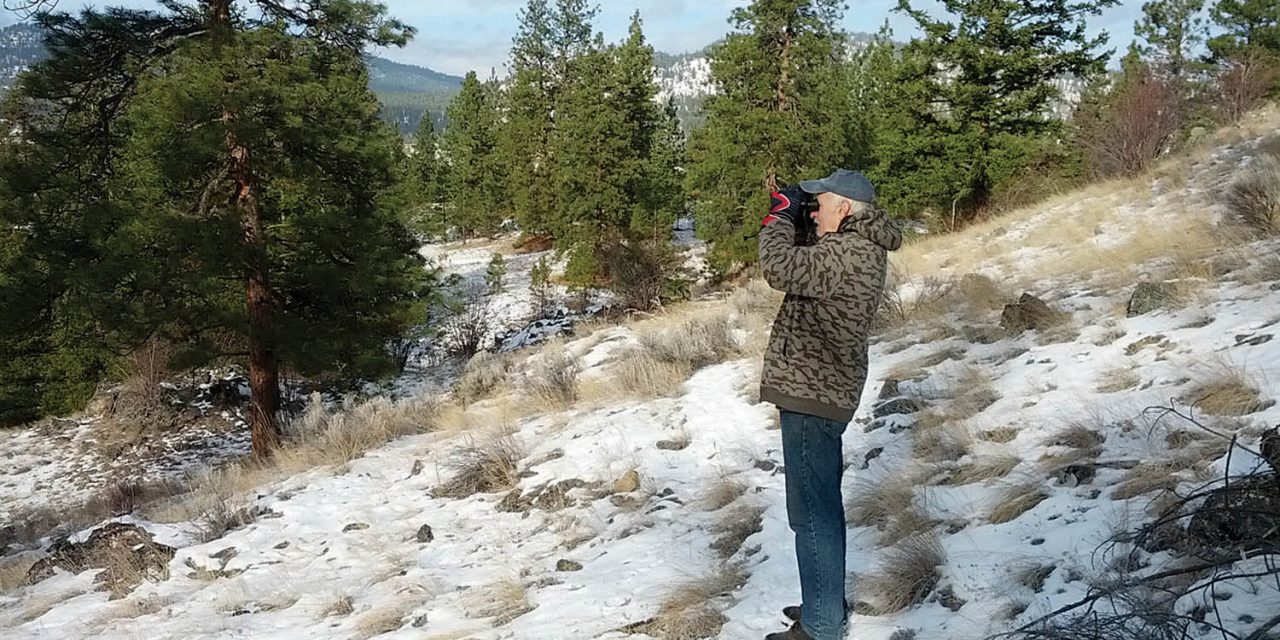

Ron Laplante of Penticton is shown taking part in the annual bird count that will take place over the holiday season across the region. This is the 36th year the event has been held in Oliver-Osoyoos and the 115th year in North America. The local event will be held on Dec. 27, but in other areas it will be held on other days between Dec. 14 and Jan. 5. (Dick Cannings photo)
Dozens of volunteers in the Osoyoos area will once again be conducting a bird census as part of the international Annual Christmas Bird Count.
This is the 36th year the event has been held in Oliver-Osoyoos and the 115th year in North America.
The local event will be held on Dec. 27, but in other areas it will be held on other days between Dec. 14 and Jan. 5.
Doug Brown, the local organizer, hopes that some new people with bird feeders will agree to keep an eye on their feeders, even if they don’t want to traipse around countryside like the more dedicated birders.
“If we get some good feeder watchers, that would be the easiest thing to do,” said Brown. “If you’ve got a feeder, take a look once or twice over the day and see what’s there and count them.”
In recent years the count has been getting between 30 and 40 local volunteers, Brown said.
“We cover a fairly large area, but the birds they’ll often be concentrated around the feeders,” he said. “Sometimes we find feeders and sometimes we don’t. Lots of times they’re not visible.”
In past counts, Brown said sometimes bird species not found elsewhere have been seen at feeders.
“Often what happens is the unusual ones hang around the feeders,” he said. “It’s the bird that normally wouldn’t be here, but it stuck around because there’s a feeder there.”
In previous bird counts, the Oliver-Osoyoos area has recorded more bird species than anywhere else in B.C. apart from the coast.
Some coastal areas record more species both because of the ideal habitat and because there’s a larger population base from which to draw volunteers, Brown said.
The Oliver-Osoyoos count covers an area from the north edge of Oliver to Boundary Point in Washington and from Anarchist Mountain to the west end of Richter Pass. Other nearby areas are covered in other counts.
While birders may delight in spotting rare birds, the count is more than just a fun exercise.
“Data from the Christmas Bird Count are at the heart of hundreds of peer-reviewed scientific studies and inform decisions by wildlife managers across Canada,” said Dick Cannings, the Penticton-based Bird Studies Canada program co-ordinator. “Because birds are early indicators of environmental threats to habitats we share, this is a vital survey of North America and increasingly the Western Hemisphere.”
Brown said there hasn’t been a huge change in birds seen in this area as a result of climate change, but some increased numbers are being noticed.
“Certainly we get way more bluebirds than we used to in the winter,” he said.
“They’re common in the summer and are usually quite rare here in the winter. Now it wouldn’t be unusual for us to have over a hundred on the Christmas Bird Count and we used to be lucky to get four or five.”
Another unusual bird that’s been spotted here in winter counts is the Say’s phoebe, Brown said, pointing out it is a flycatcher and its appearance in winter isn’t expected.
Peregrine Falcons, although threatened, have actually increased in recent years, he said.
“It’s been a slow process over decades and decades after the big thing way back with DDT,” Brown said, referring to a pesticide that wiped out bird populations and was phased out in North American agriculture in the 1970s and 1980s. “There are birds still recovering from that, large birds of prey.”
With many provincial lakes not freezing over as much, some bird species like the bufflehead duck are being seen more in winter in the South Okanagan, which conversely has meant they are seen less often on the Sunshine Coast.
“Buffleheads used to be common there in the winter on the coast,” said Brown. “They’re not there anymore. Why? Because they’re staying in the interior.”
December might seem a strange time to do a bird count with many birds gone for the winter, but Brown said the reason for doing it then is both historic and makes scientific sense.
The historical reason for doing the event at Christmas was that it was intended as an alternative to the 19th and early 20th century holiday “side hunt” in which teams competed to see who could shoot the most small game, including birds.
A naturalist, Dr. Frank Chapman, suggested people should count the birds instead of killing them.
Scientifically, the count makes sense at Christmas because that’s when bird populations are the most stable, Brown said.
Some migrating birds don’t head south until late November, while others start to return in mid January.
“At this time of the year they’re not moving around as much,” said Brown. “Because this is done all over North America, they can get a good idea of numbers because they’re not moving around in the big migration movement.”
Anyone wishing to participate can contact Doug Brown by phone at 250-495-6164 or by email at [email protected].
RICHARD McGUIRE
Osoyoos Times