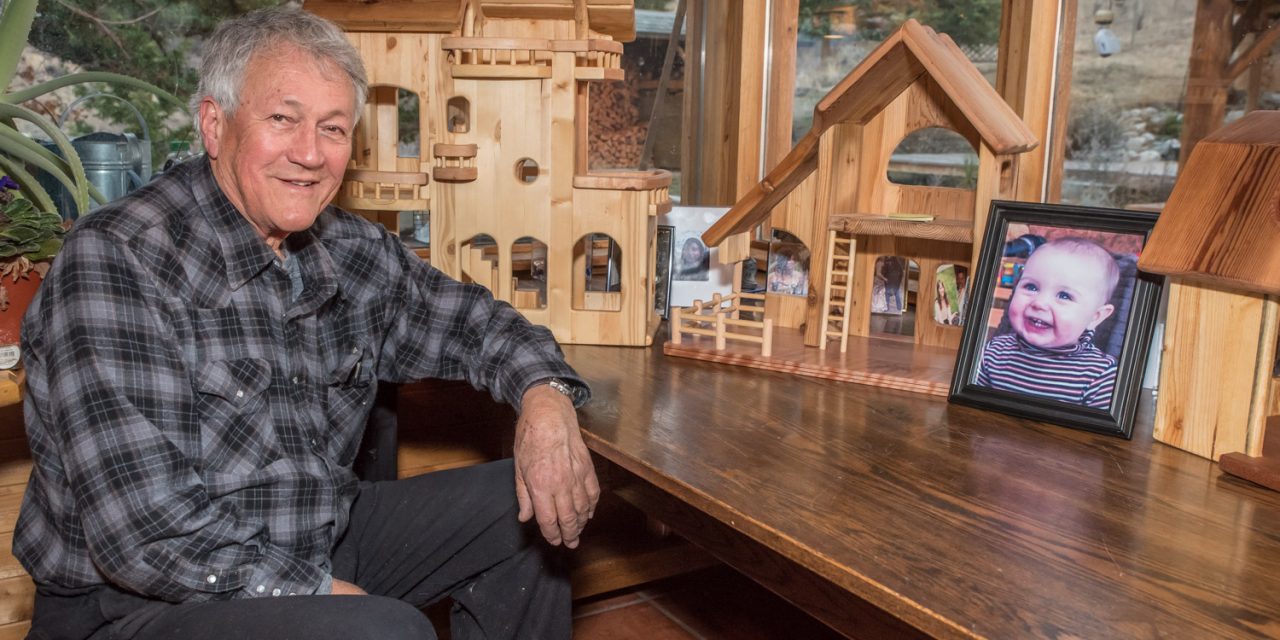
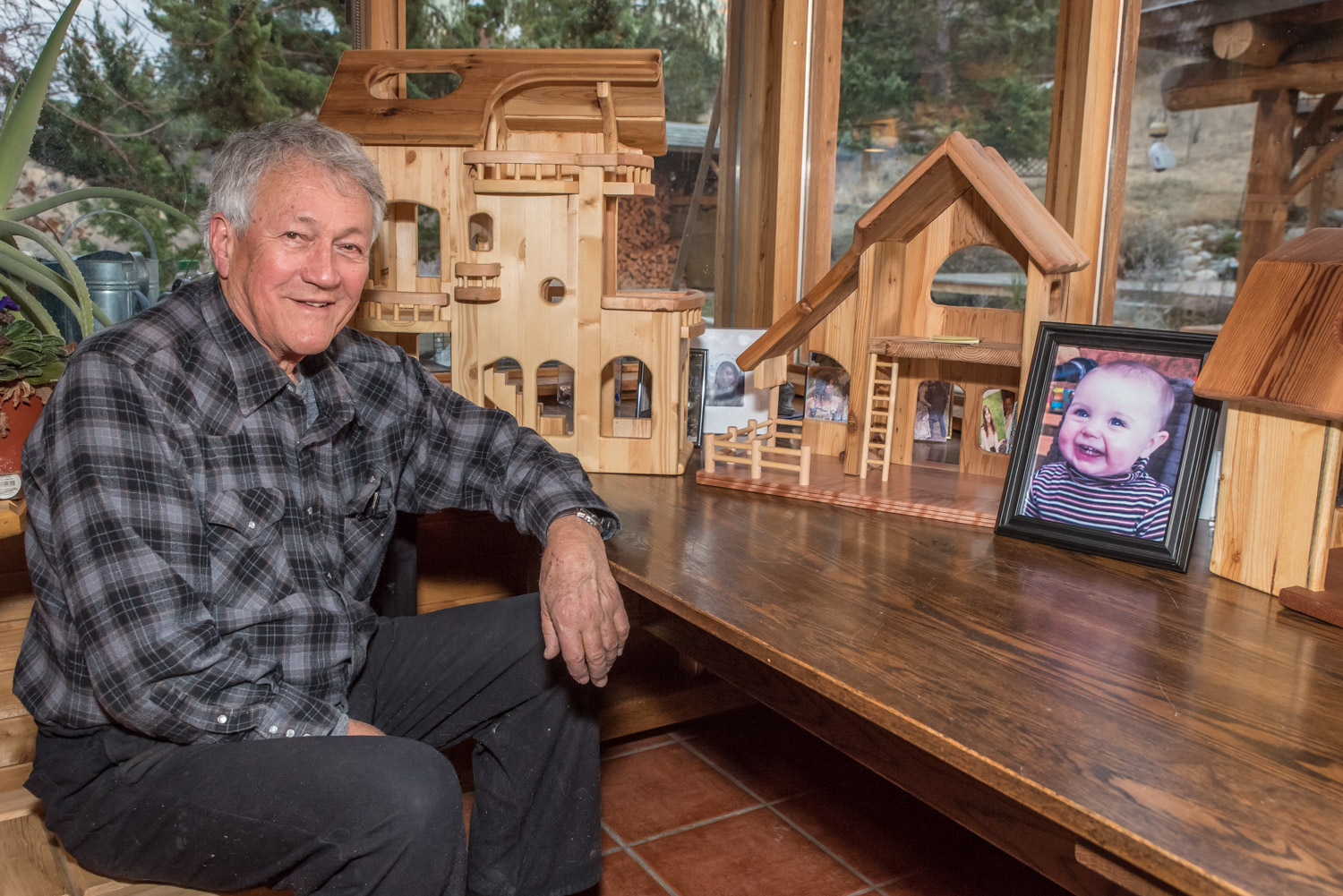
Lee Whitehead started building doll houses again in August, originally for his great granddaughter Kymera, whose portrait is on the table. He loves doing it so much that he’s kept on building others. (Richard McGuire photo)
It took the arrival of his great granddaughter for Lee Whitehead to rediscover the joy he gets from building dollhouses.
A generation ago, Whitehead, who is now 82 and lives at Kilpoola Estates in Osoyoos, made the wooden dollhouses for his granddaughters. When they grew up, his woodworking skills were employed in other directions.
A year after his oldest granddaughter gave birth to little Kymera in August 2013, Whitehead’s life took a turn when he once again found a reason to return to his woodworking shop.
“They all came up for my birthday in August and my daughter said I should be making a dollhouse for my great granddaughter,” Whitehead recalls. “So I did, and I just got into it. It was so much fun.”
The retired University of British Columbia (UBC) English professor had been at loose ends since losing his wife Pegeen to cancer in September last year.
“I hadn’t really done anything in the shop for a year,” he said. “It was so much fun it was just like being a kid again.”
When he rediscovered the pleasure of woodworking, one dollhouse turned into another and then another. Now he’s made 14.
Whitehead uses different kinds of woods – initially starting with leftover pieces he had in his woodworking shop, choosing different woods for their colour, texture and other qualities. He’s used pine, cedar, maple, oak and beech. He even has some Philippine mahogany.
He doesn’t work from patterns, but rather makes up the intricate designs as he goes along.
“Everything is not only unique, but it’s unique from moment to moment,” said Whitehead. “You just don’t know where it’s going. I have a general idea of the kind of thing I want to do and then I get started and it just kind of grows.”
Whitehead said he has a general idea of the size he wants to make and he cuts the pieces. He only adds features like windows at a later stage.
There are no metal nails or screws or other hardware. The pieces are joined with glue and what is called a “biscuit,” which is a small piece of oval-shaped wood that is fitted into slots in the two pieces being joined.
The houses have no furniture, but they do have stairways and other design features. They are durable, and although they are elegant, they are designed for children to play with rather than to sit on a shelf.
Whitehead has recently sold several of his houses under the name Woad Houses.
He donated one for a raffle to raise money for South Okanagan Special Olympics and he’s given one to a great grandniece in California, which he delivered in person.
When first interviewed, Whitehead was preparing to bring some to sell at an artisan fair at Cactus Ridge Retirement Residence.
Whitehead said at the time that he would feel lucky to sell one, but in fact he sold two along with some smaller pieces. He’s also sold one to a customer in Vancouver.
Of course Whitehead isn’t making the houses to get rich. He would, however, like to recover his costs and give anything extra to charity.
“I don’t have to make money,” he said. “Making my shop costs gives me freedom to do new things that I wouldn’t do otherwise. I’ve already bought new bits and power tools just to do this so I’ve invested quite a bit just these past few months.”
Teaching English may be very different from woodworking, but Whitehead said he’s always enjoyed the hands-on of his hobby.
He had a modest shop in his basement when he taught at UBC. Over the years he’s built kitchens, furniture, patio furniture and some structures.
Whitehead and his late wife, who was also an academic at UBC, retired early in 1986, moving to the Osoyoos area. He lives above Spotted Lake with four cats and two horses.
Whitehead said he now spends as much time in his workshop as he can, although housework ties him up more than he would like.
“This is a big house and it takes a lot of time,” he said. “I appreciate how much my wife used to do.”
In his shop, however, he said he is continually learning new things and solving puzzles – like figuring how to join two sloping perpendicular roofs with the right miter cuts.
“This is something that really gives me a reason to get up in the morning,” said Whitehead. “I just love getting up and getting out into the shop.”
RICHARD McGUIRE
Osoyoos Times