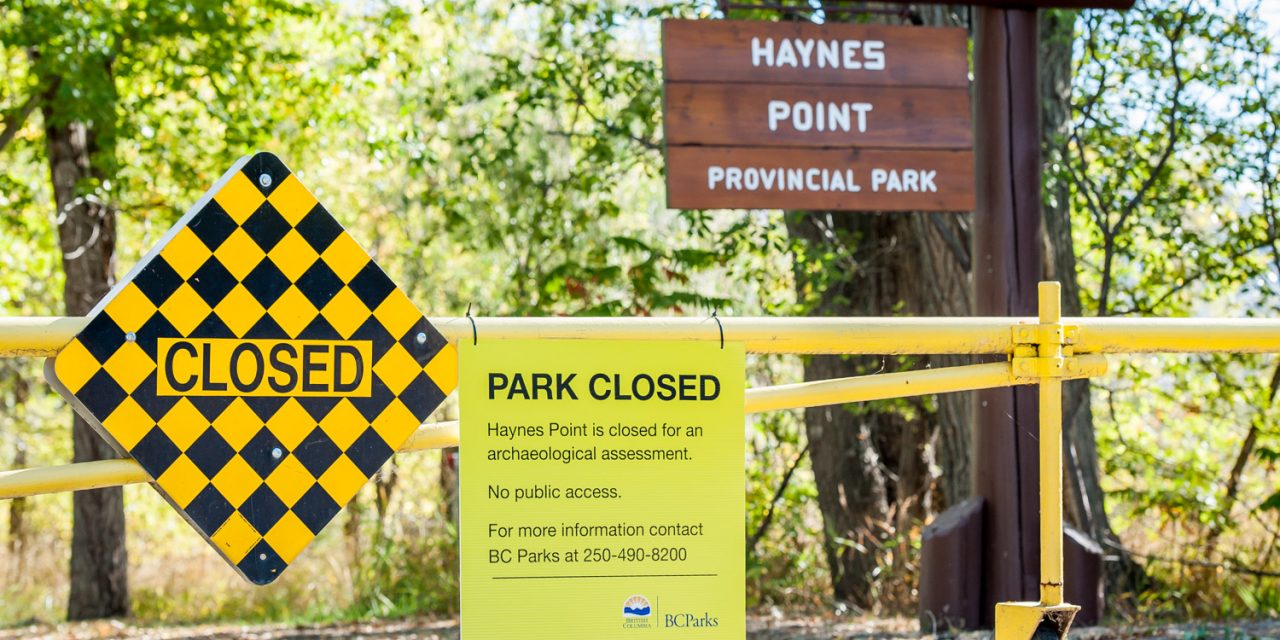
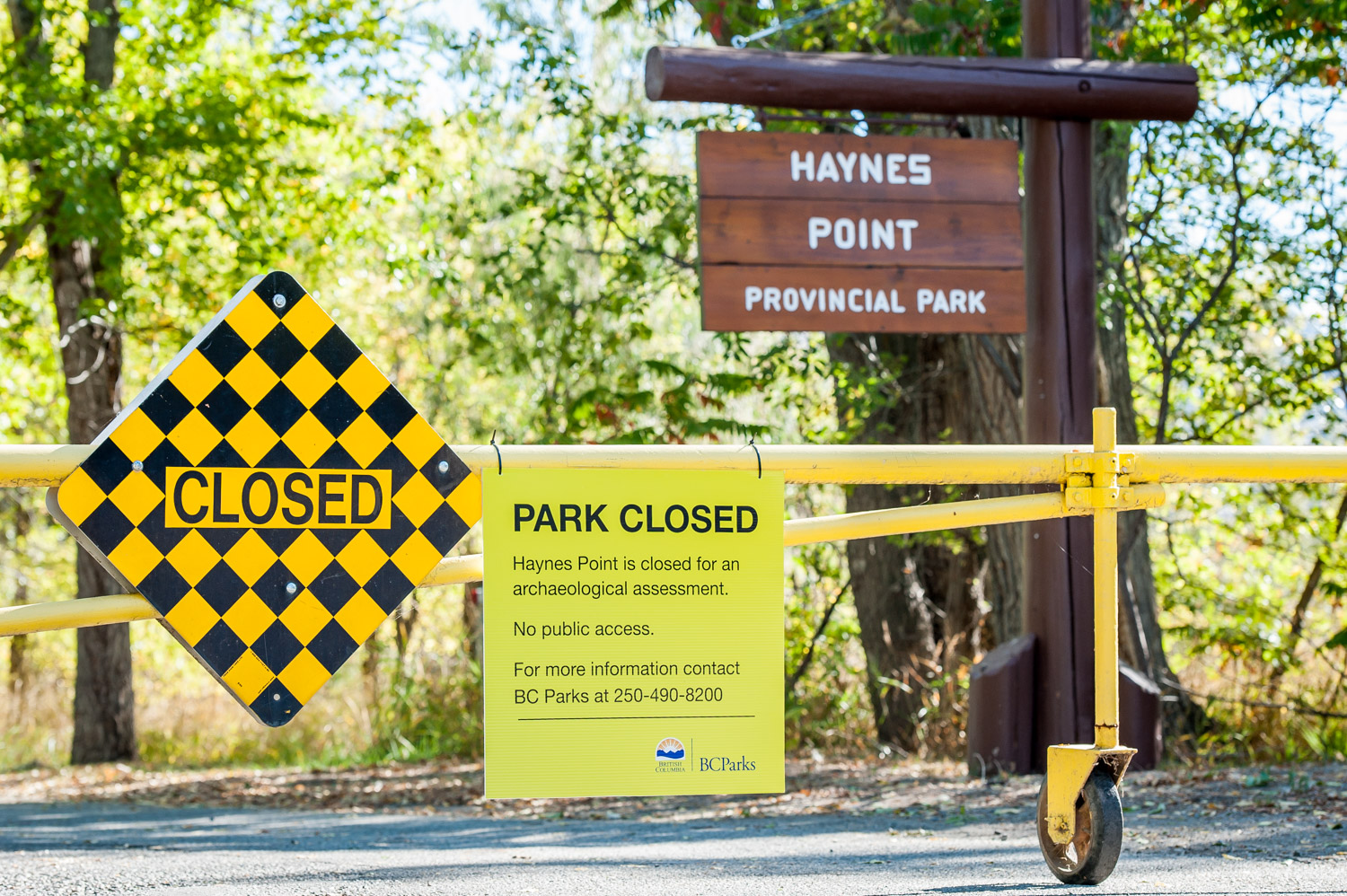
A sign informs walkers that Haynes Point Provincial Park is completely closed to public access. Even the boat launch is out of bounds. A BC Parks employee was turning away those wanting to walk into the park. (Richard McGuire photo)
Dear Editor:
Controversy over the recent closure of Haynes Point Provincial Park need not have happened if restraint and common sense had been used by BC Parks and the Osoyoos Indian Band (OIB).
I acknowledge and accept the OIB’s right to preserve and safeguard their cultural heritage, but alleging the remains are “our own direct ancestor,” then using this allegation to immediately seize the park and control the resulting archaeological investigation had no defensible supporting evidence.
The remains may, or may not, be ancestral to the OIB.
Archaeological research of early Americans, including DNA analysis where possible, has made great strides over the last 25 years.
It has become clear that the Okanagan region was populated from the south, after the glaciers receded some 12,500 years ago, by people who occupied eastern Oregon and Washington as far back as 14,300 years before present (and maybe further, as new discoveries continue).
Some of these people had skeletal and dental features indicating a significant potential kinship with modern southeast Asians and Polynesians, as well as ancient Mesoamericans (i.e. the region extending from central Mexico south through Costa Rica).
The point is that multiple lineages were present in the region, some of whom may have made their way to the Okanagan alongside the OIB ancestors.
These relatively recent concepts have been fought tooth and nail by contemporary native Americans (and Canadians) to the point of suppressing, where possible, all independent archaeological research where there is even the remotest risk that further evidence of multiple waves of human occupation, perhaps not closely related to them, may be established.
This fight has been aided and abetted by our provincial and federal governments.
At risk is the premise that “we were first” and the unsustainable industry of First Nation activists, bureaucrats, and government management it has spawned.
Note that the new information release by the federal government and OIB stipulates that “a culturally appropriate management strategy will be developed and implemented to guide the archaeological team.”
In other words, the research outcome is pre-ordained to confirm that, indeed, the remains found are a direct ancestor of some of the OIB members.
The approach taken thus far by both parties is an insult to past efforts of reconciliation with native Canadians, and, unfortunately, will tend to sustain racism for years to come.
Why could this not have been used as an education opportunity, augmenting the fine work the OIB does through the Nk’Mip Desert Cultural Centre?
It would have been easy to close the campground, have the archaeological research done by independent authorities (whatever its outcome), then as appropriate re-inter the remains with due ceremony and respect and secure the sites with accompanying informative signage or placards.
There was no need to bar recreational walking in the park, mostly by seniors or birdwatchers, as long as it was confined to the pavement/boardwalk outside the campground.
Archaeological investigation beneath the pavement and underlying fill wasn’t going to happen, as any remains there would have been disturbed beyond any meaningful scientific context.
Thank you for allowing me to voice my opinion on this issue.
Ken Murray
Osoyoos, B.C.