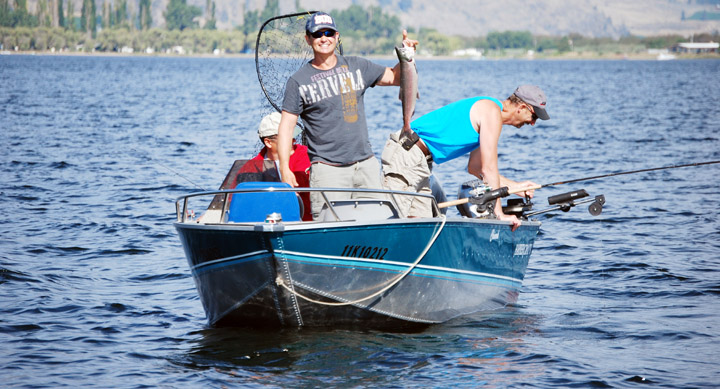
Osoyoos’s Rob Erk hit the waters of Osoyoos Lake on Aug. 19 to try his hand at salmon fishing. Here, he holds up his catch – the first sockeye salmon he’s ever caught. The 10-day recreational salmon fishing opportunity had several Osoyoos anglers out on the water taking advantage of the rare opportunity. Photo by Laurena Weninger - Click on picture for larger image
OSOYOOS TIMES-August 25, 2010
By Laurena Weninger – Osoyoos Times
It took a lot of flash, a pink hoochie and a fair bit of patience to catch a sockeye salmon on Osoyoos Lake between August 13 and 22.
At least, that’s what Osoyoos’s Rob Erk used to catch his five-pound salmon.
“This is awesome,” Erk said, holding his fish up high, with a big smile on his face. “My first one ever.”
He’s not the only one who took advantage of the week-long chance to hook one of the soft-mouthed beauties, according to counts by Dean Allan, a resource manager for the Department of Fisheries and Oceans (DFO).
Allan spent time out on the water last week monitoring the fishing and collecting information that will be the basis for future decisions regarding recreational salmon fishing opportunities on Osoyoos Lake.
He said most of the fishermen were out during the mornings and again in the evenings.
“In the middle of the day nobody’s out fishing,” Allan said.
That’s when the recreational boaters hit the water in full force.
He said on any given day there were about a dozen boats on the lake with anglers aboard, trying to catch salmon.
“It’s about what we expected. Maybe a little less than average,” he said.
Allan said the first few days of the fishery were the quietest, likely because many people hadn’t yet heard about the first-ever chance to fish for the sockeye.
But on the morning of Aug. 18, there were 31 rods out and between Aug. 13, the opening day of the fishery, and Aug. 19, an estimated 65 sockeye salmon had been caught.
“Everyone says they’re great,” Allan said about the taste of the fish, which are just starting to turn pink. “The flesh is still great.”
Fisherman Scott Nichol, who had been out each day between August 13 and 19, agreed. He said the fish were firm, with red meat – and when you cook it the fat just bubbles to the top the way it should.
Les Jantz, DFO’s area chief of resource management for the B.C. Interior, said his understanding is Osoyoos Lake fish are fantastic for eating this year.
He said a few local restaurants even have the salmon on their menu, purchased from the Okanagan Nation Alliance (ONA).
This is the second season members of the ONA have been permitted to catch the salmon for commercial sale as well as for their personal food, social and ceremonial use.
Last year was the first season such activities were permitted.
Despite recent protests by the ONA, in which alliance members are claiming rights to the sockeye and the right to have a say in the opening of the recreational fishery, it’s just not so, said Jantz.
“The minister of fisheries and oceans is the legal authority for management of sockeye fisheries,” he said, adding Aboriginal fishermen certainly have the right to fish.
“They are not the owners of the resource,” he said, adding DFO has been working with the ONA for some time.
“We have been talking to them for roughly two years now about the potential for both economic and recreational fisheries,” he said.
The decision to open up fishing opportunities is based on counts of sockeye as they pass Wells Dam in Washington state, he explained.
The minimum number of salmon DFO wants to see is 40,000, Jantz said, calling it an “escapement target.”
That is their conservation objective.
First Nations are allowed to use some of those fish for food, social and ceremonial purposes.
When the number of fish hits 60,000, the number of fish allowed for harvest by the First Nations population jumps to 10 per cent.
When the number of fish exceeds 80,000, it triggers the consideration of both recreational and economic fisheries.
For the last three years, the number of fish passing Wells Dam exceeded 80,000.
Last year, the ONA was approached by DFO, which was offering the chance for fish harvesting for economic purposes.
A couple hundred fish were harvested by the Aboriginal community, Jantz said, and sold to restaurants.
But while the threshold of 80,000 was also supposed to trigger a recreational opportunity, the ONA was opposed to that idea and DFO agreed not to proceed with a salmon fishery on Osoyoos Lake.
This year, the sockeye count past Wells Dam was 250,000.
The ONA has been given permission to harvest their usual 10 per cent for food, social and ceremonial use, but in addition to that they will be allowed to harvest up to 5,000 sockeye for commercial sale.
And despite ONA protests, DFO went ahead and opened an Osoyoos Lake recreational fishery – something that has not been in existence in the history of DFO’s monitoring of the lake going back to the 1930s.
Jantz isn’t expecting the recreational fishing harvest to make a big impact on fish populations.
“Effort levels have been very low,” he said, pointing out the timeframe has been limited to 10 days and it takes time for word to spread and for anglers to learn efficient salmon fishing techniques.
Penticton’s Bob Otway, from the Sports Fishing Advisory Council, is thrilled DFO has offered the opportunity.
“I think it’s great. Wonderful,” he said, adding the opportunity to offer salmon fishing in the South Okanagan is a big deal.
“There’s a lot of money going into the economy from recreational fisheries,” he said.
Most of the fishermen on the lake were locals as it takes time for word to spread and anglers to get ready to hit the water.
[email protected]