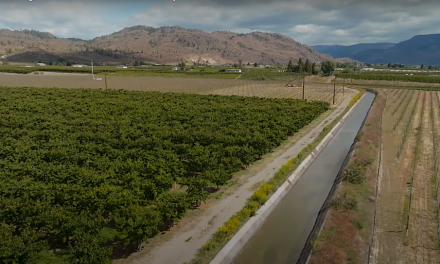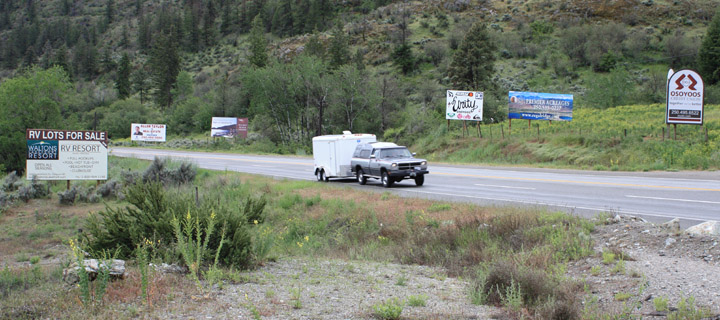
Kilpoola resident Sherry Linn said the installation of a number of signs like these along Hwy. 3 west of Osoyoos are not in compliance with an RDOS zoning bylaw and she is questioning why the RDOS won’t do something about them. Photo by Paul Everest - Click on picture for larger image
OSOYOOS TIMES-June 23, 2010
By Paul Everest – Osoyoos Times
A Kilpoola resident concerned with a proliferation of illegal signs on private properties in rural Area A said the Regional District Okanagan-Similkameen (RDOS) is going in circles in its response to a formal complaint she filed in March.
Sherry Linn mailed a letter to the RDOS on March 2 requesting that a bylaw officer enforce signage regulations for rural properties in Area A.
Linn’s concerns focus on “very large billboard signs for real estate developments, realtors and businesses in the local area” that can be found along Hwy. 3 to the east and west of Osoyoos and Hwy. 97.
Such signs, she said in the complaint, do not meet criteria set out in RDOS zoning bylaws.
The bylaw in question states that signs are only permitted to advertise a businesses operating on the property where the sign is located or goods or livestock being sold from that property.
Signs indicating the address and name of the property’s owner and advertisements that the property, or a building on the property, is for sale or rent are also allowed.
The bylaw states that signs for these purposes are limited to one per parcel and cannot exceed an area of three square metres or a height of three metres.
In her complaint, Linn said “there are multiple signs on a single property and none conform to the size outlined in the bylaw.”
RDOS staff looked into Linn’s complaint and prepared a report that was discussed at the meeting of the RDOS’s Planning and Development Committee on June 17.
Although the report states that, in addition to Linn’s concern, “staff has also observed that there is some unauthorized signage in other areas,” the recommendation to the committee was to “not enforce complaints on sign regulations, unless there is a safety hazard.”
At the June 17 meeting, Linn said people in her community are complaining about the billboards, but are keeping their concerns quiet to avoid “personal repercussions.”
The signs in question are all “third-party” billboards that do not advertise businesses operating on the properties where the signs are located, she said, adding that the signs are eyesores for motorists passing them on the road or people who live within sight of them.
She pointed out that many of the signs on Hwy. 3 are on properties belonging to relatives of Area A director Mark Pendergraft and asked if it was a conflict for him to be involved in the discussion.
Pendergraft said he does not receive any financial benefits from signs located on properties belonging to his mother and uncle but would leave the room if the committee saw his presence as a conflict.
He recommended that the RDOS should create a separate bylaw dealing specifically with signs.
Linn asked the committee why the RDOS enforces some bylaws but turns a blind eye to others and said if there’s no enforcement, people will just start making their own choices about which regional regulations to obey.
Bill Newell, the RDOS’s chief administrative officer, said “everything Linn said is true” but the RDOS does not have the financial resources this year to enforce signage regulations included in the zoning bylaw.
Most RDOS directors at the meeting were sympathetic to Linn’s concerns.
Osoyoos Mayor Stu Wells, who is also an RDOS board member, said “this is a tourist area and it looks like a garbage can.”
He added that the proliferation of signs on the highways throughout the Okanagan Valley suggests they are “breeding on the highway at night.”
The Town of Osoyoos adopted a bylaw last September prohibiting people from putting up signs or advertisements on any street or highway unless they receive permission from the Town.
Director Dan Albas, a Penticton councillor, said, however, that people have the right to use their properties to benefit themselves and companies have the right to make money.
The regional government should not take away these rights and favour the public’s desire for landscapes clear of signs over the ability for people to make money off their land, he said.
Although many directors said sufficient regulations are in place and just need to be enforced, the committee ended up passing a motion to have RDOS staff look at other options for dealing with illegal signage throughout the region and have the matter come back up at the next committee meeting.
But Linn said she wonders if any of the directors actually read the RDOS staff report prepared for the meeting since it laid out three alternate options for the board to consider.
The first is “enforcement on complaint” which would address specific signage concerns.
The second option is “active enforcement of signage” which “may include appointment of a ‘Signage Task Force.”
This option, the report states, would require “additional staff resources or repriorization of current workload.”
The final option is “no enforcement.”
[email protected]