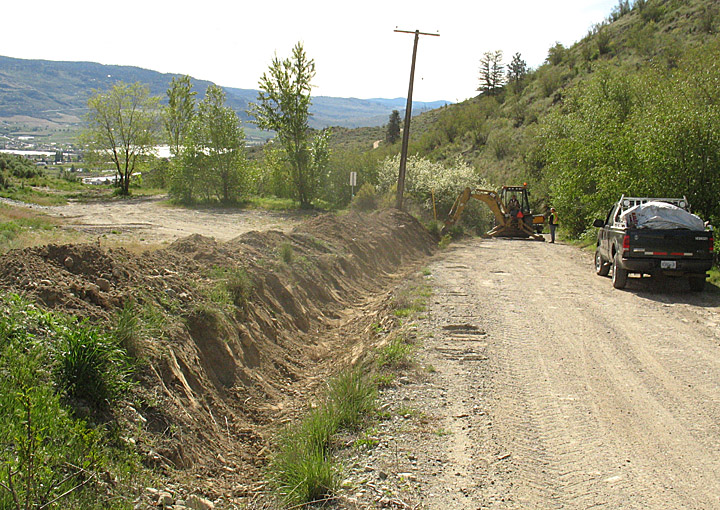
B.C. Forests Ministry personnel reestablished a ditch along Strawberry Creek Road last week to prevent people from driving vehicles onto Crown land in the area. Photos courtesy of the B.C. Forests Ministry - Click on picture for larger image
OSOYOOS TIMES-May 12, 2010
By Paul Everest – Osoyoos Times
With the summer agricultural season about to come into full swing and hundreds of seasonal workers about to descend upon the Osoyoos area, the question about what to do about the Strawberry Creek area becomes that much more urgent.
Along with concerns about trash left behind by people who have adopted the area behind the Buena Vista Industrial Park and adjacent to the Osoyoos Rifle Range, even more attention has been drawn to the site due to last summer’s fire which scorched more than three hectares of Crown land.
Rory Smith, a compliance and enforcement officer with the B.C. Forests Ministry, said the cost of putting out that fire was $50,000.
The cause of the June 30th blaze was an unattended campfire, Smith said.
The individual who lit the fire was sleeping and when the wind came up, the fire spread to the surrounding hillside.
The ministry had to bring in water bombers to combat the forest fire.
Smith said unattended campfires and fires that are not compliant with the B.C. Wildfire Act in the area, which has been dubbed “French Hill” by some, is a major problem.
The Osoyoos Volunteer Fire Department also had to attend a fire at the hill last August when a camper went up in flames.
Smith said someone torched the camper and a second camper was damaged by the fire.
Some measures to start dealing with such problems were taken on May 4 when ministry personnel reestablished a ditch along the Strawberry Creek Road to prevent people from driving vehicles onto the hill.
The ditch was filled in some time ago by someone, allowing people to drive onto the hill, which is Crown land, Smith said.
That area, he said, is actually tenured range land and a local resident pays a fee to the province for use of the land.
Large concrete barricades blocking access from the road to another area popular with summer workers camping in the area which were removed last June to allow firefighting crews access to the wildfire were also replaced last week.
And, Smith said, signs warning people against illegal dumping have been put up at several spots along the road.
On top of all that, the ministry will have “more presence” in the area this year to enforce the Wildfire Act, the B.C. Land Act and the Environmental Management Act.
Under the Wildfire Act, fires must be watched and persons must have firefighting tools handy.
Ultimately, Smith said, the ministry is trying to encourage the responsible use of fire and promote keeping the French Hill area clean.
But he added that a discussion needs to happen between the ministry, local governments, the Osoyoos Wildlife Federation and other stakeholders to find a way to deal with problems arising from people camping in the Strawberry Creek area.
Local leaders and some residents have brought up the idea of setting up a more organized camping area including washroom facilities, access to potable water and garbage collection services.
One site that is being looked at as a model for what could be developed for Osoyoos is the Secrest Road camp north of Oliver next to Covert Farms.
Allan Patton, director for Regional District Okanagan-Similkameen (RDOS) rural Area C (Oliver), said that camp, which is meant to provide accommodation to students, transient workers and those looking for local work, was born out of a partnership between the Town of Oliver and the RDOS in the 1990s.
The Oliver Rotary Club worked out a lease agreement for the property with the province and the RDOS now carries that lease, Patton said, adding that a community-based committee was established to address the needs and concerns of the campsite’s guests and neighbours.
Money to run the campsite comes through Area C’s budget and the Town of Oliver contributes in-kind funding for services such as electricity, he said.
There is also a manager who stays onsite and his salary is paid for through the $4-per-night fee charged to people camping at the site.
Campers have access to showers, Patton said, police routinely patrol the area and garbage is collected.
Fires are allowed in fire pits and there are barbecues.
“It’s worked really well,” he said. “Osoyoos should consider something similar.”
Osoyoos Mayor Stu Wells said the Town of Osoyoos “would be excited” about a meeting of interested stakeholders about dealing with Strawberry Creek.
He said it would be difficult to for the Town to “lead the charge on this” since the area falls within the RDOS and the Town would have to look at the “budgetary implications” of any effort to provide water, sanitary or garbage collection services to French Hill.
Wells added that a community group really needs to come forward to spearhead any efforts to create an organized camping facility for workers in the Strawberry Creek Area.
When asked if Strawberry Creek is really the best place for such a camp, he said there wasn’t really anywhere else in Osoyoos where they could go.
Aubrey White, past president of the Osoyoos Wildlife Federation, which runs the rifle range, said if any sort of organized campsite is developed, it would have to be supervised.
He said a previous attempt to create a “transient centre” in Osoyoos failed because it was not supervised.
Without someone managing the camp, White said, campers will continue to leave garbage and light illegal fires in the area.
Ultimately, he said, someone needs to come forward and take responsibility for the Strawberry Creek area.
White said he’s not sure who that would be, but he and others have said local orchardists who rely on seasonal labour should step up.
Joe Sardinha, president of the BC Fruit Growers’ Association, said he sympathizes with those who have concerns about agricultural workers living in the area.
He said “orchardists would be better served if workers could stay on site.”
By providing a place to stay on their property — even if it is just a place to pitch a tent — along with some basic amenities such as water, clean toilets and a stove, orchardists would have a workforce that could get an early start to the day without the need for a long commute.
Such a situation would be ideal, Sardhina said, when fruits such as cherries need to be picked in cool temperatures at the beginning of the day.
At the same time, he added, the orchardists could set “basic ground rules” such as curfews for the workers.
[email protected]