By Lyonel Doherty
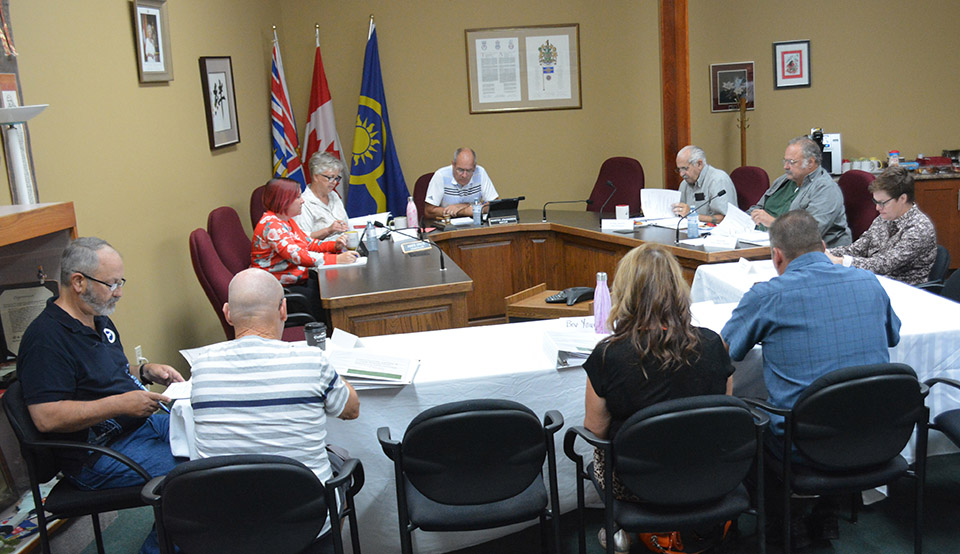
A special committee in Oliver has taken the first step to enhance public safety and crime prevention in the community.
On Wednesday the 19-member committee made public its priorities ranging from additional support for victim services to initiatives designed to curb property crime.
One of the key priorities is to
advocate for additional support to help people dealing with mental health and addiction issues. This will be achieved by lobbying the provincial government and Interior Health.
Another priority is to seek additional help for inmates released from Okanagan Correctional Centre. This includes advocating for enhanced addiction support services upon release.
The committee also wants to take stock of bed services in town by identifying churches and other organizations that provide places for at-risk people to sleep.
Nuisance properties are another problem that the committee plans to address by enhancing local bylaws. One review will look at whether the response to complaints should be reactive or proactive.
Increasing RCMP staffing levels in Oliver and Osoyoos is also on the table.
The committee plans to investigate the cost to fund a full-time officer to work in the RCMP’s Drug Enforcement Unit. A funding formula will be sought to access the unit to run proactive undercover operations.
Osoyoos Mayor Sue McKortoff informed the committee that their town has eight officers (five in town and three in the rural area).
She noted they have been approved for a sixth officer in town, bringing the total to nine officers, which is what they asked for (and agreed to) in the contract to pay 70 per cent of policing costs.
“I think you guys will be next,” she said, referring to Oliver surpassing 5,000 population in the next census.
The fourth priority the committee has established is addressing Oliver’s property crime problem.
One project is the utilization of closed- circuit television cameras in the community, while another is developing a social media campaign to encourage more reporting of unwanted activities. Like in Penticton, “See something, say something.”
Enhancing crime statistics and reporting is also top of mind with the development of a town/rural “heat” map showing hot spots for property crime.
Educating landlords on their responsibility to maintain their properties is another objective.
One project that may not be popular with some people is a request to establish a speed enforcement camera at the intersection of Highway 97 and Fairview Road.
Committee members were interested to hear that Penticton’s Community Active Support Table (CAST) would soon roll out in the South Okanagan (Oliver and Osoyoos). This project (a multi-agency approach) is designed to provide support to people struggling with mental health issues, addiction and homelessness. In Penticton, CAST has dealt with 60 situations in which at-risk individuals and families have been engaged in finding support.
De Jager told the Chronicle that rolling out CAST in Oliver and Osoyoos would feature a regional model based in Penticton.
“We will need to work on a referral process to get interventions from the South Okanagan, but I don’t think that will be insurmountable.”
De Jager added that video conferencing is a possibility as well.
Sergeant Blaine Gervais said the RCMP’s “heat” map depicts the crime hot spots in the town of Oliver.
Area C director Rick Knodel said it would be very helpful to get one for the rural area too.
Committee member Michael Guthrie pointed out that news outlets such as in the Shuswap regularly publish police news and are very specific when referring to addresses and names.
“I think we should have something like that in this town to give us an idea of what’s happening and who’s doing it.”
Guthrie referred to the recent press release from the Town of Oliver regarding four property owners who were fined $1,000 for tampering with their water metres.
He stated the Town “should be naming names,” adding he doesn’t understand the reluctance to do this.
McKortoff said the Osoyoos Times used to publish an RCMP crime report on a regular basis (but not anymore).
“My assumption is that with privacy issues that couldn’t be done; that’s why it was dropped.”
But Gervais said it was likely stopped because it took too much time to compile, noting neither he nor his officers don’t have the time to write up reports for the media. Police do it for the higher profile cases but not the smaller ones, such as bicycle thefts, Gervais said.
He stated the RCMP are trying to get more personnel trained to accommodate the media, but admitted he wouldn’t want that person working in his office because half the shift would be tied up with writing news releases.
As far as releasing people’s names, Gervais said they can only do that when the information has been sworn in court.
During question period, the committee was asked what can done about certain individuals in town with mental health problems. It was noted that one individual in particular continues to harass pedestrians and motorists on the street, which has caused angst and frustration.
Gervais said he is aware of one male and one female in particular who is not committing an offence by her actions, which are psychologically driven, therefore, she won’t be arrested.
But people who actively cause a disturbance can be charged, he noted. However, whether they show up for court or abide by any conditions is another matter, Gervais pointed out.
“I don’t have an answer for someone like that because they need an advocate from the mental health people.”
Most of the time police end up taking them to their families, which ties up members’ time, the officer said.
Gervais said he has met one particular male several times. “You don’t get anywhere with him. He’s just who he is and he’s going to be a jerk.”
Johansen admitted it’s not an easy situation to deal with, but he’s very curious what impact CAST will have in this case.
“I do believe there are people that can be helped and there are people that can’t be helped.”
Committee member Aimee Grice said she knows the individual in question and admitted she crosses the street whenever she sees him.
But she’s hopeful that CAST will address social problems like this in town.