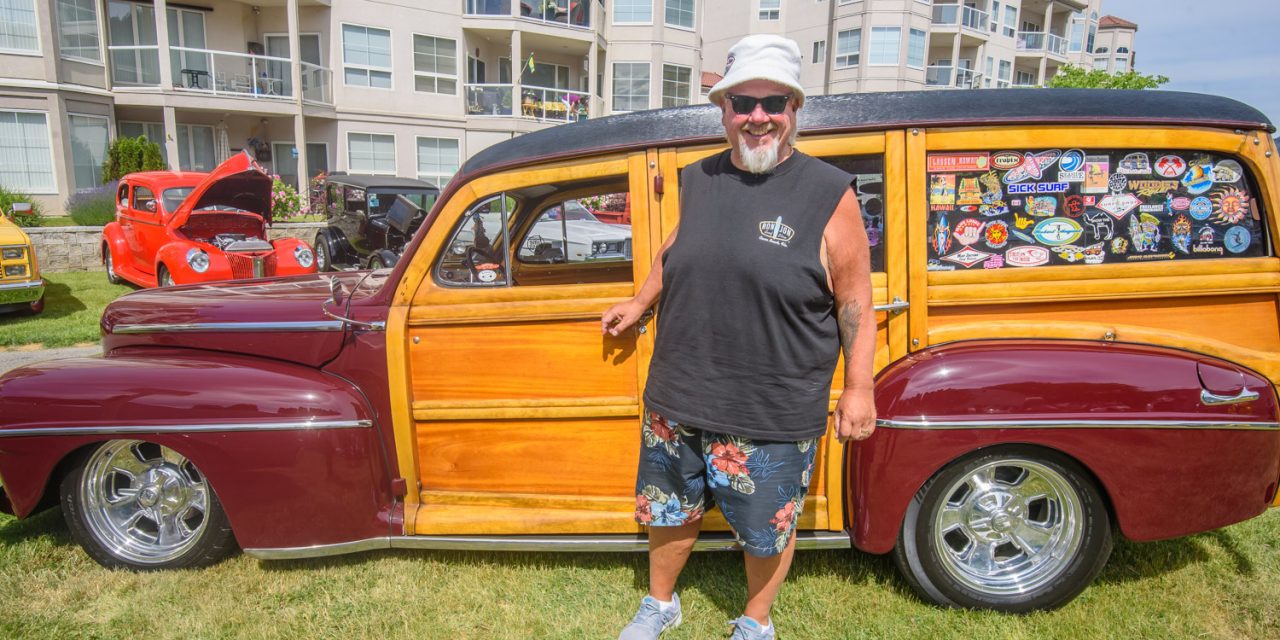

Tom Erickson shows off his 1947 Ford Woody station wagon. The back windows are decorated with numerous decals showing his travel with it. There were several Woody (or Woodie) car models produced in the 1930s and 1940s by different companies. The rubberized canvas roof was its weakness in this climate, and no doubt termites attacked some of these vehicles.(Richard McGuire photo)
Thousands of visitors to Saturday’s Cactus Jalopies show and shine were out admiring a dazzling array of classic cars and souped up hot rods spread throughout Gyro Park.
For some, the attraction is stylistic modifications that turn classic oldies into new creations. For others, it’s all about the powerful engines that car enthusiasts have added.
But for many visitors, it’s all about nostalgia. To see a car that brings back memories of childhood rides with grandparents or their first wheels as a teenager.
Some cars are modified beyond recognition. Others are meticulously restored to accurately show their classic beauty.
A 1947 Ford Woody station wagon reminded this reporter of one of his earliest memories of a nursery school field trip to the zoo.
And the owner, Tom Erickson, who splits his time between Osoyoos and Langley, was happy to show it off.
There’s a reason why you don’t see many old Woodys in these parts, said Erickson, pointing to the roof as seen from inside. It’s just wooden slats with rubberized canvas stretched across.
“In winter cold and snow, they didn’t survive well,” said Erickson.
Viewed from the front, the vehicle’s metal hood and fenders look like other cars from the 1940s. But from the sides and back, the body contains a lot of wood paneling.
“There are parts for my car in all these trees,” said Erickson. “I get parts everywhere.”
He’s owned the vehicle since 1990 and has done many show and shines, including five trips to California car shows.
He’s redone the wood about three times, added a V-8 engine and modern suspension.
“Everybody loves the Woody,” said Erickson. “In the ’60s, you paid 75 bucks for them because they were old cars. Now they’re kind of trendy. Everything that’s old is trendy, except me.”
Farther down the beach, Peter Pfannenschmidt, who came to Osoyoos two years ago from Kelowna, is showing a 1939 Willys that’s been given a powerful, sparkling engine. It originally came with a meagre four-cylinder one.
Many people think of a jeep when they hear the name Willys, but Pfannenschmidt notes that the jeeps only came during the Second World War.
“They built cars way before they built jeeps,” said Pfannenschmidt.
He rebuilt the vehicle himself, putting in a new chassis underneath, doing all the bodywork, adding a dash from a 1959 Chevy and more – pretty much everything except the paint.
“I bought the car about 30 years ago in Salmon Arm,” said Pfannenschmidt. “It was lying in a farmer’s field and it was in about four pieces. There was actually a cow eating the grass coming through the floorboards.”
Despite this, most of the car’s body except the floor was quite good, with little rust.
Pfannenschmidt has no idea how many hours he’s spent working on his hot rod, but he guesses it’s well into the thousands.
Cactus Jalopies is popular, he said, because of the local wineries the car enthusiasts tour, the weather, the lake and the scenery. But for many, the love of classic cars reaches back into childhood.
“We grew up with them as kids,” said Pfannenschmidt. “Our main thing was to have a hot rod or a classic car on the road. Now that we’ve come to the age where we can actually afford them, the families are gone, it’s going back to our roots, I guess.”
Harold Cox, from Osoyoos, has brought out his 1928 Ford Model A, which he’s showing in front of the Watermark Beach Resort.
“It was originally called a ladies’ car,” he said. “It has the looks of a convertible, but it’s not. It’s a hardtop really. It was one of the first cars that ladies could actually drive.”
The Model A was introduced at the end of 1927 for the 1928 model year, and Cox has one with a badge showing it has four-wheel brakes. This badge is only on the cars produced in the first six months.
The car was a big improvement over the earlier Ford Model T.
Henry Ford had resisted some of the innovations that other carmakers introduced, and once it is claimed he said: “Any customer can have a car painted any colour that he wants so long as it is black.”
But the Model A finally adopted some of the innovations competitors were already using – a clutch, stick shift, transmission and four-wheel brakes.
Cox upgraded his old Model T to a Model A because he wanted a car that could go more than 70 km/h instead of just 40 km/h.
“A friend of mind had the makings of it,” said Cox. “You should see the pictures of it. It was just a rust bucket. My friend used to say everything is junk until somebody wants it or can use it. That’s what this was.”
They worked on it for four years, drinking lots of coffee and talking a lot.
Cox doesn’t take the Model A out much, and when he does, it’s for a special occasion or to give his grandchildren a ride. Those trips get lots of attention.
“I like when people ask questions about it,” he said. “It creates an interest in what happened in those days … You look at these other cars and boy, they’ve done some great work on them as well.”
RICHARD McGUIRE
Osoyoos Times

Peter Pfannenschmidt shows his 1939 Willys, that he’s rebuilt into a hot rod. The original came with a four-cylinder engine and when he got it, there was a cow eating grass that was growing up through the floor. (Richard McGuire photo)

Harold Cox shows his 1928 Ford Model A, which looks like a convertible, but it’s actually a hardtop. This was a major advance from Ford’s earlier Model T, Note the rumble seat where the trunk would be at the right. (Richard McGuire photo)