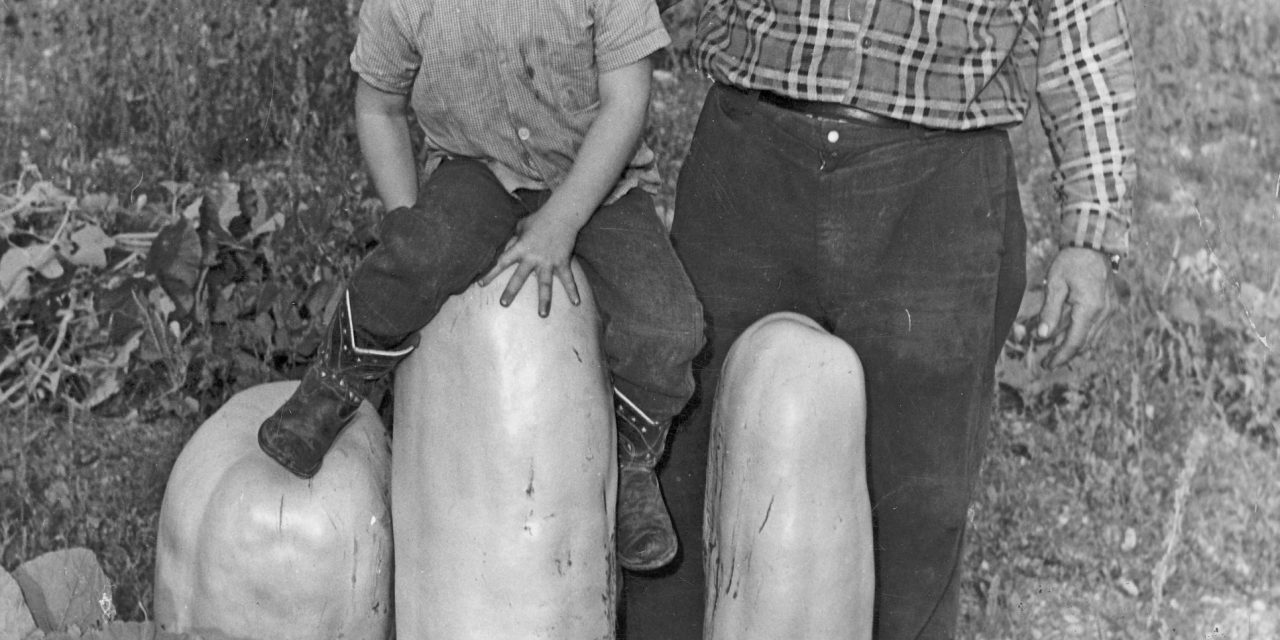

Jon Hack Sr. is pictured in his zucca melon field in Osoyoos with his grandson Ron in this undated photo. The melons were stood on end after they were cut to make them easier to locate for collection. (Osoyoos and District Museum and Archives)
For just over a decade, partly coinciding with the Second World War, a major Osoyoos-area crop was the zucca melon.
These giant melons, sometimes exceeding 100 pounds, stood like white tombstones in local fields when they were cut and stood on their ends.
The melons – actually a bottle gourd – were native to Africa, but seeds made their way to Italy, California and eventually to Osoyoos in 1938.
Herman Gummel obtained five seeds and grew them successfully. Also that year, Walter Graf was successful in growing them on a plot at the Summerland Experimental Station.
“As a result of these tests, zucca melons became one of the major ground crops of the district during the next few years,” wrote George J. Fraser in The Story of Osoyoos.
The melon was considered tasteless on its own, but the texture of the flesh allowed it to absorb colour and flavouring.
“For that reason, together with the speed in which the large fruit can be converted to a marketable candied fruit product, it became very popular,” wrote Fraser.
They were often diced, dyed and flavoured and used in fruitcakes and jams.
The zuccas thrived during the war years, when ocean shipping was restricted. Prior to the war, Mediterranean countries supplied most candied fruit. The lack of this foreign competition during the war allowed a domestic market in candied fruit made from zuccas to flourish.
After the war, the demand for the melons decreased and growers’ expenses rose. The acreage devoted to these melons decreased until the middle of the 1950s, when they ceased to be grown around Osoyoos.
At their peak of production in 1947, more than 1,400 tons were grown.
The cut melons were stood on end so they could be easily seen by workers carrying them from the fields to the road.
In the period when they were popular, hundreds of Osoyoos residents and visitors posed for photographs among the giant zuccas.
There have been more recent attempts by Osoyoos residents to grow them again, more for curiosity than commercial purposes.
In 2009, former Osoyoos Times publisher Stan Stodola was one of several local residents planting seeds from the Osoyoos and District Museum and Archives. His attempt was not a resounding success.
Do you remember the age of zucca melons?
To share your memories of them or any other Osoyoos history from this column, please comment on OsoyoosTimes.com or contact Editor Richard McGuire by email at [email protected] or by phone at 250-495-7225.
RICHARD McGUIRE
Osoyoos Times