By Lexi McFarlane, Times Chronicle
A proposed exemption application for Osoyoos properties currently included in the Agricultural Land Reserve (ALR) will go through staff and committee an additional time, following a lengthy conversation at a Regular Council Meeting.
Presenting at the April 28 meeting was Town Planner Shannon Duong, giving an overview of the proposal in addition to some updated specifics.
Duong explained that, while there is a total of 326.7 hectares of land in Osoyoos included in the ALR, only 138.24 hectares actually has agricultural designation under the Town’s Official Community Plan (OCP). That presents challenges for the ALR land that, despite bylaws and zoning permissions, restricts development and causes delays and additional costs with longer processes required.
ALR exclusion can only be applied for by the Provincial government, local, and First Nations entities. Additionally, public hearings must be held for each application with the final decision resting with the Agricultural Land Commission (ALC).
The current application includes a total of 67 parcels, which was previously stated as 69 parcels but involved two different cases of multiple parts of the same parcel being given their own designation.
Initially, the application was discussed at the December 9, 2025 Committee of the Whole (CoW) meeting, and additional properties were included as of the March 24 CoW meeting. All included properties except one are either designated non-agricultural under the ICP, or not currently seeing agricultural use. Current zoning designations would not change as a result of the application.
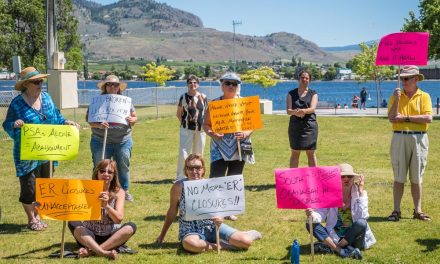
The discussions at the meeting included the requisite public hearing session, where two different affected landowner groups indicated opposition to the exemption application for different reasons.
One of the speakers, Anita Hendricks, representing a group of five Lakeshore Drive property owners affected by the proposal, brought up financial concerns that they, as part of eight properties in particular, as a result of being excluded from the ALR.
“We do receive, which we weren’t aware of until (recently), the exemption from the School Tax,” Hendricks said. “The implications of that, because of our very large increase in (tax) assessments in the last few years, means that our taxes would go up by what I calculate to be about $1,000.
“It’s a financial burden to us, and I don’t see any benefit to us,” Hendricks said.
The Oasis RV Resort, in addition to having a representative speak at the hearing, sent a letter to Council, also declaring opposition to the application.
Outlining “significant concern” with the proposal, the Resort representative stated that the owners, having discussed the application at an Extraordinary General Meeting, could not support the application without more clearly-defined aims and assurances from Council.
“Without an accepted, demonstrable, material, and clearly articulated benefit to the Association or its members, the Oasis RV Resort Owners Association cannot support any proposal that requires surrendering, weakening, or altering existing statutes, terms, or conditions governing our property,” the letter states.
The letter explained that the ALR currently affords the Oasis with “essential” land protections, ensuring the land around the resort stays as is. Transferring the land to the Town of Osoyoos, the letter says, would allow for future redevelopment that would not align with the character of the land as it currently stands.
Other concerns voiced by the Association in the letter include a “lack of binding protections and assurances” on the part of the Town of Osoyoos, and the fact that the proposal as a whole “introduces risk without clear benefit” to the resort.
The letter concludes that, while remaining opposed to the application without better protections in place, “the Association remains committed to constructive dialogue with the Town” and will remain involved in ALR discussions.
Councillor Jim King, after hearing the two opposed parties’ messages, sought to have those properties excluded from the ALR exclusion application.
“I heard two people speaking against this, so I would like to take them out of the proposal,” King said simply.
Councillor Johnny Cheong pointed out that including the area around the Oasis resort might not need to be included in the ALR exemption application.
“My understanding of the ALR use regulation is that there is a stipulation for agri-tourism,” Cheong said. “Are campgrounds an accepted use (for that designation) under the ALR’s lens?”
In response Duong said: “Campgrounds are not an outright permitted use within the ALR, and typically require ALC approval,” while noting that other accommodations might qualify for agri-tourism designation.
Councillor Myers Bennett voiced concern over the potential tax increases for the Lakeshore Drive property owners, and wanted a better documentation of how tax increases would impact those properties.
“If the taxes are going to go up that much higher, with the $1,000 as quoted, I’d like to find out more information on who’s going to get taxed a lot more and who isn’t,” Bennett said. “It sounds like there could be some discrimination between some property owners, and not some property owners, which doesn’t seem fair.”
King stated that, if simply excluding the affected properties would prove too problematic, he would back holding another public hearing on the matter.
“We should have (another) open public meeting, with a little bit more information on certain properties,” King said.
Agreeing on a motion proved challenging for Council, however, particularly as King’s motion changed from simply sending everything back to staff, to excluding the specific properties.
“I don’t want to waste (staff’s) time, so I could move this forward, but I’d like to take a few of them out,” King said.
The alternate motion by King was not seconded by anybody, nor was a motion by Cheong to move forward with the ALR exemption application as proposed. Cheong moved that option with the reasoning that the ALC holds the final say regardless.
“If we do move forward with these exclusions, the application is submitted to the ALC, by which they have the final say as to either ‘these properties are indeed appropriate to the ALC regulations’, or they’re not,” Cheong explained.
“In the case of the properties where they no longer suit the agricultural designation, then the exclusion would be successful for those properties.”
Councillor Zach Poturica moved to refer the entire discussion back to the CoW, to get additional staff information. Seconded by King, this motion passed unanimously.