By Don Urquhart, Times Chronicle
Monday was Groundhog Day across Canada with the furry prognosticators of seasonal change delivering their unanimous verdict: an early spring is on the way.
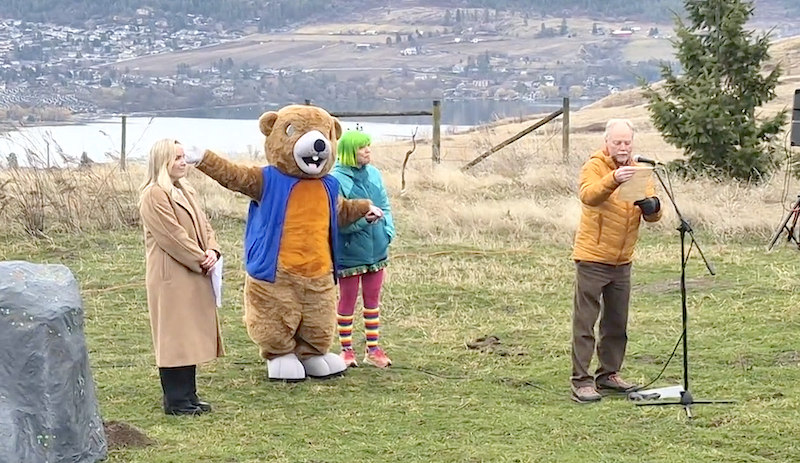
In Vernon, Okanagan Okie, the human in a Yellow-Bellied Marmot costume, courtesy of the Allan Brooks Nature Centre, delivered the good news of no shadow in sight and hence an early spring for the Okanagan. In previous years, Okie has predicted early springs in 2022-2024 with last year being the exception, where Okie predicted a longer winter.
The tradition has ties to medieval Europe, when farmers believed that if hedgehogs emerged from their burrows to catch insects, it was a sure sign of early spring. The common conception of that tradition is that if a groundhog sees its shadow, there will be six more weeks of winter, otherwise it will be an early spring.
One of Canada’s most famous groundhogs, Nova Scotia’s Shubenacadie Sam, wasn’t able to deliver her prediction personally, due to yet another winter storm edging in on the province with up to 25 centimetres of snow expected in some areas.
The provincial government cancelled the event based on the fact that blowing snow could create unsafe driving conditions. Sam’s home is in Shubenacadie Wildlife Park, about 50 kilometres north of Halifax. But because of the bad weather, the provincial government said it would not be possible for Sam to see her shadow, and hence an early spring is on the way.
The famous groundhog in Quebec’s Gaspésie region, Fred la marmotte, reportedly did not see his shadow Monday morning, calling for an early spring.
Ontario’s famous Wiarton Willy also turned in an early spring prognostication from his plexiglass enclosure onstage in the Bruce County community of Wiarton.
The most famous American groundhog, Punxsutawney Phil, in rural Pennsylvania, saw its shadow which predicted six more weeks of winter.
Given the problems south of the border, two things are possible with Phil’s prediction: it’s completely not true, or it’s an apt observation of the current socio-political environment in which the country is facing a longer, colder winter of discontent. We leave that for you to decide.
And not to spoil the fun, but a 2021 scientific paper published in the American Meteorological Society Journals analyzed a sample of predictions to see just how accurate they were. Of 530 unique groundhog-year predictions across 33 different locations, spring onset was correctly predicted by groundhogs exactly 50 per cent of the time.
This led the researchers to the conclusion that: “Using a novel phenological indicator of spring, this study determined, without a shadow of a doubt, that groundhog prognosticating abilities for the arrival of spring are no better than chance.”