By Don Urquhart, Times Chronicle
Osoyoos is looking at an increased staggering of water demand through the adoption of “watering zones” in a bid to help reduce water consumption during peak periods as the town seeks to mitigate risks associated with the critically low water supply.
In a presentation to council on Apr. 8, Rod Risling, Town of Osoyoos CAO applauded residents for cutting back on water consumption but warned the town is flirting with danger because of the demand being placed on the town’s aquifers, reservoirs and pumps.
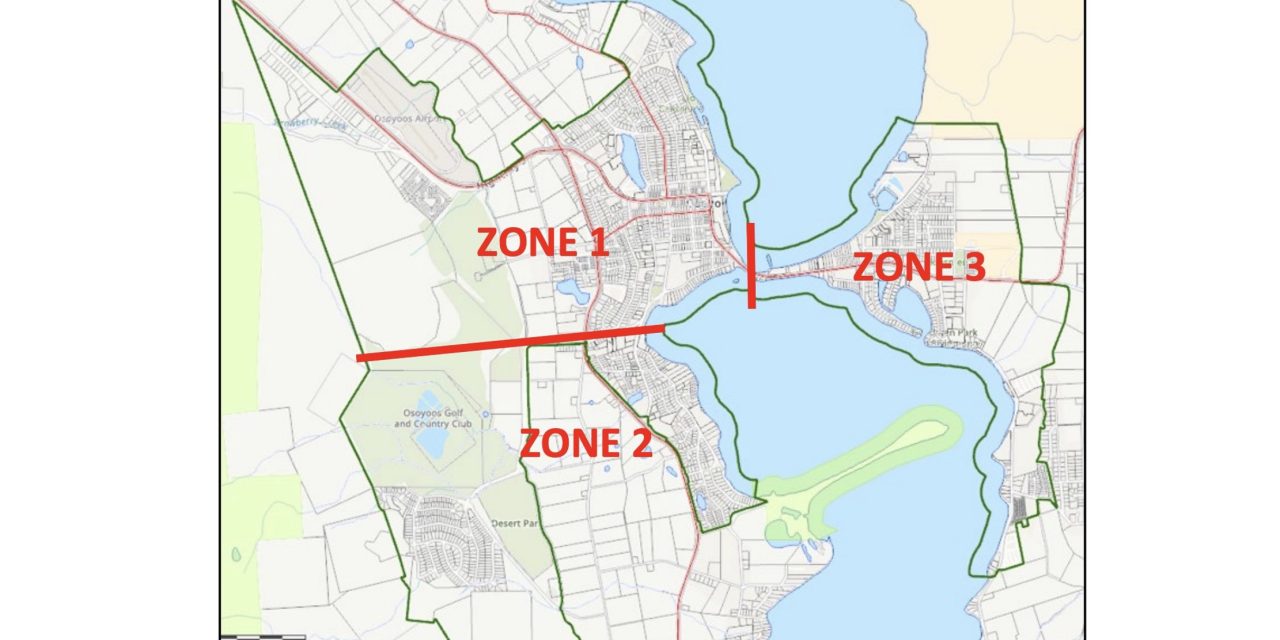
To effectively spread out the demand, the town is considering dividing Osoyoos up into three zones that would each have their own watering days separate from the others.
Currently, Risling notes that, in essence, half the community is irrigating their lawns at the same time, and by shifting to three zones, it would reduce that to a third of the community at any given time.
“In our current system, we have four days where 50 per cent of the homes are watering, and a zoned system like this would actually be 30 per cent of the homes using water over six days,” he said.
So what this would do, he says, is reduce the very high peak periods, which is the highest risk for running the reservoirs low and or equipment failure.
“I know change is tough,” Risling added. “People have irrigation systems and programming those things sometimes isn’t the easiest to do, but we do know . . . that reservoir levels are very close to that critical level, so we’re throwing out a potential option that would reduce that risk, at least in theory, and if people follow the water restrictions we should have more water in our reservoirs during these periods.
Noting that more and more people are shifting to Xeriscaping and “we do know a lot more people are complying with water restrictions, so kudos to the community, but here are still some issues.”
This includes watering on non-watering days and when water restrictions are in place. “And I can understand,” he sympathized, “you drive up the valley, and you see a lot of water. You look at the orchards, and the water is running.”
But he suspects some people don’t understand that the water used in the orchards and vineyards is not the same water that comes from the tap, which is part of the potable, or domestic water system. This domestic water system is supplied by six wells that produce water which is pumped into the reservoirs.
“When we have our watering days or irrigation days, we basically have half the community taking water to irrigate their lawns,” he says. But during peak periods, that demand causes a significant drawdown on the reservoirs, causing the water levels to plummet to dangerous levels.
“The reservoirs are dipping down to basically 40 per cent, and with all of our wells running, we still cannot keep up with demand out there,” he says, reiterating that this is during peak demand, typically at night when lawn watering is taking place.
“We have six wells running full bore, and we can’t keep up,” he said, adding that one well should always be sitting idle, even on the highest demand days, just in case of mechanical failure. “Hopefully, if something goes wrong, we’re down to five,” he said, adding that four is the bare minimum to keep the system running.
“We’ve been lucky. For years, we’ve been lucky that nothing has happened during those periods. Our staff do a great job of maintaining that equipment, but unfortunately, sometimes things do happen,” he cautioned.
“So I just really want to emphasize that we’re already on a lifeline that we shouldn’t be using, and so it really is critical from a well perspective.”
Risling then ran through some of the things that can happened if reservoir levels become too low. Should levels hit 35 per cent, then there is not adequate water to run the pumps and given that most nights when there is lawn irrigation the levels already drop to 40 per cent meaning “we’re critically close to that”.
Low reservoir levels can also lead to sediment from the lines or in the reservoirs coming out of residents’ taps, which then potentially leads to boil-water notices from Interior Health.
Risling noted that currently, the town is fortunate in being able to isolate some of the groundwater incidents, but if the entire system is contaminated, it would take a “tremendous” amount of time to clear the system.
“So again, I think a lot of messaging has gone out, and again, a lot of people have changed their habits with regards to using water.”
The recent program to install water meters will help conservation efforts with industry data showing conservation gains of anywhere from 10-30 per cent can result. Once the town starts monitoring the data, it will be helpful in guiding strategies going forward, he said.
“Right now, we’re making a lot of decisions and providing a lot of information with really little facts other than our water reservoir levels,” Risling said. But because the situation – based on the reservoir levels alone – is so dire, they are tossing ideas out and seeking feedback.
This includes not just the watering zones but also ideas on how to limit “continuous water duration.” By this, he means people who irrigate far too much, “maybe 15 minutes per sprinkler head type of thing but they are keeping it going a lot longer.” This is where water metering will help pinpoint.
Another issue is the exemptions that have been given to some properties, something Risling said Council might want to reconsider given the critical situation with the town’s wells.
“We have some options out there, we’re looking for feedback. We’re all in this as a community together, and one of the ways to get this to work is community involvement and advice to try to reduce our water consumption.”
Bob Appleby, Osoyoos Water Councillor asked whether the map as it’s currently drawn up is reflective of three equal portions in terms of water consumption. Risling acknowledged that it’s more “guessing” at this point because they don’t have the data from the water meters yet.
“We only have a couple of pieces of information. We know that our wells are running full blast and that our reservoirs are depleted, so the line was trying to hit the main roads to try to make it clear and easier to communicate.
“But is it exactly even? Absolutely not, and we couldn’t even actually calculate it now because we don’t have that information available. So that is our problem, we don’t have good information to provide you to make good decisions.”
He added that once all the water meters are in place and the data flowing, the town will have much better information to help mitigate risk – it’s just a matter of getting through this year.
Risling also noted that as he indicated at the beginning of his presentation, “we’ve been in a red zone for years. So, one more year is that okay? It could be. We could have a well failure, we could have all these things, but I just wanted to bring it to the community.”
Council voted in favour of moving forward on the idea of having three watering zones and will revisit the issue at an upcoming council meeting.