By Sebastian Kanally, Times Chronicle
Oliver has adopted an in-depth wildfire resiliency plan, which will serve to steer the town’s priorities for the next five to seven years.
The large 97 page report lays a five-year road map for the town, ultimately identifying seven categories of recommendations for developing wildfire resiliency.
These categories are education, legislation and planning, development considerations, interagency cooperation, cross-training, emergency planning, and vegetation management.
The Community Wildfire Resiliency Plan (CWRP) was created and presented to council by Kai Kaplan, Oliver’s FireSmart coordinator and Quentin Schmidt, a registered professional forester with B.A. Blackwell & Associates Ltd. who were retained to assist in the development of the plan.
Kaplan explained that this plan for the next five to seven years would be implemented based on considerations around actions that can have an immediate impact and larger goals will be pursued based on grant funding.
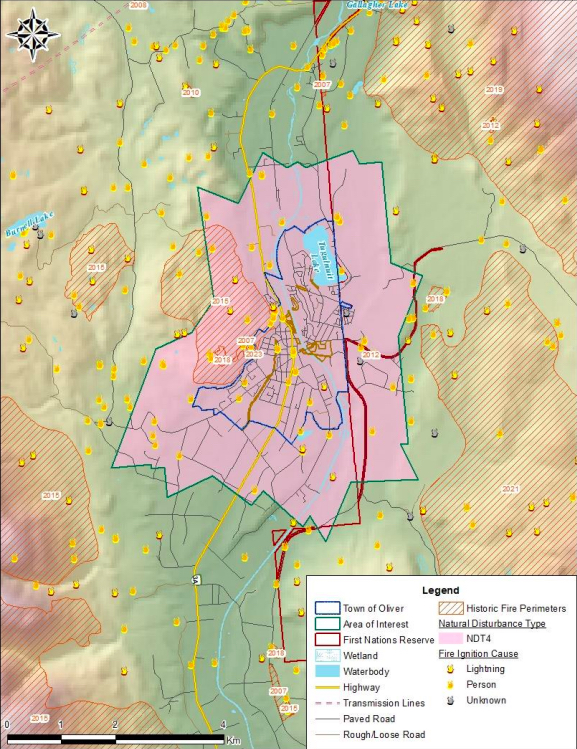
Historical fire ignitions from 1950-2022 within and adjacent to the Town of Oliver.
Town of Oliver photo
The document provides many recommendations for the town for both the short and long term. They are organized into seven areas.
First is pursuing education for Oliver residents and visitors “empowering them to adopt and conduct FireSmart practices to mitigate the negative impacts of wildfire to their homes, businesses, and communities.”
Second is the area of legislation and planning which looks at ways for the Town of Oliver to “implement wildfire risk reduction through laws and legislation by outlining government responsibilities regarding wildfire.”
Third is development considerations which point towards embedding FireSmart practices and considerations into all development within the Town of Oliver.
Fourth is interagency cooperation, which as mentioned by Schmidt is crucial because fires do not respect jurisdictions. This area of recommendations seeks “to broaden from a single-jurisdiction approach to a risk driven, multi-agency, multi-scalable approach to a wildfire emergency.”
The fifth area addresses cross training and fire department resources. This area of recommendations seeks to expand the preparedness and qualifications of Oliver Fire-Rescue and municipal emergency staff and includes the subcategories of training, water, equipment
Sixth is Emergency Planning to provide for a quick and effective wildfire response through pre-incident planning and community preparedness from Oliver Fire-Rescue and emergency management personnel.
Last is vegetation management. Resiliency can be built through the “manipulation of both the natural and cultivated vegetation that is within the community.” This would reduce wildfire intensity and ember exposure to people, structures and infrastructure.
Councillor Petra Veintimilla commented on the vegetation management recommendation noting that it’s something that seems “pretty doable and I would like to see us work on in the near future.”
“Which trees cannot be used in new subdivisions . . . it would be nice to give a guideline to the community in general, but we have the ability to restrict what people use at least in new developments so that going forward we are not planting these little matches all over town.”
The vegetation management recommendation was referred to as a “lower hanging fruit”. Some other recommendations will require longer planning and grant funding to achieve.
Mayor Martin Johansen asked about the recommendation of prescribed burns and how they would be managed in the area if they were implemented. “I thought that was an interesting initiative, definitely something that can pay off big time if done in the right area at the right time.”
Schmidt responded that “the vast majority of the area that we have identified preliminarily for prescribed burning is on crown land . . . the short answer would be the Ministry of Forests in collaboration with Osoyoos Indian band (OIB) and town staff”.
For more information on FireSmart in the town of Oliver visit the town’s firesmart website page.