By Don Urquhart, Times Chronicle
The pristine sparkling waters and sandy beaches of Osoyoos Lake belie what rests on the lake bed below, with everything from golf balls, bottle caps and discarded beverage containers to sunglasses, jewellery and tech gadgets lying silently below.
For Camille Charron there is no greater joy than descending beneath the surface of the water, something he’s been doing for over 30 years, first scuba diving with tanks, snorkelling and now scuba diving with a battery-operated ventilator.
A big part of that aquatic joy now comes from “treasure hunting” the waters around popular tourist beaches and boating areas of Osoyoos Lake which in its best case scenario means reuniting lost items with their owners.
“I’m just looking for whatever I can find, and if it helps people having done that, great,” Charron says.
He’s constantly asked by curious passersby what he’s doing, but “overall, people have been pretty good,” and once they find out what he’s doing they typically get enthusiastic and supportive, he says. Charron’s cheerful and friendly nature certainly don’t hurt in this regard.
It’s also about doing his part in cleaning up the lake, which was in fact how it started, cleaning up the area of the lake where they live.
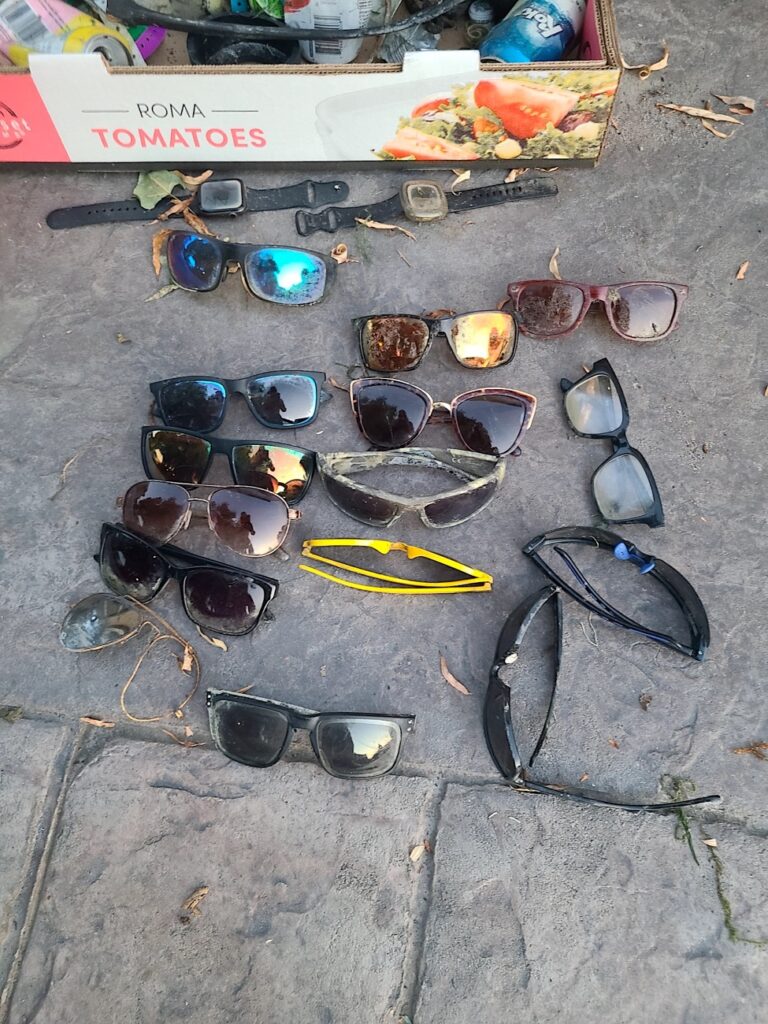
Sunglasses are a commonly found item that has gone overboad.
Osoyoos has long been the family summer vacation spot for three generations of his family now. They still live most of the year in South Surrey, coming up to their vacation home here for increasingly longer periods, stretching earlier and later on the shoulders of summer, he chuckles.
“This is my first summer, really being here a lot after coming here for 30 some odd years.”
On the sunny morning that the Times Chronicle was speaking with Osoyoos’s friendly neighbourhood scuba diver, as he’s known online, the calm morning lake water gently lapped the shoreline of a local resort as Charron prepared his diving equipment for another foray into the lake.
This time it was a simpler dive as it was within the roped off swimming area of a local resort where he was going to attempt to find a woman’s necklace. He had been contacted on social media after his recent posts of various items he’s found have made him a local celebrity of sorts.
Despite the fact the necklace was lost only 10 ft or so from the shoreline he wasn’t optimistic about finding it, however, as it had been lost in July.
What’s down there?
In the twenty minutes or so before the Times Chronicle arrived to meet Charron he had already fished out half a dozen things including a flat piece of tin with jagged edges, a bottle cap, some wire possibly from sunglasses a coin and the metal bit that holds the eraser on the top of a pencil, amongst other things.
“This is what I’ve just pulled out from within 10 feet of the shore, iIt would be nasty to step on,” he says holding up a round piece of tin with jagged edges that’s tarnished soot-black from being underwater for an extended time.
“Some of this just sits slightly under the sand, but as soon as the storm comes along, it’ll bring it back up, he says adding that aluminum cans also deteriorate and become jagged.
“People constantly lose things,” he observes – sunglasses, wedding rings, necklaces and bracelets not forgetting the pervasive tech gear like smart phones, watches and tablets. Bits and pieces related to pleasure boating as well. “There’s tons of stuff down there,” he says, some of it simply too deep to recover.
“What’s super irritating is when you find the tabs from pop and beer cans after just 10 minutes in the water.” And the bottle caps too, as they can hurt stepping on them. “Whatever I find that’s sharp I’ll pick it up,” he adds.
He’s also found dozen’s of Apple watches and other tech gadgets, sometimes even in working order. “I found another one yesterday. I might have five working ones, but I can’t return them because Apple won’t let me. They give me part of the email but not the whole email and I’m like, ‘well can you at least notify the person?’” something that appears to have fallen on deaf ears at the tech giant.
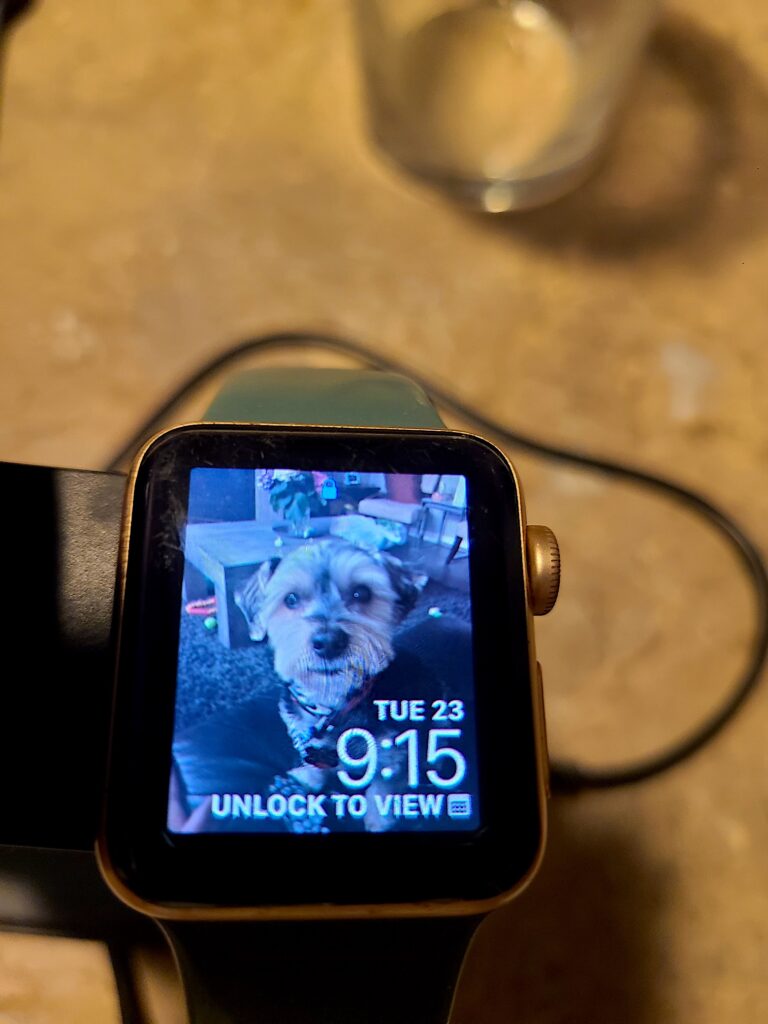
Is this your dog? Perhaps Camille Charron has found your watch.
Some people put their emergency contact on the screen and that has enabled him to return a couple of them to some very ecstatic individuals who thought they would never see their watch again. “They’re always trying to offer me money or whatever. It’s a no,” he says adding, “I’m just trying to pay it back.”
Indeed this is big part of the joy of what he does, being able to return things to the rightful owner when he can.
Sunglasses are very common thing to lose in the lake he says and they’re also very challenging to find. “I’ve realized that the lake eats them up pretty quick, in the sense that they’ll scratch in the sand and the rocks and the calcification of the hard water.” It’s also nearly impossible to return sunglasses to their owner.
He’s also found a walkie talkie, and golf balls . . . lots of golf balls. “I don’t understand golf balls,” he says, speculating that people are perhaps practicing their driving by whacking balls into the lake. Or maybe they’re just whacking balls into the lake for the sake of doing it.
While his focus is essentially what he calls “treasure”, he also cleans the lake as well. “I do pick up junk if I see it, my conscience tells me I can’t let it sit there, but there’s a certain point where there’s just too much.”
Where he finds things varies significantly around the lake. Interestingly enough while it’s tempting to think that Gyro Beach would be a hotspot of both treasure and rubbish, it’s remarkably clean he says. This could be a result of the lake currents that sweep along that beach before heading under the bridge to the south basin of the lake.
One of the areas most riddled with junk is off Lakeshore Drive opposite the campgrounds where many of the boats are moored, he notes. “It’s not their fault,” he says of the campgrounds, “there are boats there and something might have broken but the only reason I found it is because I have a metal detector.”
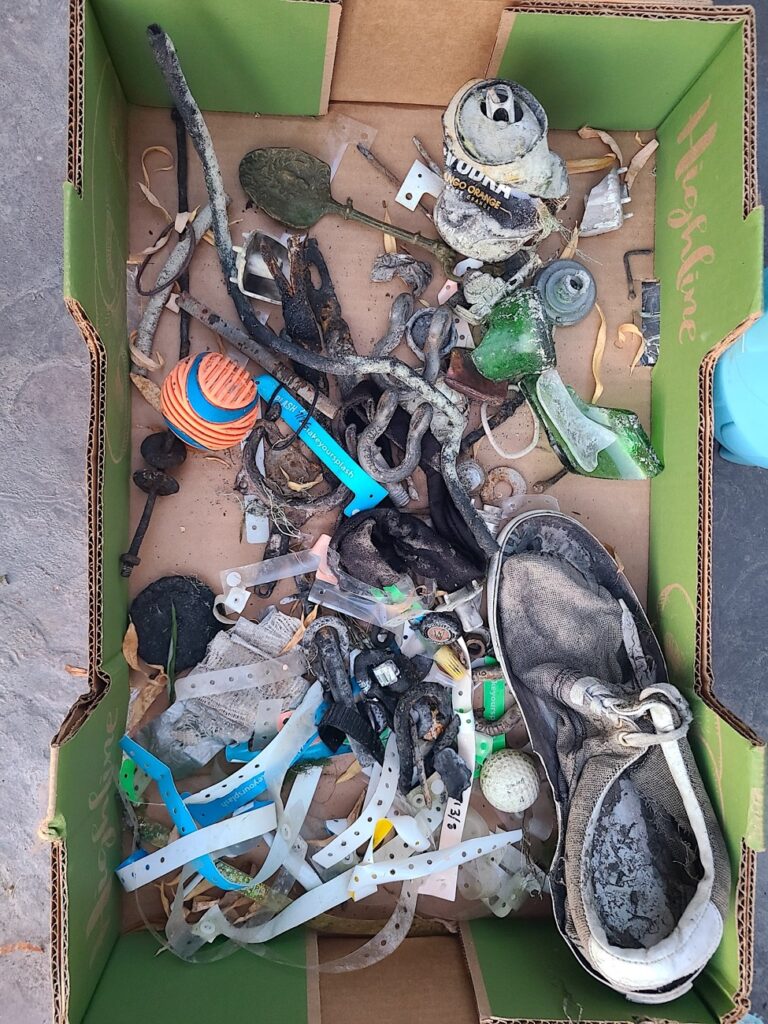
Just a small sample of the rubbish that ends up in the lake.
Lake alive
And perhaps one encouraging thing he sees consistently is fish. “I’ve seen a ton of fish, all the fish you can possibly imagine,” Charron says. But no salmon, likely because they swim deeper in search of cold water.
“The bass are the most interesting because they come right up to me, like a little Nemo. They just swim there for a while and look at me like, ‘how’s it going?’” he laughs, adding “next time don’t scare me by coming around behind me!”
And he says it was “really cool seeing a school catfish babies. It was a black blob that just kind of moves around,” although at first the black blob was a bit unnerving until he realized what it was.
There’s also a huge amount of crayfish, and lots of clams, he says. No invasive quaga or zebra mussels, so far he adds.
Diving equipment
Among the vital parts of Charron’s equipment is a battery operated pump which supplies air through a 15 ft. tube to a mouthpiece allowing him to remain submerged for about two and half hours.
This means he gets almost double the underwater time with the battery pump apparatus than when he used to scuba dive with a tank. And while he uses a 15 ft assembly he notes there are deeper ones like 20 or 25 ft, but they are harder to breathe through.
A wetsuit, weight belt, inflatable lifejacket, swim fins and goggles round out a typical scuba setup.
Two other less common bits of his kit include two metal detectors, a larger one and a smaller one for close up work which he says “with it I can pinpoint exactly where things are.”
The beeps from the devices are audible through the water but he even has a set of headphones designed for underwater which enable him to hear the fainter blips. Because of the silt on the lake bottom, he mostly goes by metal detector and by feel, but some areas are clear enough to simply see the objects, like retro beverage bottles for instance.
He uses a rope that he lays out because it can be quite murky at times but he tries to follow a grid search pattern.
He uses a sling net bag to store the objects he finds and he’s also built himself a floating container that he will surface to put broken glass and jagged metal into. Constructed out of a plastic bin and pool noodles – “thank god for pool noodles,” he laughs – it makes an easier and safer receptacle to store the refuse he’s found on the bottom.
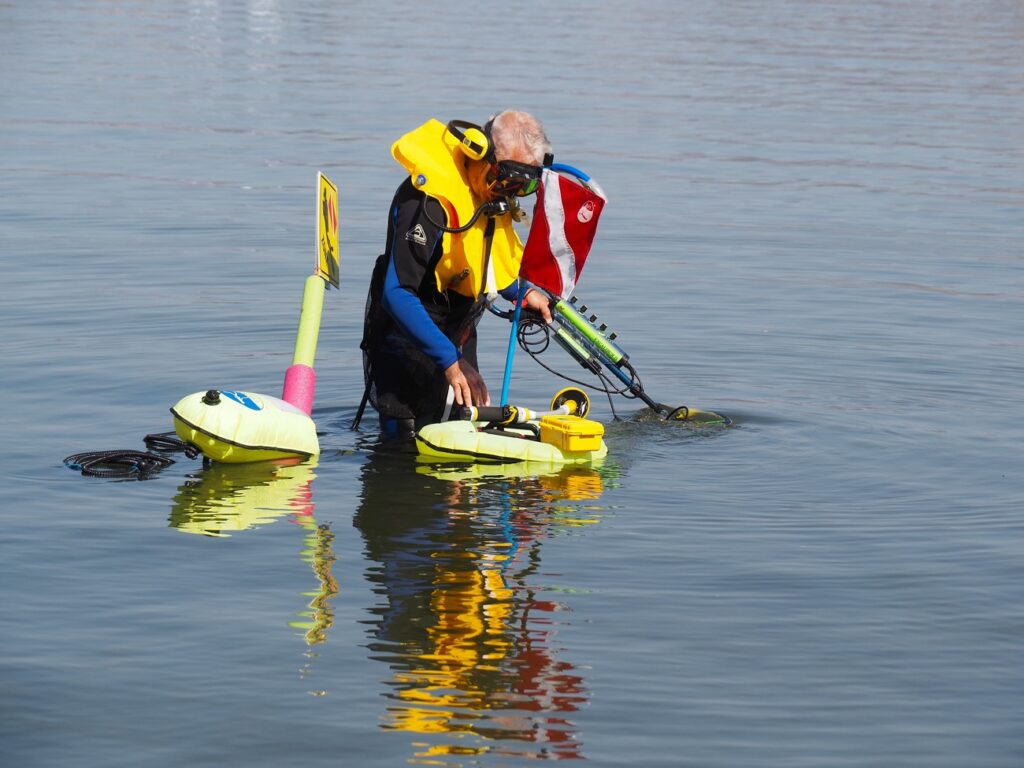
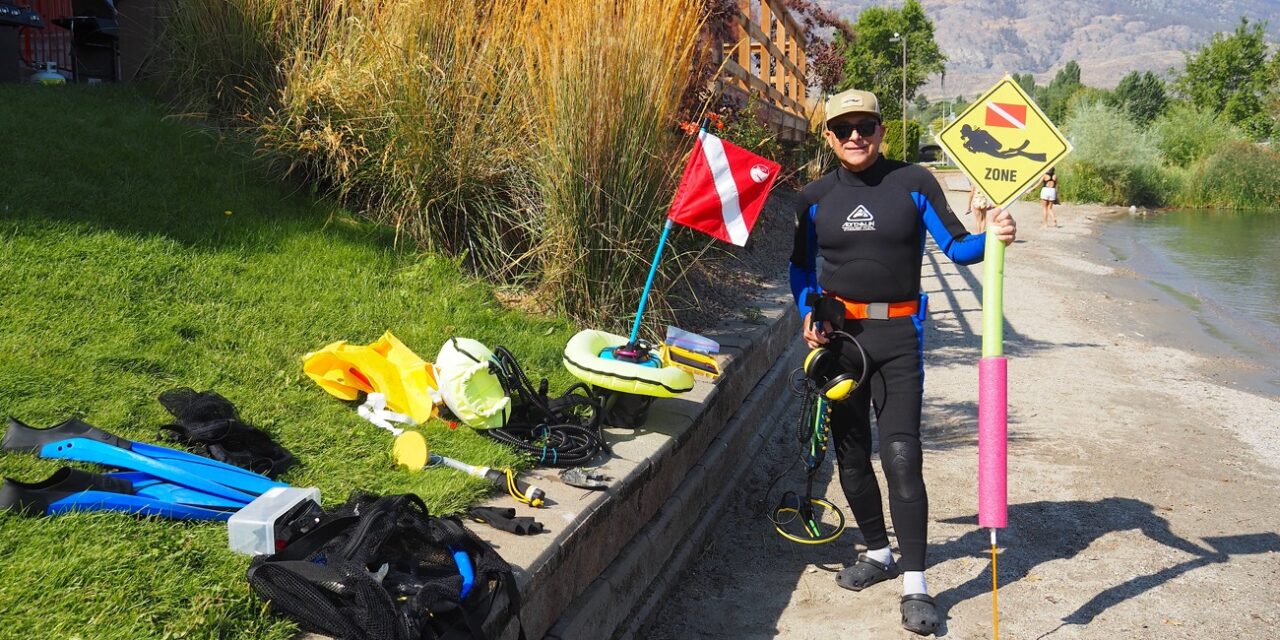
Camille Charron with his gear as he enters the lake for another search.
The challenge to finding things is the silt. “If you drop something, literally, sometimes you just can’t find it right away because it kind of sinks in, it doesn’t sit on top. So once it sinks in, that’s kind of where it’s gonna stay,” he says. That’s where the metal detectors come in.
He uses his bare hands to search through the silt of which he says “it used to gross me out to stick my hands in there,” but now he’s used to it. He’s going to get himself a pair of protective gloves for diving under the bridge because there is a lot of broken glass there, he said and he has in fact gotten a few little cuts.
An aquatic love affair
He got into this unique recreation through the natural connection to scuba diving, an activity he no longer does. “I would never go diving now because I’m too rusty,” he laughs. With the love of underwater still percolating in his mind, snorkelling helped fill the underwater void but he says he found himself having the urge to go “just a little deeper”.
“There’s times I just want to get a little deeper, because when you’re scuba diving most of what you see is within 30 feet of the surface,” he notes adding that snorkelling gives mostly just a surface view.
“And then I just started seeing some YouTube videos” about this battery powered ventilator. This was the perfect solution for him because it gives him a 15 foot envelope – more than snorkelling yet not quite full-fledged scuba diving and with far simpler equipment and no need for certification.
“But I do recommend if you are going to get one of these, go for certification because you need to learn certain things. I’ve got experience, and not the world’s best at it, but at least I know what to do,” he adds.
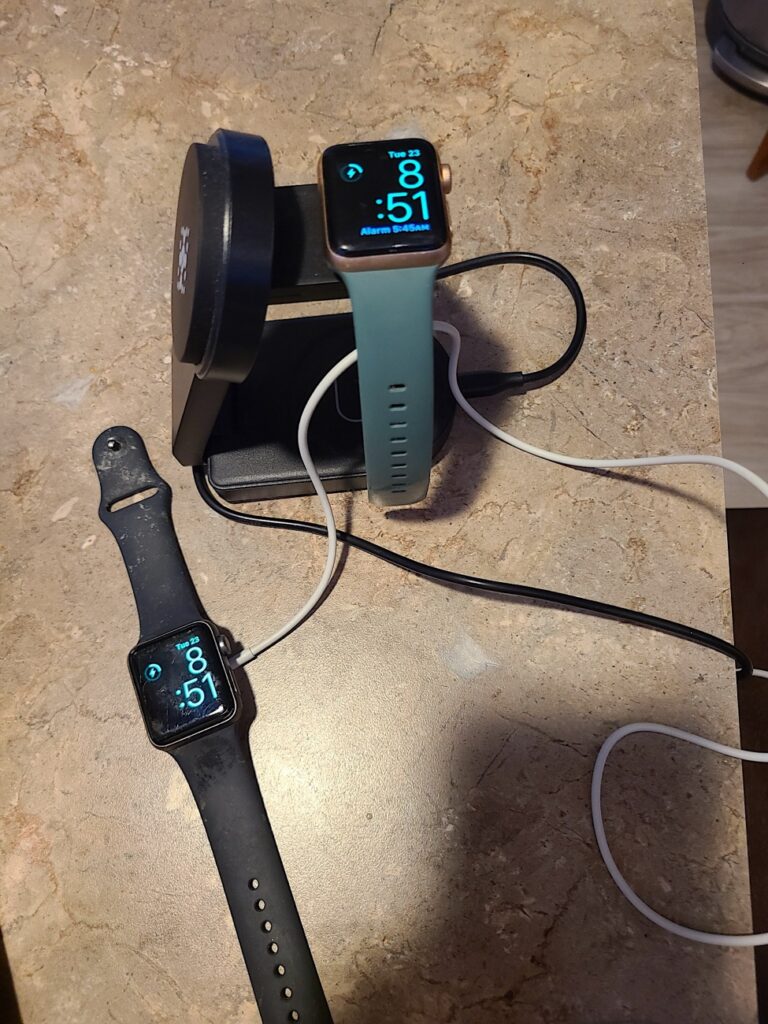
Half a dozen or so of the Apple watches found by Camille Charron are still working.
Typically he’s out every day for at least two or three hours – essentially the length of time the batteries last. He prefers the mornings before the boats get out and the water is calm. “If I get really lucky, I’ll go another two hours in the afternoon, I’m not much of a sitting on the beach type,” he chuckles.
While he says his wife has been “really good” about his new pastime, she’s been somewhat less enthusiastic with the cost of some of his gear, he says with a tinge of chagrin.
All together he’s spent about $5,000 on the equipment. “But you know, when I was younger I couldn’t afford this stuff, right? I worked really hard, we’ve lived within our means most of our lives, so okay, I’ve earned this,” he says.
And certainly compared to many hobbies or recreational pastimes this one is not exorbitant by any stretch. He hastens to add that it’s certainly cheaper than the salt water aquarium phase that he went through which filled the garage with tanks of coral and fish. “That was my mid-life crisis phase,” he laughs.
Safety first
He says he’s had his fair share of close calls with boaters. Mostly he doesn’t see it because he’s underwater, but he’s had people tell him once he’s surfaced. “I was told that there was a boat that came right by me really fast. He obviously must have seen something floating in the water but just blasted by.”
Another time it was an obviously intoxicated man on a jet ski. “He was pulling a tube and went right over my head and I confronted him very, very nicely but he was just too intoxicated to listen,” he says.
This leads to the natural question of what his wife thinks about all this. “She’s not thrilled about certain things,” he laughs. But he adds she is his safety person when he dives under the Osoyoos Trestle Bridge. “There’s only three people on this planet I trust emphatically for something like that and that would be my two kids, and my wife.”
When he asked if she would mind coming to spot for him she didn’t hesitate and in fact told him, “Your things are underwater, mine are up top!”
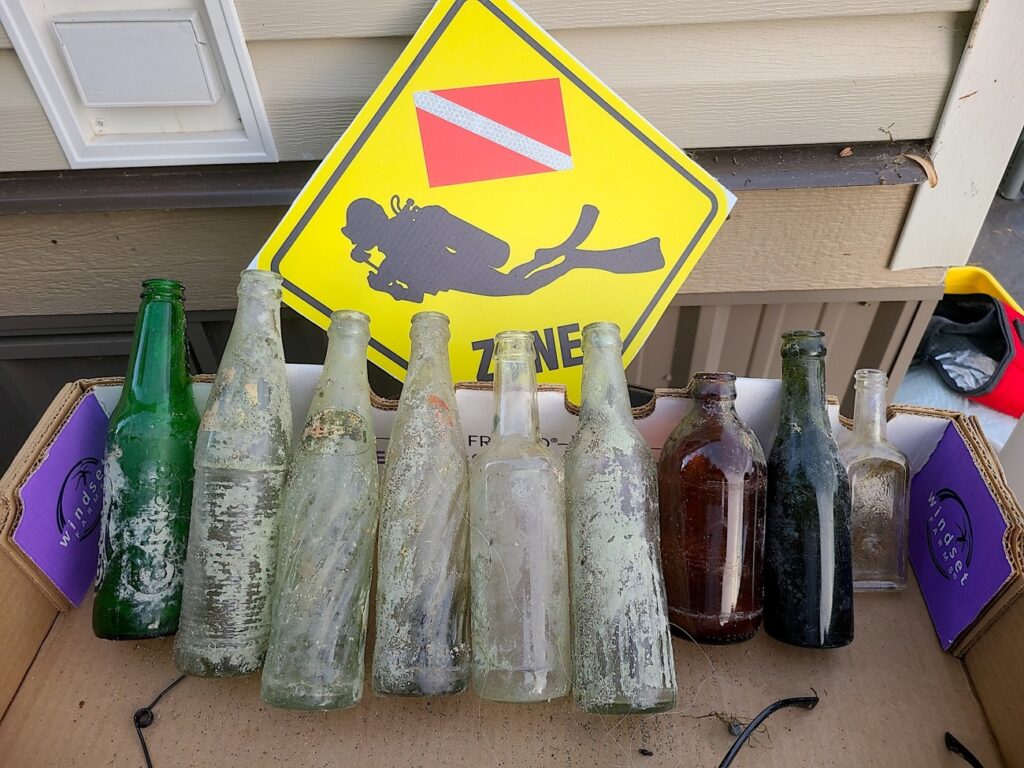
A recent haul of bottles, some a number of years old.
Safety is obviously top of mind, even though at 15 ft. maximum depth it’s a far cry from scuba diving with a tank, which he did for many years around the world’s great dive spots including the South Pacific, Southeast Asia and Australia where he originally got his diving certification back in the 1980s.
Amongst his safety gear is a quick release weight belt and a pull cord inflatable life jacket if he needs to surface in a hurry.
He alerts boaters to his location with a float with the internationally standard dive flag consisting of a red square with a white diagonal line through it. He’s also added a second reflective dive sign on top of a couple of pool noodles that floats and bobs to hopefully get boaters’ attention.
It’s shocking to hear him observe just how many boaters don’t seem to understand the meaning of the dive symbol, despite the fact it’s part of the licensing course all boat operators must take.
What’s next?
While most of his diving and treasure hunting has been in Osoyoos Lake he did recently make a trip up to Penticton to check out the channel. “I did the river twice but it gets picked through pretty steadily,” he says noting there are a lot more aquatic treasure hunters in Penticton.
And contrary to what many suggest is a high level of pollution in the channel, Charron says the water quality appears quite good, partly because it’s fast flowing from one lake to the other, he suggests.
He says he always showers after any diving in the lake, pretty much for no other reason than to get the “lake stink off,” which is no comment on the quality of water, just the natural smell of fresh water lakes in the area.
Next in his sights are the waters off of White Sands beach and around the corner the popular boating and swimming area known as Brown Sands beach. He’s got a pontoon boat that will enable him to cross the lake for that.
Respect the lake
He implores people to not throw things into the lake, especially glass bottles that eventually get broken by getting jostled around on the lake bed, cans that deteriorate and get jagged, bottle caps and can tabs.
“Some child could stand on a jagged can and get a bad cut and that would just ruin the summer vacation,” he observes.
And stop hitting golf balls into the lake.
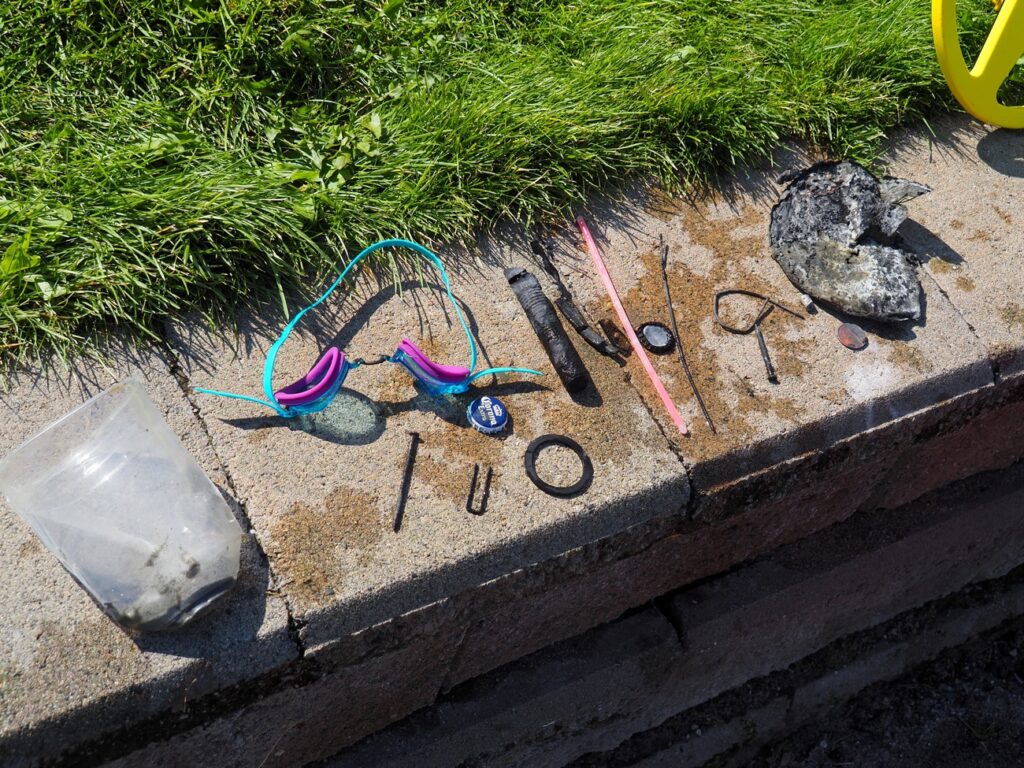
The final haul after an hour looking for the missing necklace. At least one happy young girl went home with her goggles.
And finally the important question of the day – just how safe is the water under the bridge given that it remains a popular, albeit prohibited, spot for diving off of.
While not promoting it Charron notes the activity is “a rite of passage, it’s a tradition,” he says adding that his kids have done it, his nieces have done it and so on.
He reckons the water depth is fine for most jumping but does note that as the water level in the lake drops it does become shallower under the bridge. The biggest safety concern is really watching out for the boat traffic, he adds.
And as for that necklace that he set out to find, no luck. He did find a pair of children’s swim goggles and laughs that his grand-nieces are spoiled for choice when it comes to goggles this summer.
But as fate would have it, just as he was leaving a mother and child approached him to ask if by any chance he found a pair of goggles the girl had been lost the day before. Much to their delight he pulled out the little girl’s goggles. “That’s what makes this all worthwhile,” he said.