By Madeline Baker, Times Chronicle
Waterways in the South Okanagan are running too fast, too shallow, and too straight to sustain a diverse array of fish species, according to studies by the Okanagan Nation Alliance.
Their Environmental Flow Needs (EFN) Project, which they began in partnership with the Okanagan Basin Water Board (OBWB) in 2016, sought to understand the exact conditions under which different species survive, thrive, or suffer.
Civic projects like channelization have long been designed under the assumption that leaving enough water behind will protect the fish, said ONA’s Kari Alex at the recent OBWB meeting, which she compares to building a house entirely made of foyers and assuming that the design will be optimal for humans.
“It’s hard to wrap our heads around how complex they really are and what they need,” says Alex of creek ecosystems, where every single part of a creek or river plays a vital part in a fish’s life cycle. “Just having water isn’t enough. It isn’t what they need to survive.”
Enter the EFN Project, which determined the volume and timing of streamflow necessary to sustain a healthy ecosystem – the bare minimum for survival. On the other side of stream measurement, they also discovered the Critical Environmental Flow Threshold at which fish populations will suffer irreversible damage.
Alex described this research process as an effort to “build as robust a system as possible with as robust information as possible,” then use that system to “produce defensible, transparent, and robust EFN recs for Okanagan streams. There were all these small details to study so that we wouldn’t miss the complexity of what these fish need.”
The project tracked 18 different streams within the watershed using both their EFN methods and pre-existing hydrometric stations, and their findings on stream volume were not encouraging: most streams struggled to meet even the Critical Environmental Flow Threshold at any time besides spring freshet when they were generally able to meet EFN.
“If the flows drop beneath critical level, that means there are no fish spawning,” Alex explained. “In all the creeks that we looked at within this study, all but one were fully allocated. We were almost always trying to get as much flow as possible for these fish, and they always dipped below critical.”
“The key message here is that we’re managing these creeks, and there are only these small bands of opportunity between ‘these fish are doing okay’ and ‘this is irreparable harm.’ Anything, where we can create more efficiency so that more water can stay in these streams, would be of high value to these fish.”
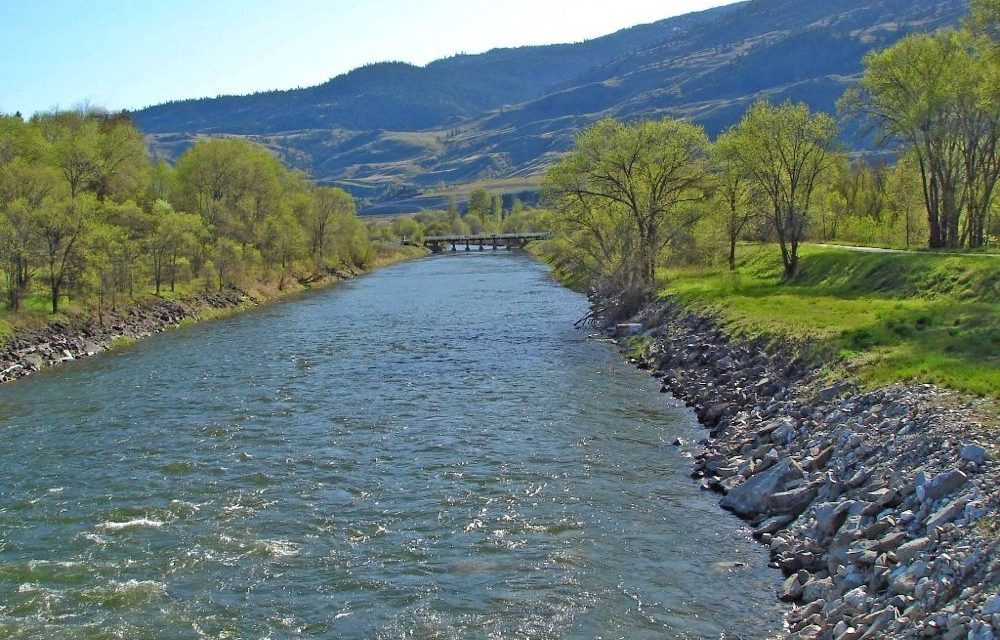
Just like the ONA’s Floodplain Re-Engagement Project covered in part 2 of this story, the EFN project found that channelizing portions of the Okanagan River’s offshoot streams in cement flumes had an entirely negative impact on water levels, flow speed, and fish stock health.
Without riffles (very shallow areas where the bed breaches the flow’s surface) and pools (the deepest, slowest areas) to vary the flow of a river or stream, it was found to flow so quickly that it would carve a narrow, deep, straight channel called a glide, which is a regression to a much earlier stage of river development.
Narrow, fast-flowing streams cut off the spaces in which many species of fish would naturally spawn, feed, overwinter, and other life processes without which they cannot sustain healthy stock numbers. The flumes themselves are totally inflexible and eliminate the whole floodplain, which makes their conditions even worse.
“We’re taking a lot of water [from streams] and can’t keep water in because we’ve created a creek that’s all glide,” said Alex.
These are problems we’ve made for ourselves, and recreating the conditions in which the rivers sustained themselves is not only the best way to keep them healthy, according to Alex, it’s also more economically sound than the existing infrastructure of concrete flumes and channels.
“Natural rivers are cheap! They maintain themselves!”
Alex also believes that the increasingly severe issue of invasive species choking the waterways will be improved by returning rivers and creeks to their natural state, as their research found that invasives tend to thrive when native species suffer. Indeed, they were able to flush milfoil from the creeks they re-naturalized without removing any themselves.
Whether invasive fish species like carp, bass, and catfish will likewise disappear as salmon stocks get healthier is still uncertain, but Regional District Okanagan-Similkameen director Rick Knodel noted that “when we change things [in waterways], it seems like [invasives] find a very favourable home. It’s one of those things that keeps me awake,” he admitted.
It is the greatest hope of everyone involved with the EFN Project, said Alex, that reverting those changes will also revert the alarming rise in invasive species of both flora and fauna.
Fellow OBWB member Jason Littley has seen the impact that invasive mussels can have on existing river infrastructure when they affix themselves to concrete surfaces, which makes the concrete more porous and weakens its bonding. He agreed that natural rivers are cheaper and added that placing too much faith in the existing cement flumes could soon become very expensive.
The EFN Project holds environmental and economic significance for everyone in the region, but for the Okanagan and Syilx nations, that meaning runs along deep historical and cultural channels that have also begun to run dangerously dry.
They were traditionally salmon people, said Alex, and the mishandling of these waterways has “taken their primary economic interest and business” as well as a food source on which they have depended for centuries.
She was quick to clarify, however, that maintaining healthy waterways and fish stocks is not a matter of claiming constant or exclusive ownership of them, only the ability to use them at all. “The concern is that these fish get lost. If we lose any of these stocks, we’re really losing them forever.”
Anna Warwick-Sears had very high praise for ONA, describing their many projects as “some of the most interesting work in the valley.”