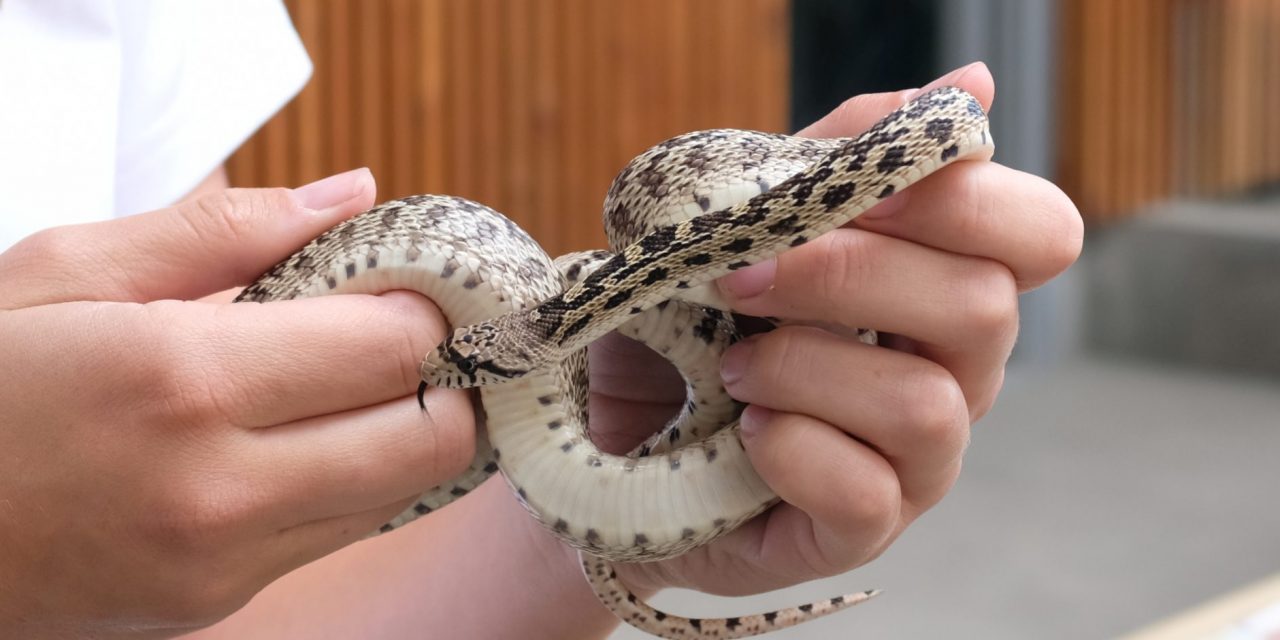
The Nk’Mip Cultural Centre came back this year to celebrate World Snake Day on July 16.
The centre hosted special events throughout the day to educate residents and visitors about the slithering creatures around the Okanagan.
This year snake biologist Chloe Howarth gave a talk detailing the types of snakes in the area thanks to all of the work her team is doing to monitor and study the reptiles.
Since 2002, the centre has been doing a program called ‘Mark and Capture’ where they find snakes in the region and tag them in order to gain a better understanding of the population and study their growth.
They also do radio telemetry (started in 2004) which helps with tracking snake movements.
“We’ve learned about their den locations and structures, where they forage, the mating sites, shedding locations, movement and migration routes, habitat preferences, behaviours . . . and it’s really cool because everything that we learn here applies to snakes around the province as well,” said Howarth.
This project is a collaboration between the Osoyoos Indian Band, Environment Canada, and Thompson Rivers University.
Some of the recent research findings, Howarth explained, shows that snakes in the area face a lot of disturbances. With campgrounds, golf courses and new developments, snakes have been forced to adapt to the rapidly changing human environments.
In researching this issue specifically, the team has looked into how the change in environment impacts the snake’s body condition and their movements.
“Then most recently, we’ve looked at female reproductive ecology of rattlesnakes. So that’s looking at pregnant females, looking at how they’re living, where they’re choosing to give birth to their live young, what kind of habitats they’re using, and the timing of their reproduction,” said Howarth.
Matt Macpherson, PhD student who works in the same lab as Howarth, said his work focuses mainly on direct conservation in the area for snakes.
“Unfortunately, despite how great and amazing snakes are, a lot of the populations around here are in decline,” explained Macpherson, who listed the three main causes of habitat loss and fragmentation, persecution from humans, and road mortality.
“Snakes will often cross roads around their habitat, and sometimes they’ll even bask on the road if it’s a really cold day . . . and so this just further contributes to population decline,” said Macpherson.
With this in mind, Macpherson suggests for people to keep an eye out for snakes on the road while driving, and brake for them when necessary. Additionally, rodenticides should be avoided as snakes may eat these dead or dying rodents.