By Keith Lacey, Local Journalism Initiative Reporter
The Regional District of Okanagan-Similkameen has joined a national health initiative to combat radon gas — the second leading cause of lung cancer in Canada after smoking.
Pam Warkentin, project manager of Take Action on Radon, presented the 100 Radon Test Kit Challenge to the RDOS board Thursday, urging local participation in the free testing program.
Warkentin, based in Winnipeg, manages project oversight and distribution of radon detectors. She explained that radon is a naturally occurring gas that forms from the breakdown of uranium in soil, rock, and water. When it becomes trapped indoors, especially in basements or ground-level spaces, it poses serious health risks.
“Radon is the leading cause of lung cancer in non-smokers in Canada and causes more than 3,000 deaths annually,” Warkentin told the board.
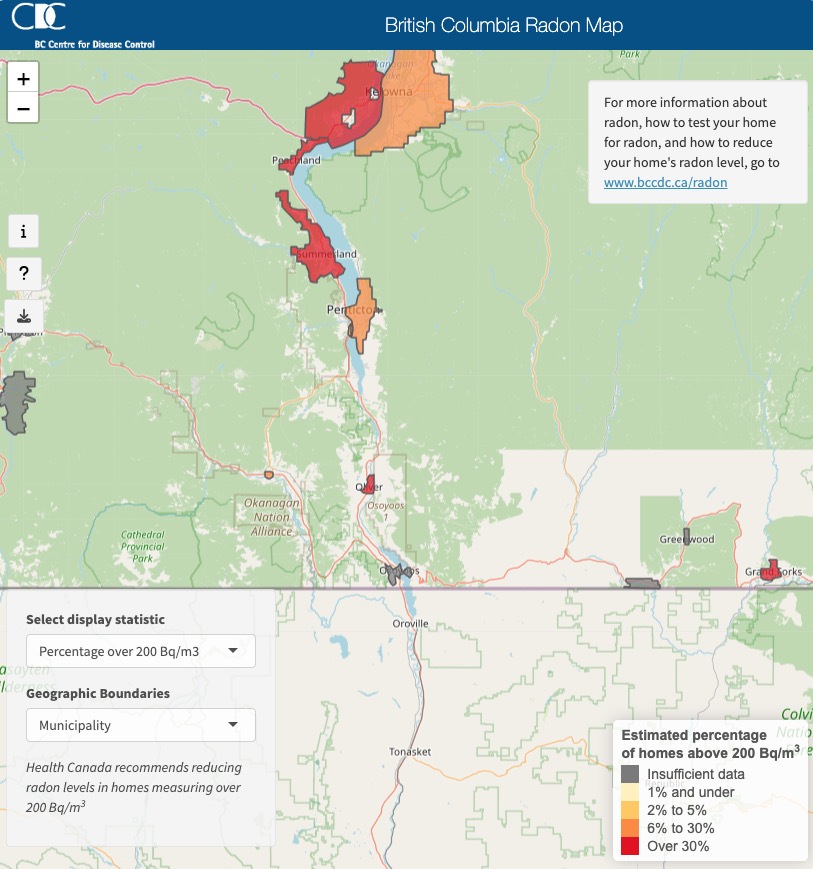
BC Centre for Disease Control radon map shows high concentrations of radon in over 59 per cent of households in Oliver. Osoyoos has insufficient data to estimate.
BC CDC map image
Take Action on Radon is a coalition that includes the Canadian Association of Radon Scientists and Technologists (CARST), the Canadian Cancer Society, and researchers like Dr. Anne-Marie Nicol of Simon Fraser University. The group is funded by Health Canada to raise national awareness.
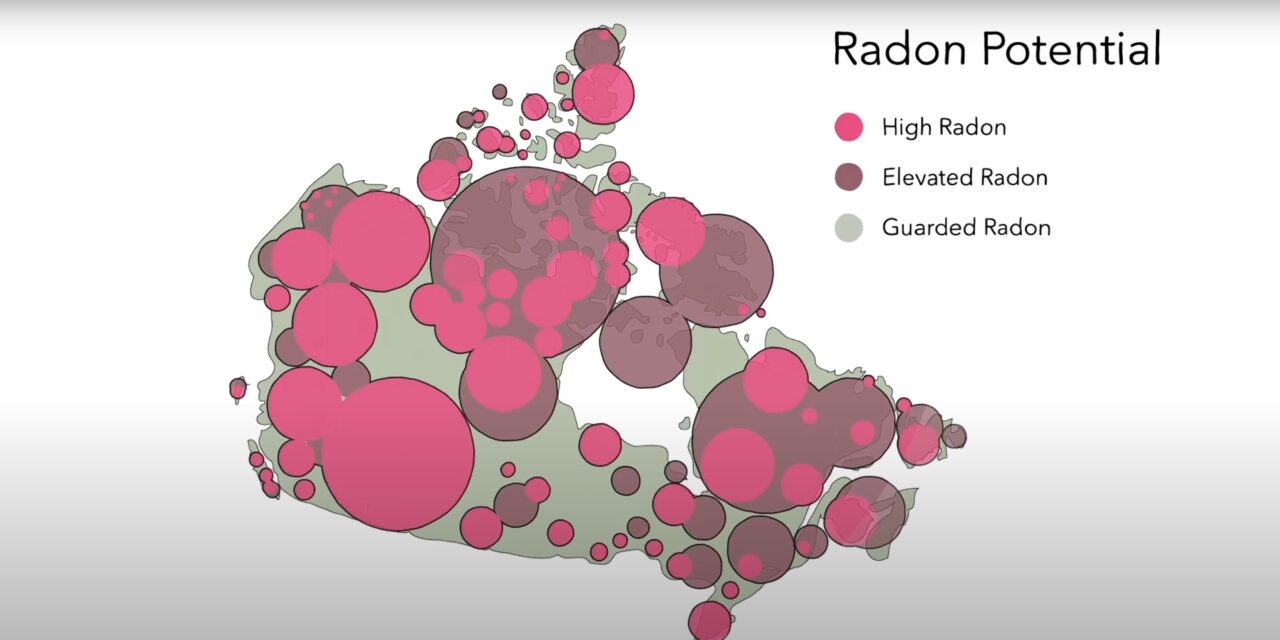
The 100 Test Kit Challenge aims to promote radon testing, gather local data, and educate communities. The program has already reached over 160 Canadian communities, including 10 First Nations and two Métis groups. More than 30,000 detectors have been distributed, with over 21,000 homes tested — 30% of which exceeded Health Canada’s safety guideline.
“The goal isn’t just to distribute test kits,” said Warkentin. “It’s about local awareness, data collection, and long-term mitigation planning.”
The process includes a public information session, distribution of free radon test kits, a 91-day testing period during the heating season, and a mass collection in spring. Participants receive personalized reports, and communities get summary data showing the percentage of homes above and below safe levels.
Radon enters buildings through cracks and gaps in foundations, and is most concentrated in lower levels. Smokers exposed to radon face an even higher risk of lung cancer.
The test kits use an alpha track device that remains in place during testing and is later sent to a lab for analysis. Results are private and returned directly to homeowners.
If elevated levels are detected, mitigation steps can reduce radon exposure by up to 90%. Warkentin noted that guidance and a list of certified mitigation professionals are available, with Health Canada recommending radon reduction within one year of high readings.
Communities across B.C. have participated in the challenge, including Summerland, West Kelowna, Kelowna, Vernon, Peachland, Lake Country, Keremeos and Oliver. In 2026, Osoyoos and Penticton are expected to join.
Soil tests in many Interior communities reveal concerning radon levels.
Recent findings show:
- Kelowna: 22% of homes above guideline
- Keremeos: 31%
- Vernon and Summerland: 38%
- Peachland: 41%
- Lake Country: 51%
“We’ve seen high levels in the Interior Okanagan, and our program helps local governments inform and protect their residents,” Warkentin said.
Take Action on Radon also contributes to the BC CDC Radon Map, which offers public access to data. For those affected, multiple support programs are available.
Residents with radon levels above 800 Bq/m³ can apply for a free lung health screening through the BC Cancer Agency. Additionally, the Lungs Matter Grant Program, through the Canadian Lung Association, provides up to $1,500 in financial support for low- and moderate-income households and lung cancer patients needing radon mitigation.
With November recognized as Radon Action Month in Canada, the RDOS launch is well-timed. The public awareness campaign begins in early October, with the official information event set for October 27. Kit distribution will follow immediately across Areas A (Rural Osoyoos), C (Rural Oliver), F, and H, with expansion to the entire RDOS planned for next year.
Test kits will be collected in February after the 91-day exposure period. Participants will receive their confidential results, and the RDOS will get a community summary report.
The RDOS board voted unanimously to participate in the program.
Oliver, meanwhile, participated in the 100 Radon Test Kit Challenge from November 2024 to March 2025 with participating households receiving their test results in May.
This article first appeared in the Penticton Herald.