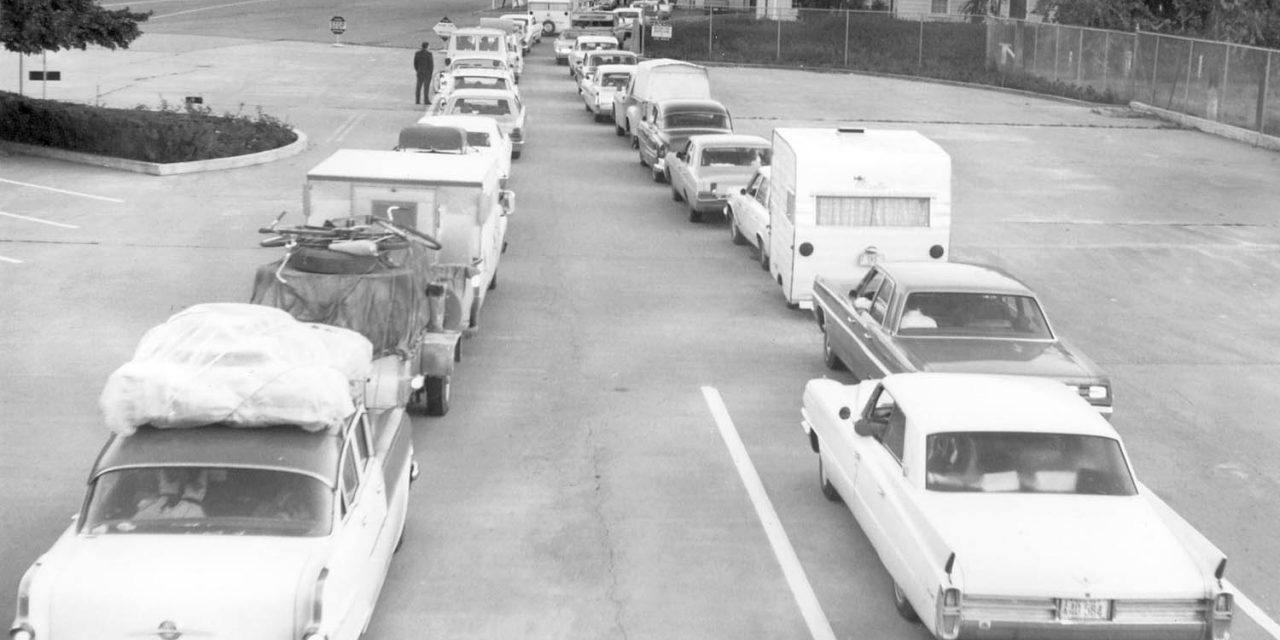

The more things change, the more they are the same. This photo shows cars lined up at customs heading into the United States. The museum doesn’t have the exact date, but judging from the mix of 1950s and early 1960s vehicles, we think it must have been early 1960s. Does anyone have a story to tell about crossing the border in those days? (Osoyoos and District Museum and Archives)
The more some things change, the more they stay the same.
A lineup of cars trying to cross the border on a holiday weekend may look a little different today, and may be more high-tech, but the experience of inching forward in your car is the same.
The museum record suggests this could be the 1950s, but we recognize some vehicles that would definitely be early 1960s.
We hope readers will share their memories of crossing the border and how it was different in earlier times.
Last week’s photo
The photo we published last week, which showed the Lake-View Café and bus stop around 1950, stirred some memories for long-time Osoyoos residents.
We were contacted by readers who shared some of those memories with us, even if it was just to correct the record on the dentist office next door.
The information in the file at Osoyoos and District Museum and Archives said it was Dr. Leonard’s office.
But one reader corrected us that Dr. Leonard was a medical doctor. In fact, the dentist was Dr. Johnson, she said.
A number of others, however, said it was in fact Dr. Granger. Maybe they both had offices there? Do you know?
Judging by some comments, visits to the dentist weren’t entirely fun.
Lake-View Café – a memory
One caller, Barbara Bryan, recalled working at the Lake-View Café when she was 15 around 1954 or 1955.
“I was a waitress there and I also sold bus tickets and things like that,” she told us.
She recalled working for Louis Hebig, who ran the restaurant.
As the Greyhound stop for buses coming from Vancouver and Penticton, the café saw many people leaving and arriving in Osoyoos.
Bryan remembers taking the bus into Penticton sometimes with a friend to go shopping. And then they caught another bus back.
During that time in the mid-1950s, many immigrants from Portugal were arriving. Often the men came ahead of their families. Many, said Bryan, worked for a man named Louis Hart.
“I got to know a lot of the Portuguese because they would come into town every Friday night or Saturday to get the groceries,” said Bryan. “And they would come to the restaurant to have ice cream or pop or whatnot, so I got to know a lot of them.”
One, she said, was Tony Braz, who told Bryan his wife and two young sons were arriving from Portugal.
“He didn’t know what day they were arriving, and he said to keep an eye open for them.”
Bryan checked the noon bus when it arrived each day for several weeks. Finally, a Portuguese woman arrived with two little boys.
“I met her, and she didn’t speak any English, so I took her into the restaurant, got her a cold drink and got the little boy something,” said Bryan. “She was nursing the baby.”
Bryan located the local taxi driver, who she remembers as Johnny Letowski, and asked him to take the woman and sons to Louis Hart’s orchard where Braz was working.
Other people coming through the café were catching a bus to Vancouver, Penticton or the Kootenays, to visit family or look for work.
Bryan said that across the road from the café was the Osoyoos Motel.
Your comments and stories welcome
You can comment at OsoyoosTimes.com or on Facebook and you can contact Editor Richard McGuire by email at [email protected] or by phone.
RICHARD McGUIRE
Osoyoos Times

The more some things change, the more they stay the same. This photo shows cars lined up at customs heading into the United States. The museum doesn’t have the exact date, but judging from the mix of 1950s and early 1960s vehicles, we think it must have been early 1960s. Does anyone have a story to tell about crossing the border in those days. (Osoyoos and District Museum and Archives)