By Don Urquhart, Times Chronicle
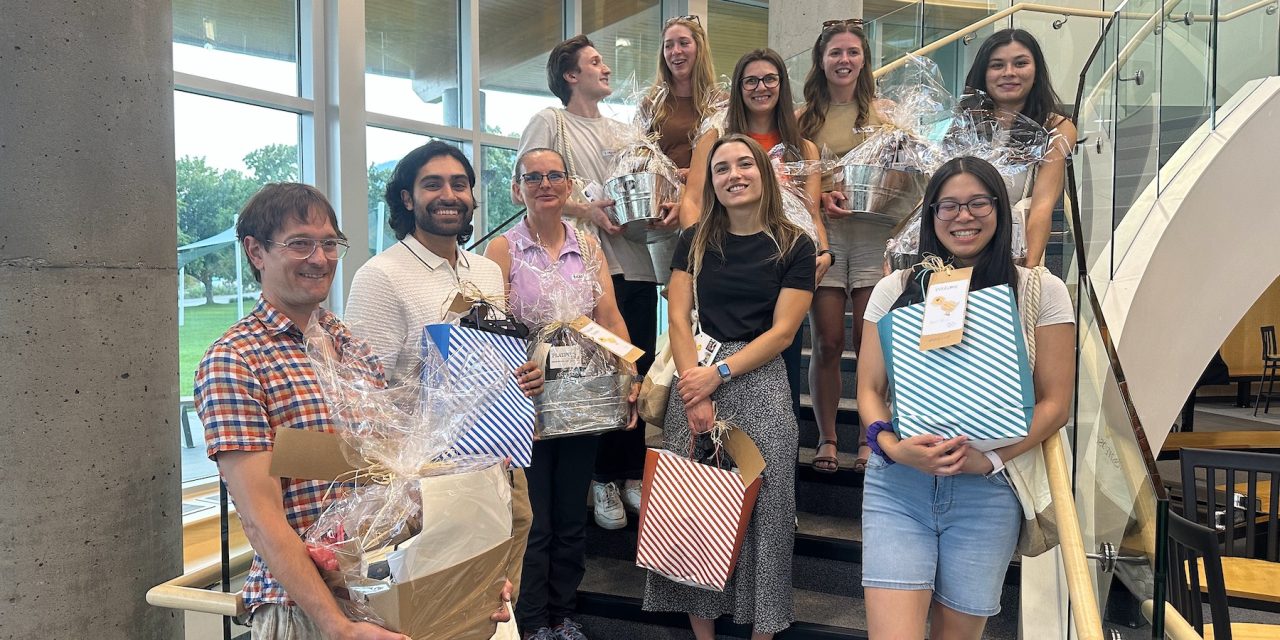
The South Okanagan and Similkameen pulled out the stops in an all-out charm offensive for a visiting group of seven residents and two medical students last week as the local initiative continues its efforts to attract new doctors to the area.
The Second Annual South Okanagan Connection Tour for Medical Residents on Sept. 10 built on last year’s successful inaugural tour and was organized by the local Supporting Local Physician Recruitment Working Group led by Oliver general practitioner Dr. Robin Craven.
The event saw the seven residents (technically doctors but still under training and supervision) and two medical students, along with one new doctor who arrived from Quebec just shy of two weeks ago, to join the South Okanagan General Hospital (SOGH) Emergency Department, toured around the area, including visits with local health practitioners.
This year, the University of British Columbia (UBC), which has responsibility over the residents, asked the working group to include Keremeos because that community has lost two doctors in the last six months. “So we added them in, and it was really great because these rural communities, I think we have to look after each other because if Keremeos goes down, then all those patients come here,” observed Craven.
She relates a story about the emergency closures when she first came to the area to practice. “I heard when I first got here that the emergency department was closed because doctors didn’t care. And it wasn’t very many people, but okay, my sense was that maybe there was starting to be a feeling that the doctors in the community weren’t doing anything about that.
“But actually, people go where they feel that they’re important and their ability is appreciated. My patient population is very appreciative, so I knew that if they [the medical residents] had a chance to feel welcome and had a chance to work out of here,” it would be much easier to attract doctors here.
“So we made the committee and we welcomed the residents last year and it was pretty good, but this year’s been even better because we’ve also involved people from Osoyoos to help us plan.” Last year, Osoyoos wasn’t involved.
And she says they had extra momentum this year because the residents who came last year liked the tour very much, and word is getting around. Craven even succeeded in convincing UBC to let her have the residents for a whole day instead of just half a day like last year.
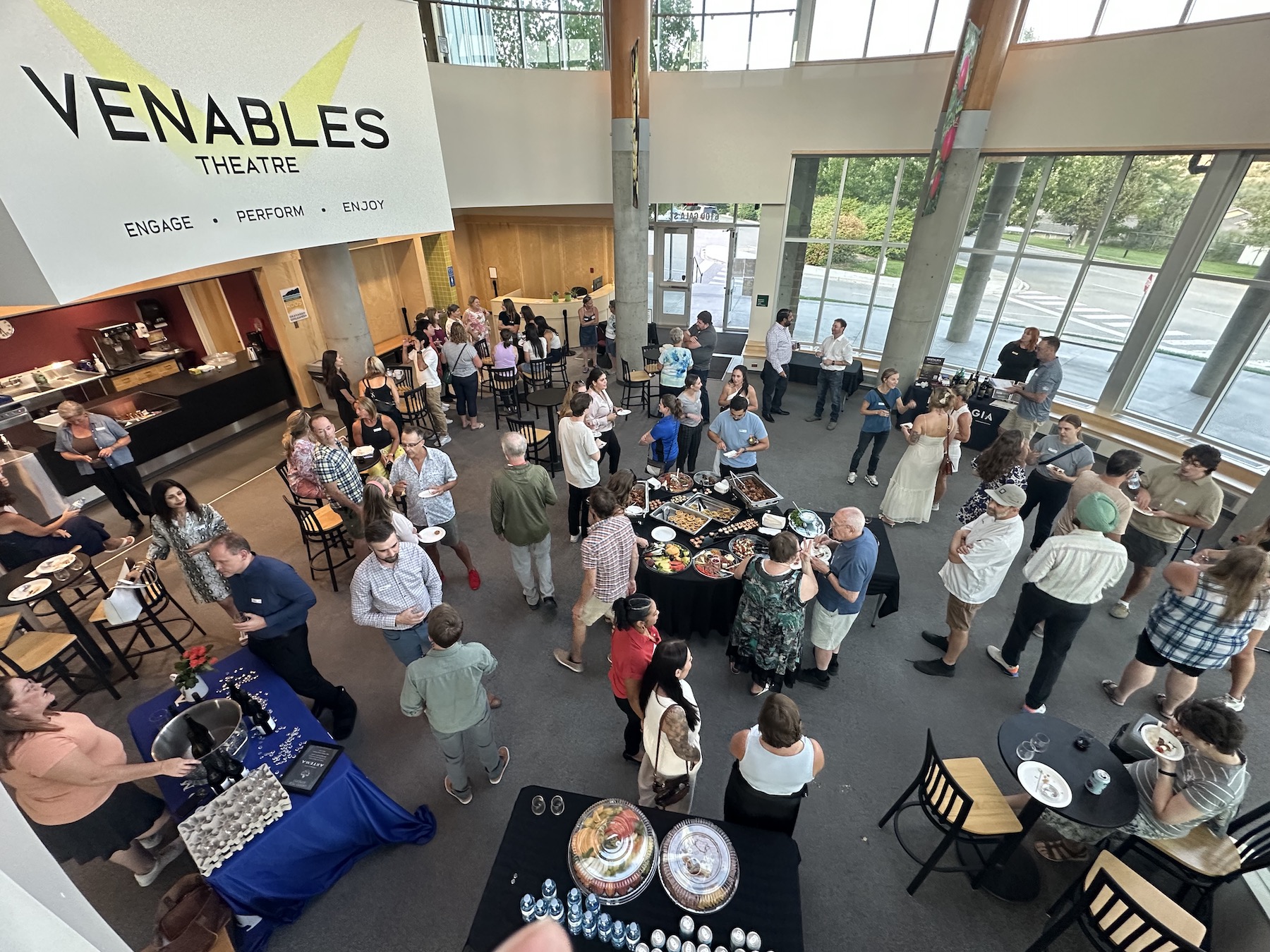
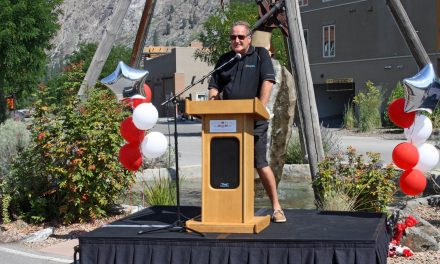
Venables Theatre was the venue for the South Okanagan Meet and Mingle event, capping off a day of events. Food was provided by Oliver Eats with wine tastings by Domaine Artema and Nostalgia Wines.
Don Urquhart photo
While it may appear from the outside as a bit of a junket for these med students and doctors in training, getting toured around to see the sights as it were, but it is important for them to experience what this area has to offer and to visit local businesses and other healthcare professionals, Craven said.
She relates an experience she had about six months ago when she was interviewing medical residents who had just graduated six months prior to that. She asked them how their first six months in their residency were and what key challenges they faced.
“They all said the big challenge wasn’t medicine, ‘we’re trained in medicine,’ they said.” The challenge was far more basic, like where do you go to get this or that and how do you find the bus to get to such and such a place – all the little things of daily life that locals in rural communities take for granted.
“I think it just sort of changes how they feel, now they know what is here,” she said. She cited the example of their visit to the Nk’mip Desert Cultural Centre, which she said made an impact on them. “They were really connected by that and I just think this has become a real place that I think they will consider,” she adds.
The visit also took in the South Okanagan General Hospital (SOGH) along with the Nk’mip Resource Centre Walk-in Clinic located within the Osoyoos Indian Band (OIB) Health Centre which offers a one-day a week walk in clinic for anyone in the community, thanks to Craven’s efforts.
Some of the residents are already working with Craven in the recently opened walk-in clinic, which she spearheaded. “So they’re working with me in the clinic, and they’re working with the other doctors in the emergency department because they have to do a rotation,” she explains.
“I asked if I could have some residents to help with the walk-in clinic,” she says of her request to UBC. “All the ones that were on the tour last year said “yes, we’ll help’, because we stood in that building, and I said ‘look at this beautiful building, yet it has no doctors’.”
The involvement of those residents has been crucial for Craven to get the clinic up and running. But she points out the next problem – they’re all going to graduate next July. “This is a long game,” she observes thoughtfully, adding, “If we can hang on to even two of them,” there’s hope going forward.
To say that the medical crisis in Canada is extremely complicated is a major understatement. It’s a system of overlapping concerns and players from education, to professional bodies to government regulators and more.
Even the terms “resident,” “intern” and “medical student” cause confusion amongst non-medical people. When is a doctor really a doctor, and when can they practice unsupervised?
One misconception that Craven clears up straight away is the fact that “when you finish medical school, you’re a doctor.” But that doesn’t mean you can hang your shingle and start a practice. In fact far from it.
“You then have to decide what specialty and specialties have different lengths. It’s like an apprenticeship, she says. So an apprenticeship for family medicine is two years. You have to be supervised; you can’t write a prescription by yourself. The preceptor has to watch everything you do, and my license and malpractice insurance covers them,” she adds.
So an intern is just a first-year resident, she says. The reason that term is confusing is because in the old days – and it’s still like this in the US – a first year residency was general residency, and every specialty was done in the second year. Now that has changed.
One aspect of the Canadian system that she says needs to change is that here the ratio is one preceptor to one learner. “That’s not going to get us any more doctors, because there’s only one churned out every year.
In the US, it’s more of a pyramid set up with one attending (a preceptor) supervising a third year resident, who supervises two second year who supervise two first years and they in turn supervise the med students. It’s what’s called “layered learning” she says.
Craven has managed to convince UBC to allow her to undertake a pilot project employing a similar model which sees a second year resident supervising a first year resident who overseas two medical students. This, she explains, is how she managed to get the walk-in clinic up and running.
She gives the example of one of her med students at the clinic whom she told, “When you come to my clinic, you will remember why you went to med school”, in reference to how grateful the patients are to have access to a doctor.
“She didn’t believe me, but at the end of the day, she’s like, “people, when you first go into the room, they’re like, thank you very much for being here. And then you do your thing, and then they say at the end, thank you, thank you.”
A sharp contrast to working In Vancouver, where the med student has had people swearing at her, asking why she is so slow, Craven relates.