By Don Urquhart, Times Chronicle
Water levels in Osoyoos Lake and further upstream at Okanagan Lake are being kept at higher than normal levels for this time of the year due to low snowpack levels which may contribute to drought conditions this summer.
The International Osoyoos Lake Board of Control (IOLBC) which oversees the operation of Zosel Dam in Washington State to manage water levels in the shared Osoyoos Lake basin said that it is maintaining a historical maximum water level – at 277.92 metres (911.81 feet) – in anticipation of lower spring run off due to the lower snow pack.
For former fisheries biologist Dave Kumka, the move is a good one but there are tradeoffs. Kumka who volunteers with the Osoyoos Lake Water Quality Society (OLWQS) says keeping the lakes full is a “standard engineering biologist type strategy for water conservation.”
On the plus side, it means cooler lake temperatures which are good for fish, but less flow through means more stagnant water and the potential for oxygen to be depleted in some areas which is not good for fish.
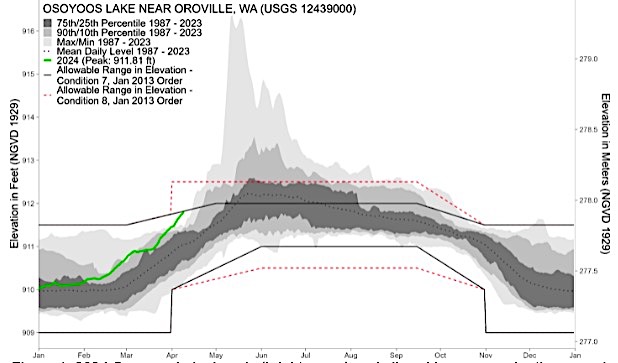
2024 Osoyoos Lake Levels (bright green) have been brought up to the maximum allowable under the normal “rule curve” defined by the International Joint Commission Orders of Approval for Osoyoos Lake (solid black). For the period of record from 1987-2023, the mean daily lake level is shown as a dotted black line, and the historical gauged minimum, 10th, 25th, 75th, 90th, and historical gauged maximum lake levels are shaded grey (USGS, 2024).
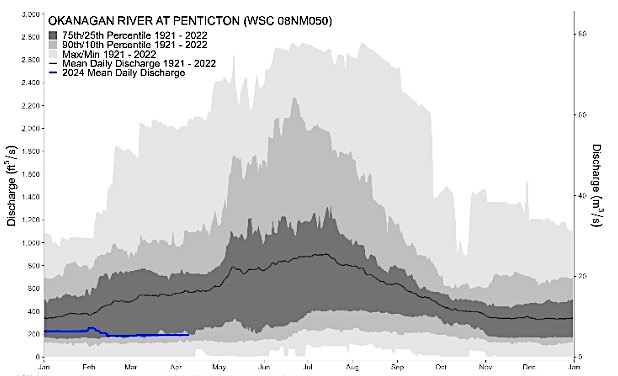
Upstream of Osoyoos Lake, Okanagan Lake is also at a higher-than-normal elevation, the board of control noted. Typically there is an increase in water discharged from both Okanagan Lake and Osoyoos Lake in late winter to prepare for the inflow from melting snowpack.
“However, due to the low snowpack observed across British Columbia this winter, lake managers have decided to counteract the potential impacts of a low runoff year by holding more water than usual in the lakes.”
Snowpack levels reported in the BC Snow and Water Supply Bulletin on April 1 indicate that the Similkameen and Okanagan Basin Snow Indices were at 62 and 73 per cent of normal, respectively.
Data from the Mission Creek snow pillow station with the orange line illustrating the Snow Water Equivalent, or the amount of water the snow melt would be equivalent to, for the current year (BC River Forecast Center, 2024).
The snow pillow gauge – used to determine the amount of water the snow contains – at Mission Creek (elevation 1,780 metres) in the Okanagan Basin has recorded below-average snow water equivalent for all the 2024 water year. The water in the snowpack is currently around the 10th percentile.
The snow pillow station at Blackwell Peak (elevation 1,940 meters) in the Similkameen basin has experienced near historical recorded lows for snow water measurement since mid-November. The snow water equivalent is currently near the historical recorded minimum for April 9.
Lake health 101
One of the biggest problems for Osoyoos Lake is due to the channelization of the Okanagan River which elevates the temperature of the water in the channel as well as adding warmer water to the lake. This and general changes due to climate change have caused average temperatures to rise over the last 20 years, according to Kumka.
He notes that the expectation is that the lake and the Okanagan River will both be warmer later in the summer. “By retaining water and allowing that water to flow in the August, early September timeframe, that will lower the water temperature and create a better habitat for fish that are moving through the system.”
This high water level for much of the summer followed by a higher outflow of water in the late summer may cause headaches for boaters, however. With high water levels, some boats will be unable to pass under the Osoyoos Trestle Bridge due to clearance issues. On the other hand, lower water levels as water is released make it difficult to access some marinas on the lake.
“I know last year that there was considerable consternation from people who were using the marina around the cottages area as the lower lake levels were causing them issues getting their boats in and out of the marina,” Kumka added.
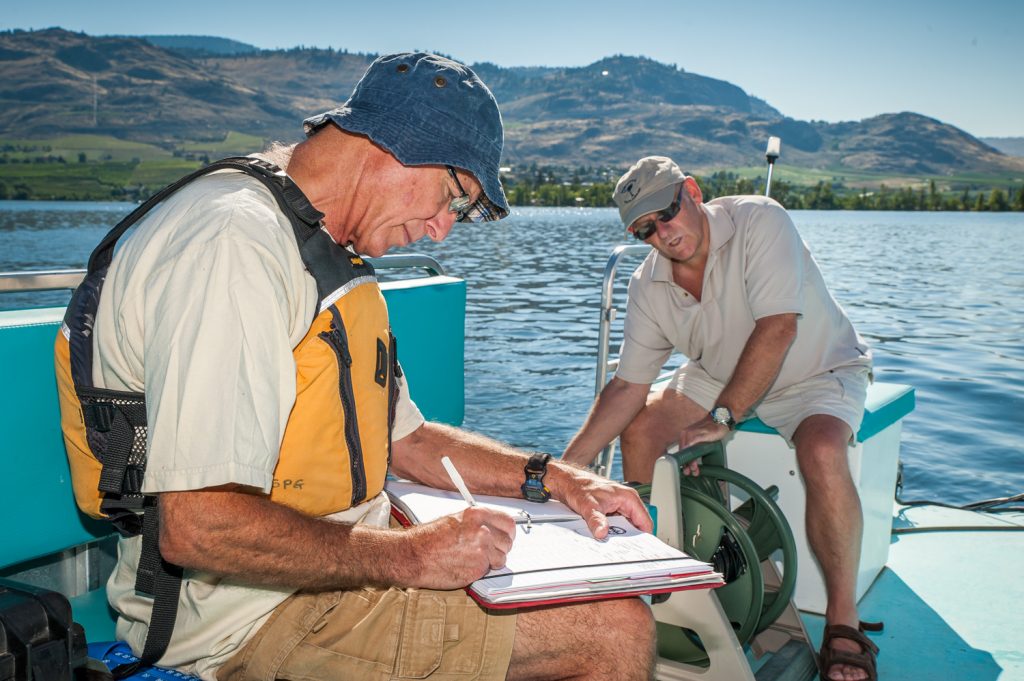
Osoyoos Lake Water Quality Society on the water – John Gates records data in the log book while Bryan Holgate lowers an instrument to measure water temperatures and oxygen concentrations. File photo.
He went on to explain that the water quality society, in its regular program of water sampling (which includes temperature), includes a couple of deep spots that exist in the South Basin on the Canadian side, one about 30 metres off of sẁiẁs Provincial Park and another 30 metre deep spot just before the border. An even deeper spot at around 64 metres in depth is located in the North Basin opposite the old packing house.
“Those areas form spots where the temperature stays very cool even through the summer.” In the spring and fall wind blowing across the top of the water creates what are known as “convection cells” (basically think of it as stirring up the water), which introduces dissolved oxygen into the water.
In the spring and fall, he explains, this oxygen will make its way to the bottom of the lake. In the summer, however, when the lake starts to heat up, it forms temperature layers. There’ll be a top layer that’s quite warm, a medium layer in the middle that’s warmish and then a fairly cool – seven or eight degree celsius layer at the very bottom, he says.
The problem is that in the very warm parts of the year the oxygen levels in the lower parts of the lake where it’s cool enough for fish, “the oxygen gets so depleted it’s almost uninhabitable by fish,” he says.
The 64 metre deep spot in the North Basin still keeps a fair amount of oxygen and remains cold which is where the migrating fish like the sockeye end up because that’s best for them to live while they’re moving up the river to spawn.
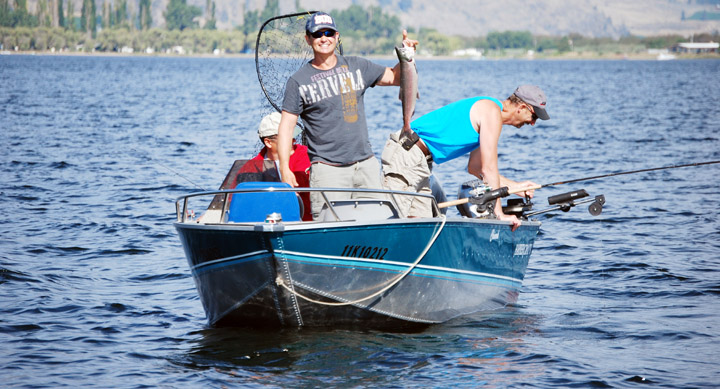
Salmon fishing on Osoyoos Lake.
“In very warm summers, when there’s not a lot of flow through the southern basin of the lake, the lake water can get quite warm and it’s a challenge for some of the aquatic organisms that live there,” he notes. A higher lake level means that it’s going to warm up less quickly, he adds.
“So that’s a good strategy again, to moderate the temperatures in the lake. But if the flow out of the lake is reduced then there’s a chance for more stagnant areas in the lake – stagnant being where the oxygen levels have dropped quite sharply, so that it’s not as ideal for resident fish, for example.”
It’s good to have a full lake as long as there is some flow through it he says. “If they were to cut off all the flow then that would be a different story, but the fuller lake with a minimal flow mitigates to some extent the fact that the flow through the lake is less.”