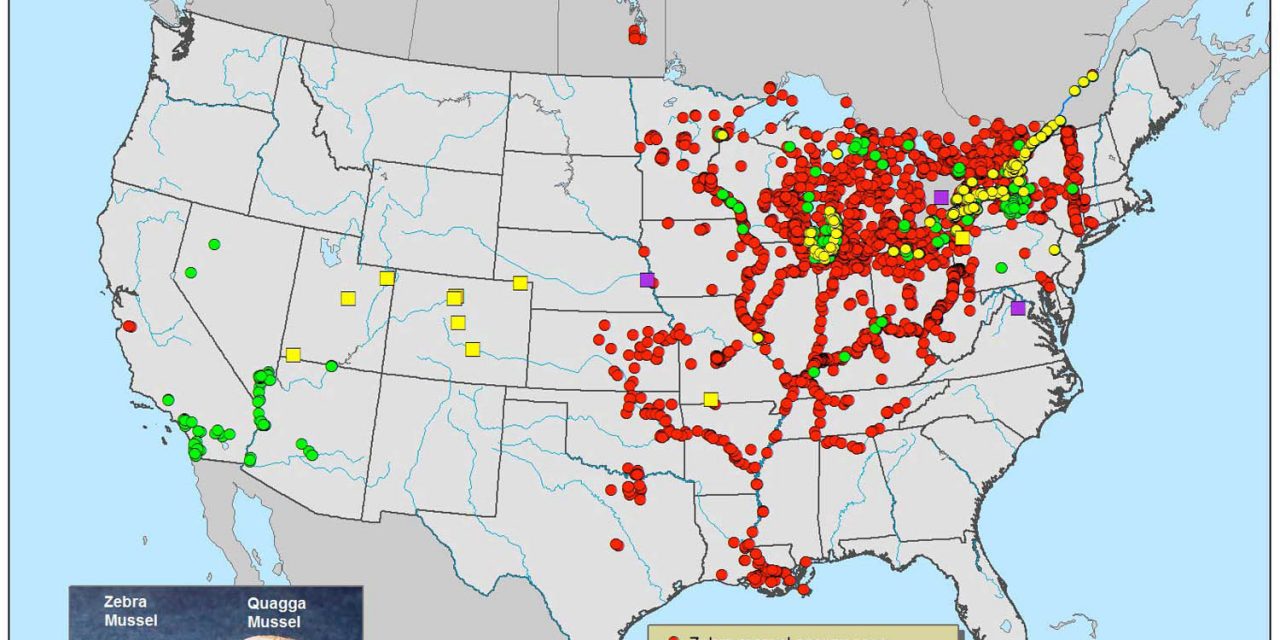

A map of zebra and quagga mussel distribution shows that zebra mussels have reached Manitoba and quaggas have reached the U.S. Southwest. Roads leading into Idaho have boat inspection stations. (U.S. Geological Survey)
The provincial government’s recently announced strategy to prevent invasive mussels from reaching B.C. is a good start that doesn’t go far enough.
That’s the view of the Okanagan Basin Water Board (OBWB) and others concerned about the spread of zebra and quagga mussels that have done billions of dollars damage in other parts of North America.
“Obviously they’re now engaged in the subject and are recognizing that it’s a problem,” said Doug Findlater, chair of the OBWB and mayor of West Kelowna. “We’re pleased they’re engaged in the subject. In the past, the silence was quite deafening.”
The provincial government announced on March 31 that it is providing $1.3 million dollars for early detection and rapid response.
This includes three mobile decontamination units for the province, expanded monitoring and outreach and additional highway signage.
A Ministry of Environment spokesman said this money will be allocated as $149,000 for start-up and operations in the 2015-16 fiscal year and $600,000 in each of the two following years.
Findlater said he’s concerned that the $1.3 million is spread out rather than being a single year’s commitment.
The program also falls short of addressing the OBWB’s request for inspection stations to check boaters coming into the province.
Mussels are mainly spread by recreational boaters who have failed to decontaminate boats before transporting them from infected waterways to uninfected ones.
“What OBWB asked for was basically full-scale inspection stations at all the major roads into British Columbia of which there aren’t really that many when it gets right down to it,” said Findlater.
This, he said, would mean the Yellowhead, Trans-Canada and Crowsnest highways since the federal government is in the process of empowering border officials to stop boats suspected of carrying mussels that are coming from the U.S.
The Environment Ministry spokesman didn’t directly respond to the question of why inspection stations weren’t included in the program.
He did, however, suggest that there is room for the program to grow and work in conjunction with other jurisdictions.
“This initial program will allow us to build capacity, experience and additional partnerships to expand the mussel prevention program in the future,” the spokesman said in an emailed reply. “The province continues to develop and implement a perimeter defence plan for zebra and quagga mussels with neighbouring jurisdictions with the goals of keeping Washington, Oregon, Idaho, Montana, British Columbia, Alberta and Saskatchewan free from these invasive species through a co-ordinated effort.”
The province is co-ordinating training, locations and timing of boat wash stations with neighbouring jurisdictions, he added.
Findlater said he’s not sure three mobile decontamination units are enough to cover the province.
Alberta, he noted, is spending more money on the problem and last year inspected thousands of boats, finding some that carried mussels.
The OBWB estimates that if invasive mussels get into the Okanagan waterways, the annual cost just to mitigate the problem will be about $43 million. Once established, mussels spread quickly, encrusting every surface with razor-sharp shells and they cannot be eradicated.
Prior to the recent announcement, B.C.’s spending to address the problem was the lowest among the 11 northwest jurisdictions with inspection and decontamination programs at just $20,000 annually.
Findlater observed that B.C. is relying on other jurisdictions with advanced programs, such as Idaho, to protect this province – a risky strategy.
Even if mussels do make it to the Okanagan at some time, “each year they’re not here is money in the bank, particularly for local governments,” he said.
Former Osoyoos Mayor Stu Wells is also the former chair of the OBWB and will be chairing the Osoyoos Lake Water Science Forum in October. His reaction to the announcement was similar to Findlater’s.
“It was very good to see that this was being taken seriously,” he said. “I don’t know that they’ve got it exactly where I would like to see it, which would be a form of intervention at the Alberta-B.C. border, but this is certainly a great step forward. They’re throwing some serious money at trying to stop this infestation from getting here.”
Norm Macdonald, the provincial NDP energy and mines critic who has been the spokesperson for his caucus on mussels, said he supports the government’s announcement.
“I think it’s a good first step,” he said. “I was very pleased that it’s going to be up and running this season.”
Work still needs to be done, but the money invested “could very easily be the wisest investment that a government could make,” Macdonald said.
The opposition MLA said he was not concerned that the government took longer to implement the program than it committed to when he asked about it in the Legislature last May.
“My bigger concern was that they would continue to ignore it over the next number of years because it is a somewhat obscure issue,” he said.
Pointing to Manitoba where the zebra mussel has recently become established on Lake Winnipeg, Macdonald said B.C. cannot repeat the experience of taking ineffective measures for photo ops only to spend millions of dollars when it’s too late.
RICHARD McGUIRE
Osoyoos Times