Sophie Gray
Local Journalism Initiative
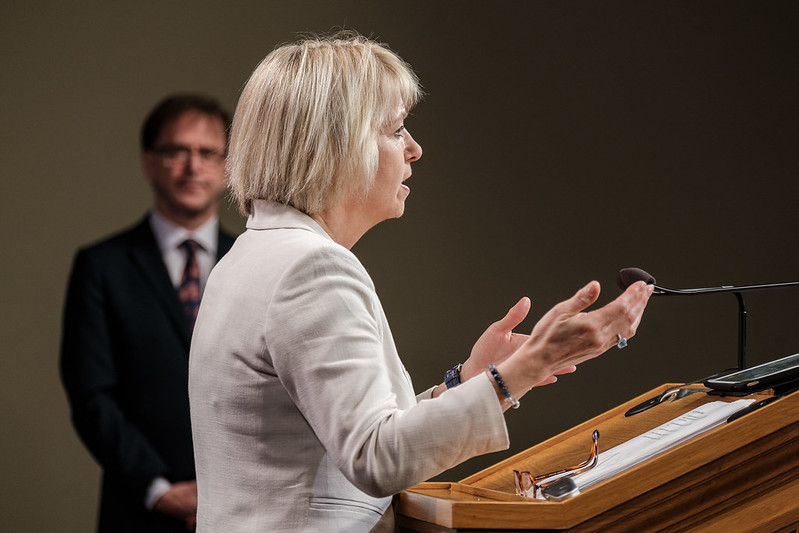
Provincial health officer Dr. Bonnie Henry took to the podium this afternoon to present the newest set of COVID-19 modelling data to British Columbians.
The data covered a number of statistical outcomes, including the chance of virus spread related to children returning to school, rates of transmission related to relaxed restrictions in phase two of the restart plan, and updated data on gender and age-related COVID-19 cases.
Dr. Henry also went into more detail around the impact of COVID-19 in different areas around the province. A slide that mapped out the density of confirmed cases based on health service delivery areas showed the abundance of cases in the Lower Mainland. The data also showed the spread and reach of the virus.
“It tells us that there are no communities in British Columbia that have not been affected by COVID-19,” said Dr. Henry. “Some of them, more so than others and this is not a surprise for any of us.”
Dr. Henry noted that more detailed data on the impact of COVID-19 in individual communities is being worked on and will be available in the near future.
Thursday’s presentation also outlined the potential impact children who returned to school on Monday will have on the spread of the virus. Dr. Henry explained that children have a much lower transmission rate than adults.
The modelling showed that even at such high rates of transmission, the partial return to in-class schooling this week will have little effect on transmission in the short term, provided adults maintain physical distancing.
The key to this, said Dr. Henry, is isolation for children and adults when they are sick.
“As schools reopen and even if all schools were open and all children were in, if we relaxed our distancing measures, as long as we were fastidious about staying away if we are ill, whether it’s children or adults in particular, then we still would be able to prevent a rapid increase in epidemic growth,” she said.
Other data was revealed including strains of the COVID-19 virus traced backwards to show where areas around the province were contracting the virus from, and updated numbers showing the effect of reopening at a variety of rates.
Dr. Henry also introduced a new case counting category. The province is now tracking epidemiologically-linked cases, which are previous cases of COVID-19 that were contracted through close proximity to confirmed cases but were not officially tested.
Four out of the nine new cases reported today belong in this category, all of which have already recovered.
Dr. Henry said health authorities will continue to report epidemiologically-linked cases along with test-positive cases in the updates from now on.
“Those are numbers that will be helpful for us and cases for us to follow going forward.”
All numbers are helpful moving forward according to Dr. Henry, who plans to use the data presented today and gathered in the next few weeks to chart the province’s path.
“These are the types of things that help us give evidence and data to support how we need to do things going forward, and these are the things we will be following,” said Dr. Henry. “We’ll be following what’s happening in schools over the next couple of weeks and we’ll be following the transmission patterns that we’re seeing in our community, over this, the second incubation period since our restart.”