
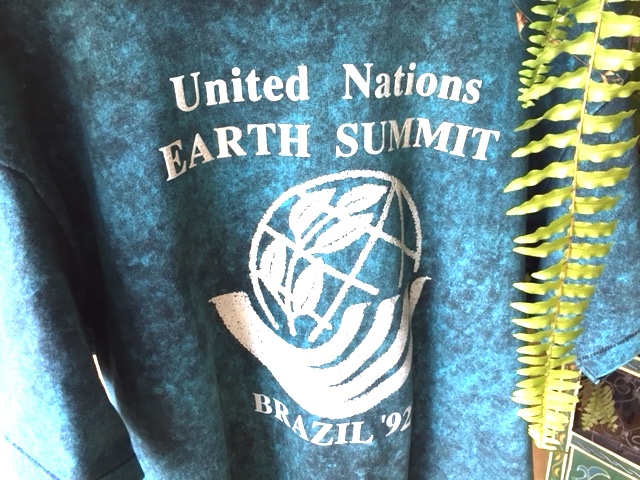
Submitted photo.
By Natalie Drache
June 1992. I flew from Vancouver to Rio de Janeiro to film the presence of Indigenous community leaders from around the world attending the UN Conference on Environment and Development (UNCED) also known as the Earth Summit. My media team had access to both the official UN and non-governmental press conferences where world leaders and some other 30,000 participants shared their perspectives, among them, issues of climate change and biological diversity. The official delegations rolled out Agenda 21, a non-binding comprehensive plan of action to be taken globally, nationally and locally by organizations of the United Nations system, governments, and major groups in every area in which human impacts on the environment.
In addition, three conventions were adopted: The United Nations Framework Convention on Climate Change (UNFCCC), the UN Convention on Biological Diversity (CBD) and the Convention to Combat Desertification. International Conventions are treaties or agreements between countries. In 1992, Canada signed and ratified the UNFCCC and the CBD. These landmark conventions and Agenda 21 became the first steps on the road map addressing what has become a crisis in our lives today.
The government of Canada has long recognized the principle that free and open trade, protecting the environment and acting on climate change must go together. In 2001, our government officially ratified the Kyoto Protocol with a binding greenhouse gas emissions-reduction obligation based on the scientific consensus of global warming; and the Stockholm Convention, a global agreement to reduce or eliminate emissions known to result in serious harm to the environment and human health. In 2015, Canada and 194 other countries reached the Paris Agreement to fight climate change.
October 2019. South Okanagan-West Kootenay. 27 years after the Earth Summit. Think globally, act locally. As we vote in this year’s federal election, we are marking our ballot with a commitment to ensure that our choices for honest and transparent leadership benefits the health and security of our local communities. The increase of floods, wild fires, loss of homes and businesses; loss of crops and livestock demands rebuilding our lives in a more equitable and sustainable environment.
Time to make choices. Economic development, science and social justice issues have coalesced into ambitious platforms of action.
The time has come to adapt or to carry the consequences forward for the next generations of our children to solve.
It can no longer be business as usual. This involves a shift from natural resource extraction to training for new and sustainable energy grids; there could be increased costs of living, loss of income, and instability until this transition is perfect.
That is what this election is all about. Getting to a perfectly balanced series of actions requiring a new form of leadership capable of reaching across the aisle in order to implement the most beneficial alternatives, considering immediate priorities and future objectives.
Today, every one of us represents the possibilities envisioned at the Earth Summit in Rio. We are all Agenda 21 in action. Trust ourselves and trust in Turning Canada Green!

