By Dan Walton
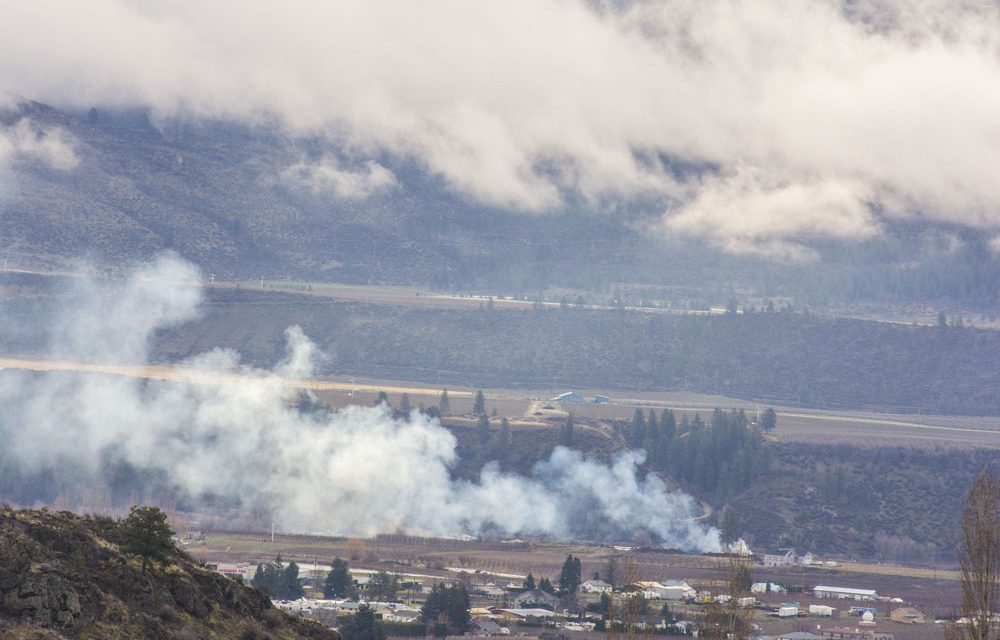
It’s the time of year when orchard and vineyard workers go about disposing debris, but the amount burning this year has added a noticeable amount of smog to the local skies.
“All the sludge from the air end up in our backyards and in our lungs,” said 81-year-old Doris Wobick, whose asthmatic bronchitis makes her more susceptible to airborne pollution.
Wobick said this year has been particularly bad for smoke. She suspects that is largely due to unfavourable weather patterns, brewing overcast skies which allows the smoke to stagnate.
The air quality index for the South Okanagan is measured by Environment Canada in Penticton, and because that’s nearly 40 kilometres from where she lives, Wobick doubts how accurately those measurements can reflect the air quality in Oliver.
“Oliver air is different than Penticton air,” she said.
Wobick has written to the Ministry of Environment and encourages anybody else bothered by the smoke to do the same.
“My idea is to have people mail in their complaints as they arise,” she said. If enough people complain, the ministry would hopefully install “a portable monitoring system here in Oliver so we can monitor our air.”
After 26 years of living in Oliver, Wobick said the air quality seems worse now than ever. She’s frustrated that the actions of a few are able to negatively affect so many in the community.
Wobick assumes that most burnings are legally sanctioned, but if there are any happening illegally, she has little faith in the effectiveness of legal enforcement. She understands that vineyards and orchards produce waste that needs to be disposed, but she believes there are better alternatives than burning.
Another Oliver resident, Pat Hampson, is also advocating for better disposal practices. He contacted the Regional District of Okanagan-Similkameen to air his complaint.
Area C director Terry Schafer agrees that agricultural burnings are causing a problem, but he says the regional government is doing its best to strike the right balance.
“As an asthmatic I do agree with Pat Hampson that dry pile burning is far better than trying to burn green wood and that forced air combustion creates less air pollution but this issue is more complicated than what first meets the eye,” he said.
Farmers usually have their burning window open until April 15, and Schafer said he continually gets requests for that date to be extended. And within that sanctioned time frame, farmers are restricted against burning on days that have too much or too little wind.
“In regards to extra costs to farmers for, say, gas powered blower rentals, I also get plenty of complaints from farmers that they’re suffering ‘death from a thousand cuts’, citing the increase in the RDOS budget, the hiking of the landfill fees and the costs of generally everything continually going up. I sympathize.”
Through the regional district, farmers have access to a chipping program which require growers only pay 25 per cent of the cost.
“It’s not mandated though and, naturally, some prefer to burn. I can only hope that people will recognize the principles of burning smart and being considerate to our environment and our neighbours.”
Fred Steele from the B.C. Fruit Growers’ Association agrees that burning debris isn’t the best way to dispose of waste. From an agricultural standpoint, he said the practice of burning is becoming less common every year. Steele has to deal with organic waste from his own property every year and he said flail mowing is his preferred method of removal. Flail mowers mulch up the material which can then be used for compost.
“It becomes a good natural fertilizer,” he said.
Steele said his wife has a severe respiratory problem and is also very sensitive to poor air quality.
“But more and more people are going to flail mowing and the chipping program.”
However, there are circumstances when burning is the only option, he says.
“Some pieces of wood have fungal disease – you always want to burn those.”
When fungal disease is present, it can wipe out an orchard in a week if it’s left unchecked, he said.
Also, the province provides grants for farmers to dispose of their debris through a chipping program, but limited funding prevents it from being more popular.
“When that funding runs out what else does a rancher do with a pile of pruning?” Steel said.
“In some cases burning is a necessity, but we encourage people not to burn when they don’t have to.”
Roza, Aylwin, bylaw enforcement coordinator for the regional district, said open burning is permitted between October 15 to April 15 of each year. Specifically, within the rural Oliver area, if the resident is wanting to burn piles greater than four feet in diameter they must contact the Ministry of Forests for a burning permit (1-888-797-1717). For pruning and clippings piled less than four feet in diameter, there are no permits required. However, she said it is in the best interest of the community for the resident to contact the Ministry of Environment (1-888-281-2992) to obtain the “venting index” for their area. If the venting index is good, they should advise their local fire department (by leaving a voice mail message) of their intention to burn and the date they will be burning.
Aylwin said people should make sure that all prunings are dry so they don’t smoulder.
Other suggestions include: don’t burn on a windy day; clear the area around your burn pile to avoid spreading; have shovels and water on hand; and don’t leave any fire unattended.
“Remember to be mindful of your neighbours when burning,” she pointed out.