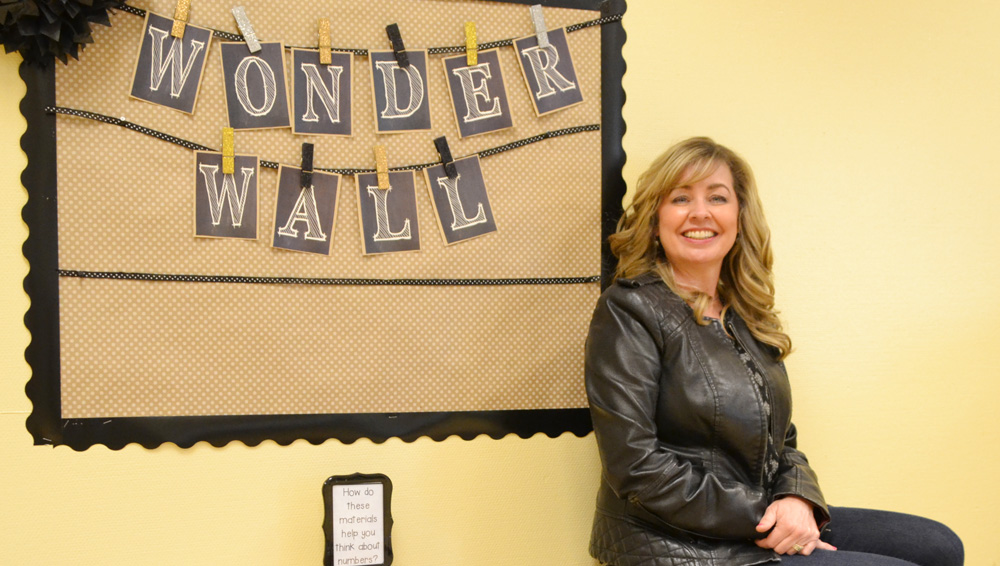

Melia Dirk sits with a “provocation” from her Oliver Elementary School classroom. Teachers from Dirk’s early learning network have been exchanging ideas on provocations, which attempt to engage students through playful inquiry. Photo by Trevor Nichols
A government grant is helping connect early learning educators across the Okanagan-Similkameen school district in new and exciting ways.
The $8,000 grant comes courtesy of the Innovation Partnership Working Group, a collaboration between various provincial government and educational bodies, and is one example of the 32 different “Innovation Partnership Projects” running in BC.
The Okanagan-Similkameen project is an “early learning network” that brings together teachers from across the district each month to share ideas and watch new teaching techniques in action in the classroom.
Melia Dirk is a teacher at Oliver Elementary School, as well as the learning network leader who brings the group together.
The network, she explains, is a collaborative research project that helps the 20 teachers and StrongStart facilitators find new ways to help all students become more engaged in their personal learning.
Each month they meet and swap ideas about new “provocation” and “inquiry activities” they are doing in their classrooms.
“We get ideas from each other: what works, what doesn’t work, what you could do different next time. Then we take it back to our own classrooms,” Dirk says.
This exchange is particularly useful, she says, because it is happening district-wide, so ideas and techniques flow from Oliver to Osoyoos to Cawston and Okanagan Falls.
“There are teachers from every school. So they go back to their classrooms and they do a provocation and then you have other teachers who ask ‘what are you doing?’ And it just catches on.
“It’s just that authentic collaboration with someone in the same position as you, and just getting their expertise: how they are doing it in their classroom, how you can take that back into yours, and basically it’s making teaching better—for everybody,” Dirk says.
As well as their monthly information swaps, the teachers also get the chance to visit classrooms to see some of the learning techniques in action: money from the Innovation Grant pays for fill-in teachers, who take over while members of the network participate in classroom visits.
It also allows Dirk, as the network leader, to visit schools outside the district to learn techniques to bring back. Earlier this year, for example, two teachers went to the Opal School in Portland, a charter school in the Portland Children’s Museum, to learn about playful inquiry.
The ultimate goal, Dirk says, is to enhance the educational experience of the kids they are working with.
“Education is beyond the four walls, so how can we get kids excited and keep them curious and have them help direct their own learning, and have them make connections with their own life and school, and sort of bridge that gap?” Dirk asks.
Commenting on the collaboration program, Minister of Education Mike Bernier said: “The world is changing and parents expect us to do everything possible to prepare their kids for future success. Innovation Partnership projects help us do that.”
Bernier said it’s encouraging to see what is possible when education partners come together and focus on students. “I’m looking forward to seeing these projects in action.”
Other examples of new K-12 Innovation Partnership programs in BC include opportunities for kids to: use technology to conduct self-directed scientific research; partner with a local symphony orchestra to learn about Canadian history; and participate in enhanced STEM (science, technology, engineering and math) programs.
By Trevor Nichols