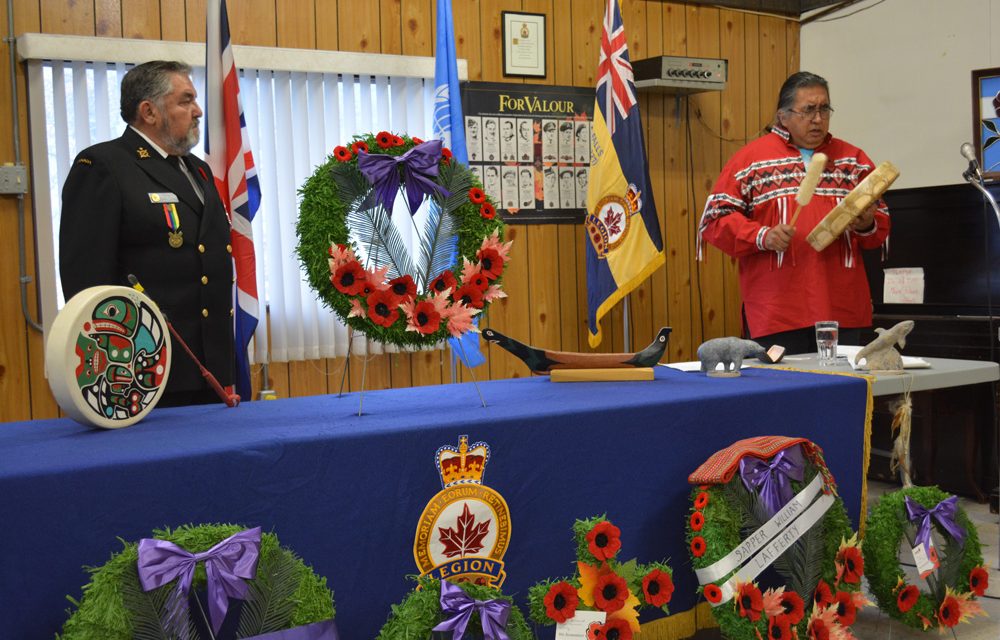
 An historic event on November 8 saw the Okanagan Falls Legion host a ceremony honouring aboriginal war veterans.
Veteran Tim Syrette organized the event that recognized the role that aboriginals played in major military conflicts.
Syrette, an Ojibwa Indian, served in the Navy for 35 years, retiring as a chief petty officer, 2nd class.
He was born in Sault Ste. Marie in Ontario in 1948 and was raised on a small farm on the Batchwana Indian reserve.
His father was a trapper and a guide.
“We spent a lot of time in the woods doing what he taught us,” Syrette said.
At one point he, his father and mother contracted tuberculosis and spent some time in the hospital.
He later got into trouble at home and thought he would join the Navy like his brother-in-law.
“I decided if I stayed at home, I would stay in trouble.”
At age 17, Syrette knew he could get an education and a trade in the Navy, so he jumped on board and sailed away.
“I sailed on everything. I was the only Ojibwa on the Ojibwa submarine in 1967 to 70.”
Syrette’s first posting was on the HMCS Algonquin destroyer, and his last was on a new frigate.
The comradeship was what struck him the most.
“There were 250 men on board. By the time I finished my posting, I knew all of them close. It was just like one big family.”
Syrette said whenever there was a cause, there was no question who would come forward to help.
“I don’t remember the bad times, but I remember the good times.”
The highlight of his Navy career was receiving an aboriginal medal from the admiral of the west coast fleet.
The closest Syrette came to conflict was in Portugal while he was a member of a NATO squadron. He was on shore patrol and had to tell everyone to come back to ship because there was a mini revolution in the streets.
“We pulled out of port immediately,” Syrette recalled.
The veteran stated that of all the places he visited during his career, there was no place like home.
“It made me appreciate Canada. Every time I got home I would kiss the ground.”
Syrette retired in 2000 after 35 years in the Navy. He subsequently served five years in the reserve force.
Last Saturday Syrette honoured four aboriginal veterans, including Private George McLean and Edith Anderson from the Okanagan tribes, and Metis Cpl. Charles Henry Byce and Ojibwa Thomas George Prince.
Private McLean was intimately involved in the battle of Vimy Ridge in 1917, when he launched a daring solo attack on the enemy.
Armed with a dozen small grenades, his attack was extremely effective. He single-handedly captured 19 prisoners. When attacked by five more enemy soldiers who attempted to reach a machine gun, the wounded McLean was able to disperse them unaided.
He saved a large number of casualties and was awarded the distinguished conduct medal.
McLean left the military and later became a firefighter in Vancouver.
During the legion ceremony, Osoyoos Indian Band Chief Clarence Louie said records show that First Nations people volunteered for the war effort at a higher rate than any other segment of the population. This occurred even when aboriginals were not allowed to vote, Louie pointed out.
“Our people have always defended this land, and we will always step up to defend this land.”
Dr. Marlene Cox-Bishop, president of the South Okanagan Similkameen Metis Association, said the Metis walked hundreds of kilometres to enlist in the Second World War.
Aboriginal Veterans have honorably served during the First and Second World War, Korea, the United Nations, NATO and most recently Afghanistan.
It was noted that First Nations served as far back as the War of 1812.
Lyonel Doherty
Oliver Chronicle