 Officials to work with local RCMP
Oliver Mayor Ron Hovanes says the Town doesn’t want the new correctional centre to be a drain on local police, and he has been assured that won’t happen.
Hovanes addressed this issue at a recent council meeting where he talked about a discussion he had with Minister of Justice Suzanne Anton.
Hovanes said he was given assurances that the prison will have very little impact on local police resources.
Stuart Bertrand, public affairs officer for the ministry, said BC Corrections will work closely with local police to ensure public safety.
“The new centre will reduce pressure on local police lockups, as provincial inmates who would normally be held in local police cells while awaiting court outcomes can now be remanded at the Okanagan Correctional Centre (OCC).”
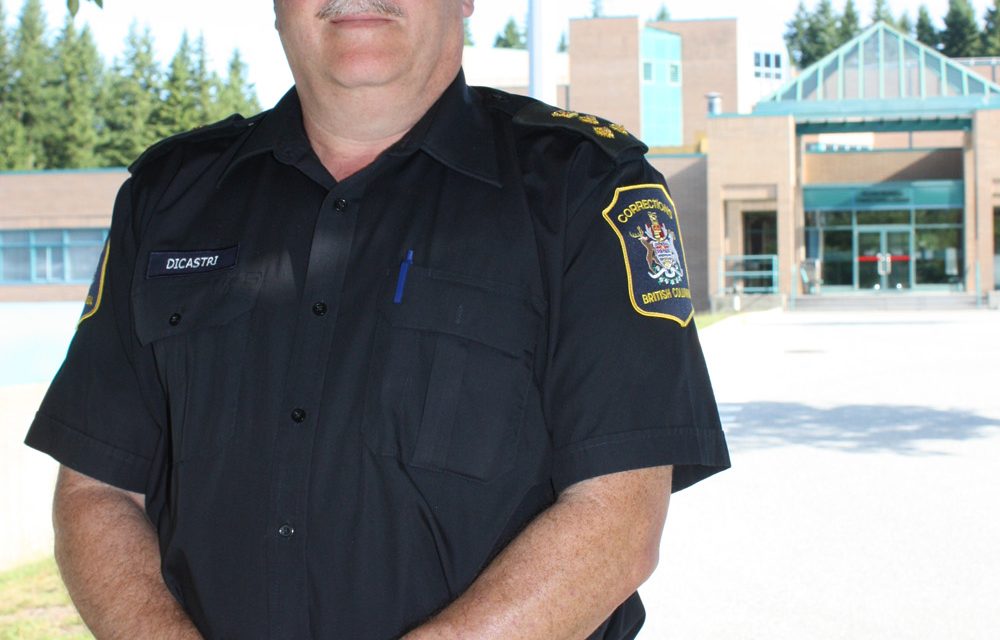
Newly appointed warden Steve DiCastri said he’s looking forward to building relationships with South Okanagan communities and the Osoyoos Indian Band.
“As we build this new (high security) correctional facility from the ground up, we will also be building a professional team of correctional officers.”
DiCastri said he encourages community members to learn about the profession, how it contributes to public safety and how they can make a difference in the lives of offenders.
“With these jobs, not only will our group of professional staff bring significant and positive contributions to the region, we will be engaging those whose paths have led them astray in rehabilitative and educational programs, and helping them reintegrate into society.”
DiCastri will be responsible for making decisions about the facility’s operations and security. He will also be involved in the recruitment process for new staff.
According to the ministry, the number of inmates will fluctuate daily but will be based on the facility’s 378 cells. Approximately 240 correctional officers will be employed at the centre.
A number of contracted service providers will also perform work there, including nurses, doctors, dentists, food service workers, trades personnel and counsellors.
The OCC construction site is already seeing activity.
Richard Burley, vice-president of project delivery for Plenary Group (the company building the prison), said a lot of intensive design work had to be done before construction could begin last week.
In addition, crews had to perform site-clearing work to address environmental conditions, such as the relocation and preservation of local flora (plant life).
Now all systems are a go. “The project is on schedule; there is no delay,” Burley said.
He stated that once the foundation and footings are poured, people will start to see more activity.
He noted that the prison cells are being manufactured now and will be shipped to the site.
“People will be pleasantly surprised at the progress.”
Burley said that two local contractors have been hired to perform work at the building site. H&M Excavating from Penticton will conduct civil works (in-ground services), while Rite-Way Fencing will erect temporary security fencing.
H&M Excavating said it would be in a position to comment once it started work on the site.
Bertrand said the OCC will accommodate remanded individuals awaiting trial, and those sentenced to less than two years.
In BC, the average length of stay is approximately 33 days for remanded inmates, and about 70 days for sentenced inmates.
Bertrand said BC Corrections is still in the preliminary stages of considering the daily routines, programming and community service options that will be available for inmates
Generally, BC Corrections’ inmates are offered opportunities to participate in work programs in various skilled trades, building maintenance and food or laundry services.
Inmates will also engage in educational, rehabilitative and behavioural programs (substance abuse and violence prevention).
“We are continually looking at ways to reduce the factors that contribute to the continued over-representation of aboriginal people in the justice system,” Bertrand said. “We welcome Chief Clarence Louie’s ideas and look forward to working with the Osoyoos Indian Band.”
Louie previously stated that the band hopes to utilize horses as a form of rehabilitation for the inmates.
At the request of the community, appropriately classified inmates can participate in supervised community work programs, Bertrand said.
He noted that inmates are subject to a comprehensive risk assessment prior to being assigned to these programs. “These are partnerships with the community and can involve activities such as roadside clearing, park enhancement, firewood production, fire suppression, and other work that the community might request.”
The ministry was asked about the facility’s security measures. For example, how will it stop contraband (drugs) from entering the prison?
Bertrand said BC Corrections has stringent and state-of-the-art security measures in place (both internally and externally), and a zero tolerance policy pertaining to contraband.
“All inmates are thoroughly searched for contraband upon admission. Cells are also checked for contraband on an ongoing, as needed basis,” Bertrand said.
He also pointed out that BC Corrections has rigorous policies and security practices in place to mitigate the risk of inmate escapes.
Upon admission, inmates are assessed to determine the level of security they require. Escape risk and public safety concerns are primary considerations, Bertrand said.
BC Corrections works closely with local police to ensure public safety information is promptly shared.
“In the last five years, there has been only one escape from a secure, provincial facility. This was in 2009, and the person was found and returned,” Bertrand stated.
The ministry was asked how has the role of correctional centres changed over the past 20 years.
More than a decade ago, BC Corrections’ staff began delivering a set of cognitive behavioural programs designed to reduce the risk factors that contribute to crime.
Offenders at medium or high risk to re-offend are referred to cognitive behavioural programs. These programs address issues such as violence, substance abuse and other negative behaviours.
Additional programs include literacy, education, and work experience programs.
“In the time since we first incorporated these programs into our strategy, we have learned even more about the factors that contribute to criminal behaviour—and the factors that are effective at changing it,” Bertrand said.
The ministry continues to build on its behavioural programs for inmates with new intervention strategies that help offenders overcome obstacles such as mental health issues, low literacy or lack of work and social skills.
Through testing, research and the collection of evidence, they can see which aspects of these programs have a positive effect and which do not.
It comes down to what helps lessen a person’s risk of re-offending.
Lyonel Doherty
Oliver Chronicle