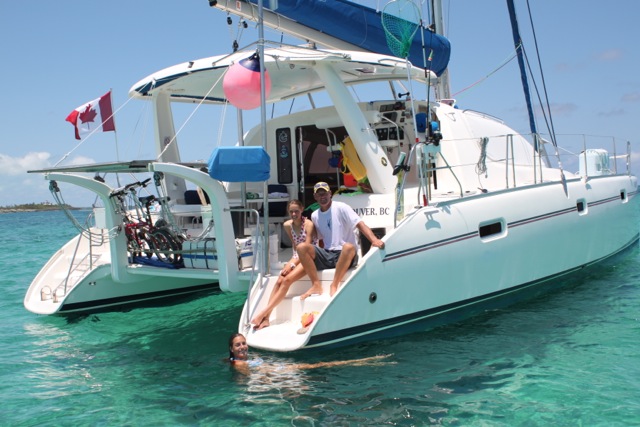

The Ruddimans took a 10-month sabbatical sailing journey throughout the Bahamas, an adventure that changed their lives forever.
Photo contributed
Last week, in the first part of the Ruddiman’s adventure at sea, readers learned how the idea to go on a 10-month sailing sabbatical was fostered, and how the dream became a reality.
Then, on the family’s second night in the Bahamas, they were put to the test, and discovered reserves of knowledge and strength in a stressful situation. After that experience, the Ruddimans knew they could rely on each other in any situations they might face while living at sea.
One of the things that had to be considered when making the arrangements to embark on their adventure was the girls’ schooling. At that time, Courtney was going into grade 10 and Olivia was going into Grade 8. It helped that both girls were strong students in the first place, but integral to the success of the endeavour was the support they received from the school district, especially from Barb Paterson, principal of YouLearn. She viewed this as a golden opportunity for the girls, advising them not to let themselves get too bogged down with their school work, making sure to apply what they were learning to what they were living.
In one instance, Courtney had to write a provincial exam, so Barb got in touch with a school in the Bahamas and the principal there allowed her to tie up the school’s only computer in order to complete her two-hour exam. These are just a few of the examples of the support the family received in regards to their furlough.
“Right from the time that we made the decision, the support that we got from our friends and family, a lot of people don’t get that support,” Christina acknowledged. “So everyone that we surrounded ourselves with were very encouraging and supportive. It makes it doable. Once you’re out there, everyone wants to help, and share their experiences.”
There are so many reasons that people find for not pursuing their dreams, whether it’s sailing, or backpacking, returning to school or changing careers.
“Putting all of the obstacles in your way is something that people use as a way of not addressing their fears,” noted Christina. A personal fear that she herself faced was the water. “When I met Alan I didn’t swim,” she revealed. “I am the weakest in swimming and sailing, but I wasn’t going to miss out on the opportunity because of that fear, and they also looked out for me.”
The experience was empowering for the entire family, with each of them learning a great deal about the world and cultures around them, and also about themselves and each other.
Olivia is now certain that whatever she pursues as a career will be something that helps people, and that it will not involve anything that produces garbage and needless waste.
“All of a sudden she’s got this whole list,” Christina said, smiling. “And it has to be making a difference in this world. It had a massive impact. The people in the Bahamas don’t have much money, but they’re happy. It’s about investing time in other people, rather than things.”
As you might imagine, the return to Oliver and their normal lives was a sort of adventure in itself. The family found themselves spending a lot of time in the kitchen, close by, continuing to share closely in each other’s daily lives.
“One of the fortunate things that we did was invite family and friends to join us on the trip, which really helps when you come home because they’ve been a part of it, so they don’t mind hearing about it and sharing it, so you can keep living it when you come home.” said Christina. “We also came back to a small town, where people communicate with each other; we didn’t go back to a big city, like many boaters did. It made the transition much easier. But it was difficult, probably for the first year to be home.”
To this day, the Ruddimans are very conscious of their consumption, especially of water, and disposable goods.
“You’re so aware out there of water, it’s precious,” Christina recalled. “You have to pay for it, you could run out of it . . . what are you going to do if you run out of it? You become incredibly aware of water, you don’t waste any water, and that continues when you come home.”
Christina said you can’t buy something without thinking about what do you do with it at the end of its use. “Out there you couldn’t just put it in the garbage. I don’t think that we’ve probably got more than 10 plastic bags since we’ve been back for two years, we’d rather scoop it all into our arms and carry out our stuff. Even though it was only 10 months, the impact was massive. You can’t get away from being totally aware.”