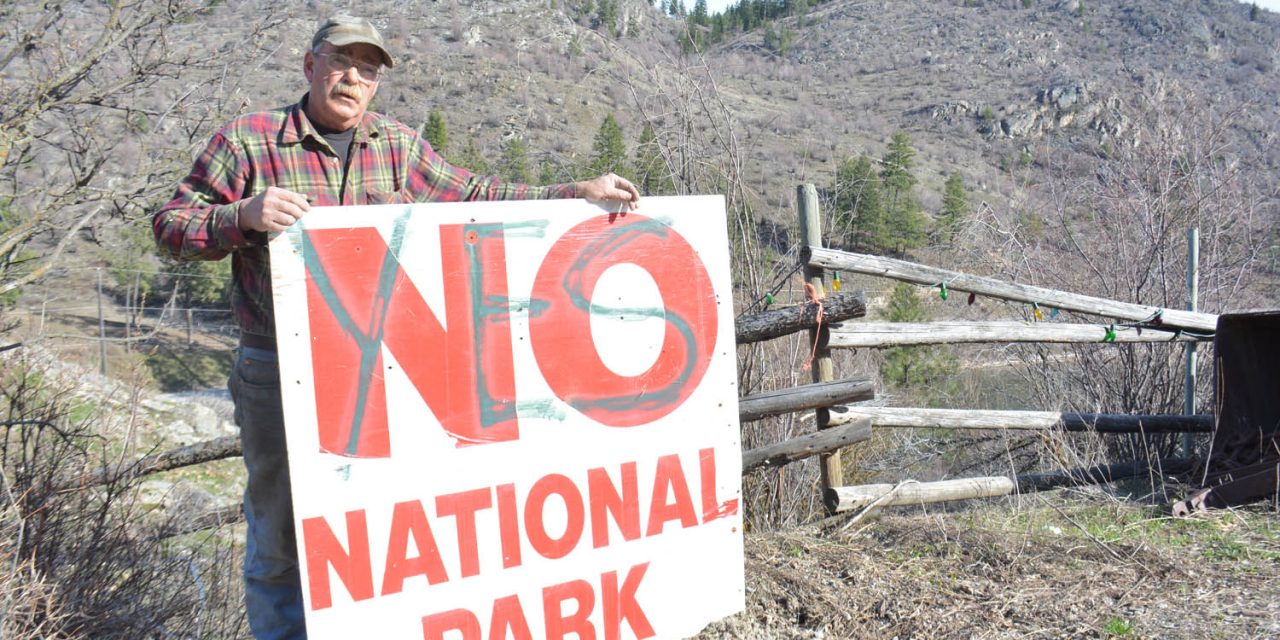
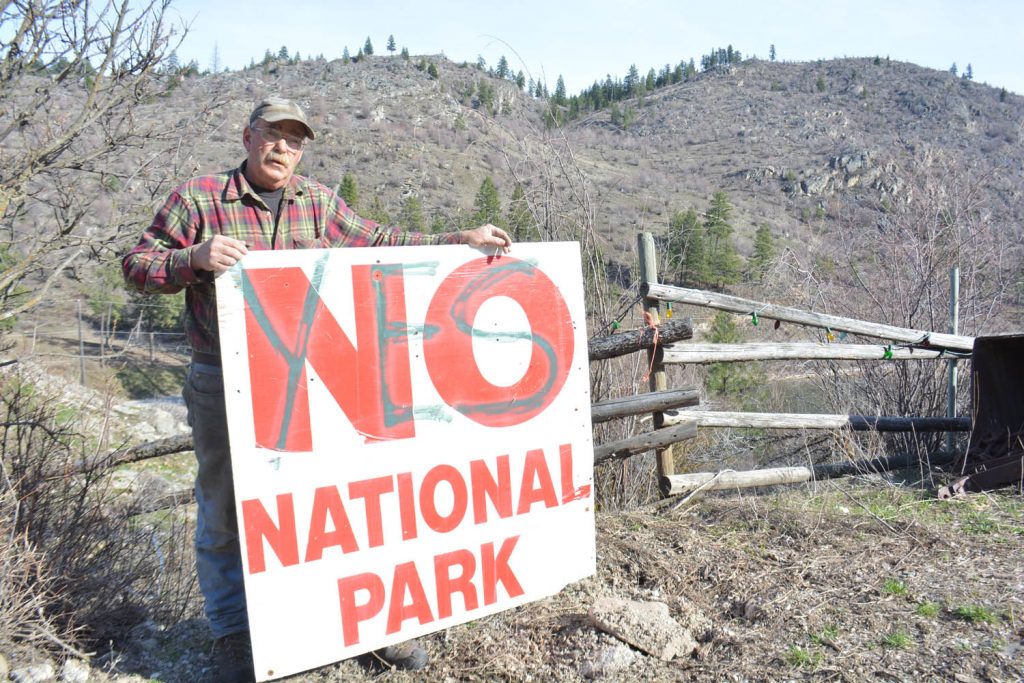
Greg Norton, the spokesman for the Grassland Park Review Coalition, shows a “No National Park” sign that was vandalized last spring. He worries park opponents won’t get a fair hearing. (Lyonel Doherty file photo)
Greg Norton, a long-time opponent of a national park reserve in the South Okanagan, says he remains skeptical that senior levels of government will give his side a fair hearing.
Norton, who speaks for the Grassland Park Review Coaltion (GPRC), an informal group that has opposed the park for the past 15 years, said officials contacted his group before the Oct. 27 announcement to give them a heads up.
“They made lots of promises about having input and transparency,” Norton said. “We’re very skeptical. We have to look at history. We’ve never felt like this was an unprejudiced or an unbiased process.”
Norton said the officials sounded sincere, but he adds: “Parks Canada is an entity unto itself, so time will tell.”
GPRC has roughly 15 members, Norton said, but he adds that they represent a lot more people from a cross-section of stakeholder interests.
“We’re basically the same faces and have been for 15 years,” he said. “We’re not a revolving door… We don’t have a membership list. We don’t operate like that. We’re a coalition. We’re totally resolved and sticking together on this thing. Everybody appreciates each other’s reasons for objecting to this.”
Norton said his group has numerous concerns about a national park reserve and they can’t be prioritized because every concern is important.
Potential limits on cattle grazing are a big concern, but Norton said it’s broader than that – it’s the negative impact on agriculture more generally.
“If you eliminate hunting, there will be an increase in mule deer and black bear populations,” says the orchardist. “What effect is that going to have on our horticulture and forage crops?”
He worries about the impact on core lands in the valley bottom that ranchers own, and which support the ranches with cattle that graze on the mountains.
Wildfires caused by lack of cattle grazing “is another huge issue,” says Norton.
He says that in 2007, Parks Canada hired a fire behaviour specialist to do an analysis and when Norton raised concerns about wildfires at a public meeting, the specialist agreed with him.
He acknowledges that cattle don’t prevent wildfires, but he said they keep fine fuels that can start fires in check. Without cattle, the fire risk goes up exponentially, Norton said.
Wildfires, he said, will ruin grape crops, hurting agriculture.
He’s not reassured by suggestions that Parks Canada will continue to allow cattle grazing. In the past, Parks Canada officials discussed incorporating existing provincial grazing laws into the Canada National Parks Act.
“They’re saying that they can allow grazing, but some of our people talked to the folks in southwestern Saskatchewan,” he said, referring to grazing in Grasslands National Park. “The ranchers said no, they may let cattle in, but it’s such a short period of time and it’s just not practical for a commercial operation. It’s restrictive.”
Norton is also concerned that a national park reserve would curtail the activities of HNZ Topflight, a Penticton-based helicopter training school.
If they can’t operate in the park, they’ll leave, he said, noting that HNZ Topflight accounts for 65 per cent of the landings at Penticton Airport.
If the airport loses such an important customer, he adds, that could lead Transport Canada to close it.
“Will that threaten the existence of Penticton Airport?” asks Norton. “Will all the people in the South Okanagan-Similkameen then have to drive to Kelowna to catch a flight? What does that mean?”
The loss of recreation, particularly hunting, is another major concern for Norton and his group.
“There’s a lot of hunting activity in that area,” he said. “What effect is that going to have on other neighbouring areas? Are we going to be concentrating hunters on other areas? What impact will that have on populations?”
He points out that many generations have been hunting in the same places for decades.
“We’re getting ready to throw families off that mountain that have been on there for a century,” Norton said. “If you get rid of cattle grazing up there, those pioneer families that have been up there all of a sudden can’t do their business and support the family. The history of the family just disappears overnight. What kind of effect is that?”
Norton said his group has always been prepared to go to the table with government, but it has avoided engaging the pro-park side in direct debate because most of what they say isn’t factual.
Two claims from the pro-park people that get under Norton’s skin and bother other park opponents are the suggestions that 70 per cent of people support a park and that a park will bring 700 jobs.
Norton said it’s the pro-park people – not Parks Canada – that make such claims.
The 70-per-cent-support figure comes from a public opinion poll conducted in March 2015 by McAllister Opinion Research, which surveyed 501 people throughout the Boundary-Similkameen and Penticton provincial constituencies.
The 700-jobs figure is based on an April 2011 study by The Outspan Group for Parks Canada. It considers direct and indirect jobs and is the average for all national parks in B.C., including large and small.
Norton wants any public consultation to be objective and for no decisions to be made before the public has been heard.
“We’re Canadians with real concerns,” he said. “This is our livelihood, our lives, our homes, our lifestyle. This is a big issue for us and we think we deserve a proper hearing before the decisions are made.”
Norton doesn’t believe that Parks Canada will be able to address the concerns through the Canada National Parks Act.
“At the end of the day, I think the realization that this is not a good place for a national park will come through,” he said.
RICHARD McGUIRE
Osoyoos Times