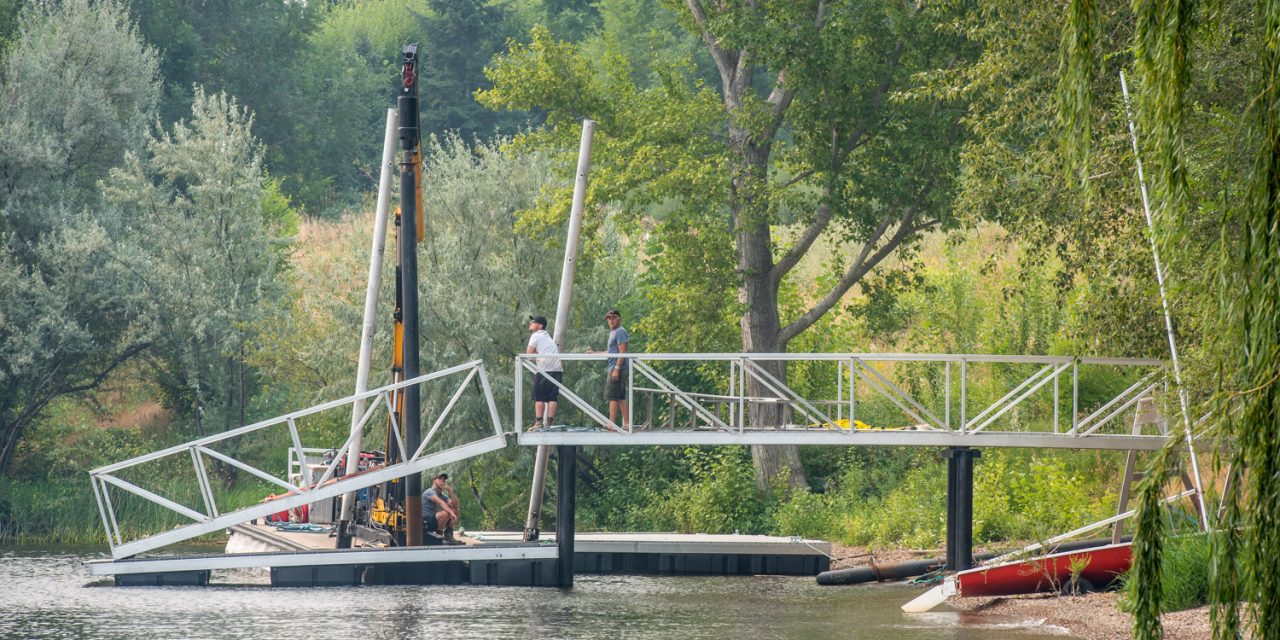
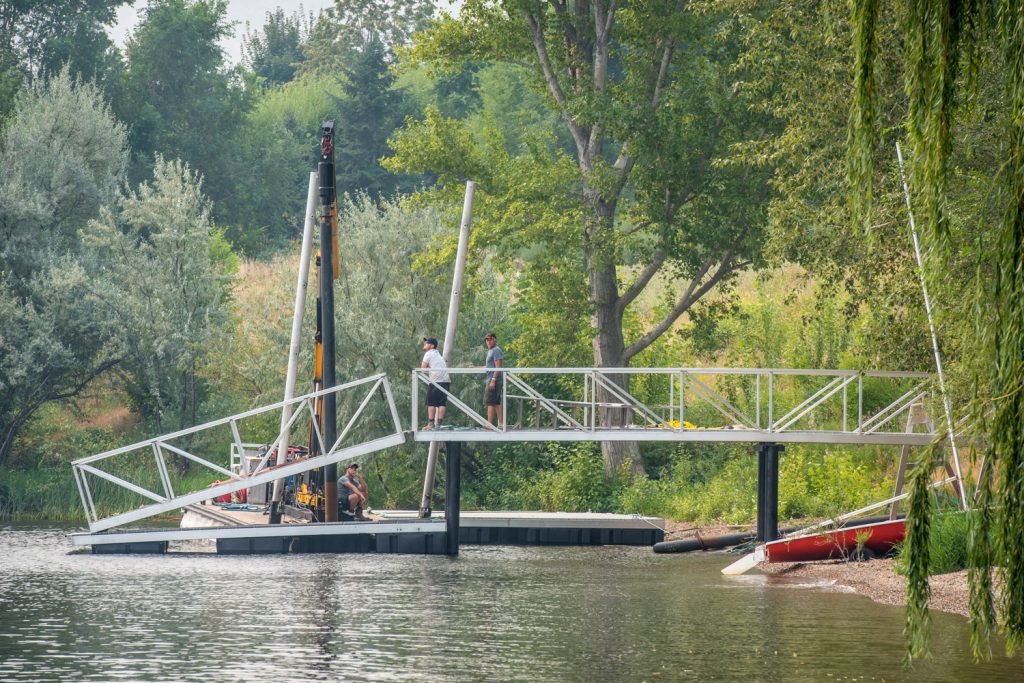
Workers were assembling a large dock at La Stella Winery last week and this has upset local residents. (Richard McGuire photo)
The construction of a large dock at La Stella Winery, now underway, is once again inflaming tensions between the successful Osoyoos winery and its neighbours.
Although the province approved the 100-foot dock proposal in November 2015, some residents thought the idea was dead and were surprised when construction started recently.
“We didn’t know it was still on the table,” admitted Mario Esposito, a neighbour who says he’s concerned about the additional traffic and possible floatplanes the dock will bring.
Even Mark Pendergraft, director for Area A of the Regional District of Okanagan-Similkameen (RDOS), says the development is a surprise for him.
“I haven’t heard anything since a couple of years ago,” said Pendergraft. “I kind of thought the issue had died.”
Several upset neighbours contacted the Osoyoos Times with numerous concerns, but they didn’t want to be identified, fearing this would exacerbate an already tense relationship with the winery.
Their concerns include safety and noise that would be generated by use of floatplanes and boating traffic in their quiet residential area.
They also raise environmental concerns and are frustrated with the consultation process that took place two years ago.
But both proprietor Sean Salem, of Vancouver-based Enotecca Winery and Resorts, and Brad Elenko, the land consultant working as an agent for the winery, insist the proper permitting was obtained and the project will benefit local tourism.
They’re also frustrated with what they see as unreasonable complaining by the neighbours.
“The neighbours weren’t at all co-operative with anything we’ve done,” said Salem, pointing to the success of the winery.
“We brought a very successful winery to the community,” said Salem. “We don’t take anything away. We’ve added jobs … this is agricultural tourism and this is agricultural land.”
Elenko said the winery went through an approval process to obtain Crown land tenure to build the dock into the lake and this included an environmental assessment, which even entailed hiring a diver to look at aquatic life.
Public notices were advertised in the Osoyoos Times and were posted at the site, he said.
“The real story is that this is a successful winery in a rural agricultural area that’s zoned agriculture,” said Elenko. “They’re using it for agriculture, for wineries, which are permitted. They’re doing a great job at promoting the area and bringing tourists to the area.”
The problem, he said, is that people move into an agricultural area and then complain about agricultural operations.
But Mike Greig, one of the few local residents who spoke to the Osoyoos Times on the record, said the problem isn’t the winery, but rather that the large dock and the traffic it will bring isn’t compatible with a quiet residential neighbourhood.
“It’s a great winery and they’ve got a nice business going,” said Greig. “I don’t think anybody is not supportive of the winery. They just don’t want to see a commercial application on the waterfront.”
Greig said residents are concerned about safety, traffic and the “enormous, big structure” that doesn’t fit with the character of the lake in their quiet bay.
“They’re just worried about all of a sudden this commercial activity in a family-friendly area,” said Greig. “They’re worried about boating traffic and more people around posing a risk to families that are using the water.”
Residents are also concerned about the process for approving the application two years ago, which allowed written submissions by residents, but didn’t provide for a hearing.
“We just don’t think that was a meaningful consultation process,” said Greig. “There was no requirement for Enotecca to meet with the locals and come up with an action plan or to work out problems. It was just simply, ‘submit your comments.’”
The province did impose a condition that the dock can’t be used for parties, private gatherings or functions hosted by La Stella Winery that generate loud noise by visitors or guests after 10 p.m.
The province also granted a shorter five-year tenure instead of the usual 10 years in order to see whether additional conditions might be required, said a spokesperson for Ministry of Forests, Lands, Natural Resource Operations and Rural Development.
But Greig thinks the government didn’t address the other issues.
“They tried to deal with the issue of noise,” he said. “I think they looked at part of the problem, but not all the problem.”
The apparent noise issue is part of a longer history of poor relations between the winery and local residents.
Some neighbours point to problems when the winery hosted weddings on their property several years ago, saying guests were noisy, stumbled onto neighbouring properties and created security and parking issues.
Elenko agrees there is a history of bad relations, but he puts some of it down to jealousy and says that the complaining residents “are just going after the owners for anything.”
When his own son had a wedding there, he intentionally went down the street to check the noise level and couldn’t hear anything.
“It’s really sad that people have nothing better to do than complain and think the worst about things,” said Elenko. “Yes it’s a dock. It’s a commercial business and the dock is bigger than what an ordinary dock is, but it went through a Crown process and people have got the right to use the dock.”
While Enotecca obtained provincial sign-off for the dock extending onto Crown land into the lake, it’s not clear that a concrete support wall on land complies with RDOS requirements.
Christopher Garrish, planning supervisor with the RDOS, said he could find no record of Enotecca obtaining a watercourse development permit for the concrete structure.
This permit is to protect riparian values around watercourses, such as the lake, and it typically requires a biologist to do an assessment and make recommendations, Garrish said. It applies to the land above the high water mark.
When the province sends a “referral” of the project to the RDOS, the RDOS normally responds with standard wording advising that the watercourse development permit is required for any works above the high water mark.
The province confirms it notified Enotecca of the RDOS requirements.
“The location of the footings for the dock, from what I can see in the photo appear to be above the high water mark,” said Garrish, referring to a photo set by a concerned citizen.
“We checked our system to see if any permits have been issued and we couldn’t see anything,” he added.
But Elenko said he believes the concrete structure was built on Crown land and so would not need the watercourse development permit and said a surveyor is checking this.
“I’m hoping we’ve got it in the right spot,” he said. “If not, it might be an inch or two out and we’ll submit the development permit.”
The structure simply replaced an existing one built with railway ties and other materials.
“They (complaining neighbours) are looking at anything and everything now to create problems,” he said. “I know we’re under the microscope.”
Elenko said he suspects home owners in the area have built docks without permits and says it’s ironic that these residents are complaining when La Stella has followed the proper process.
RICHARD McGUIRE
Osoyoos Times
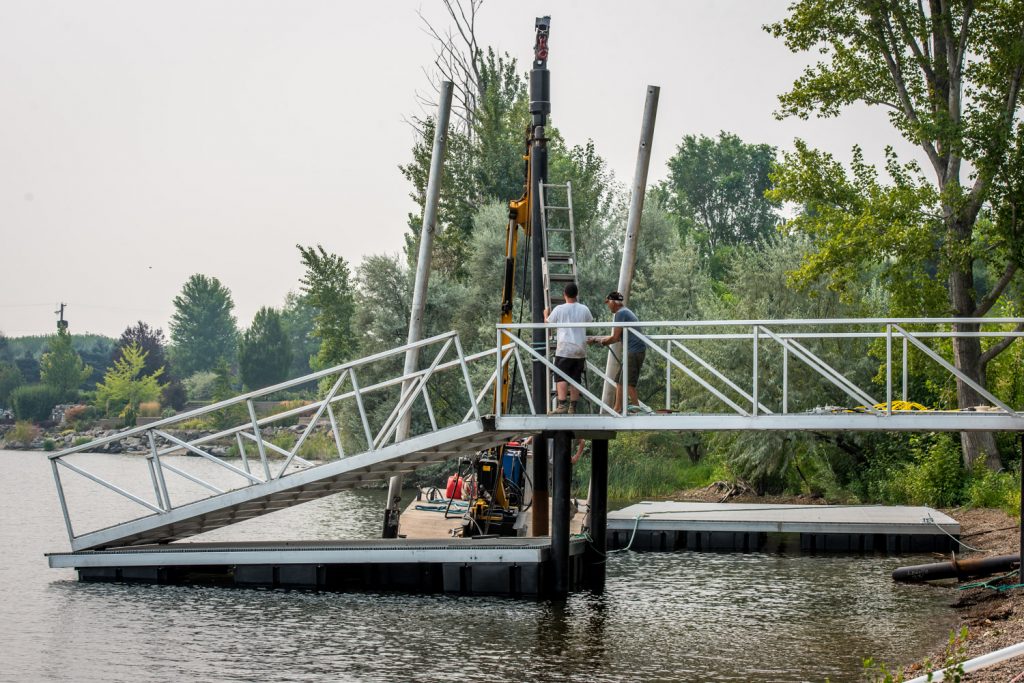
Workers were assembling a large dock at La Stella Winery last week and this has upset local residents. (Richard McGuire photo)