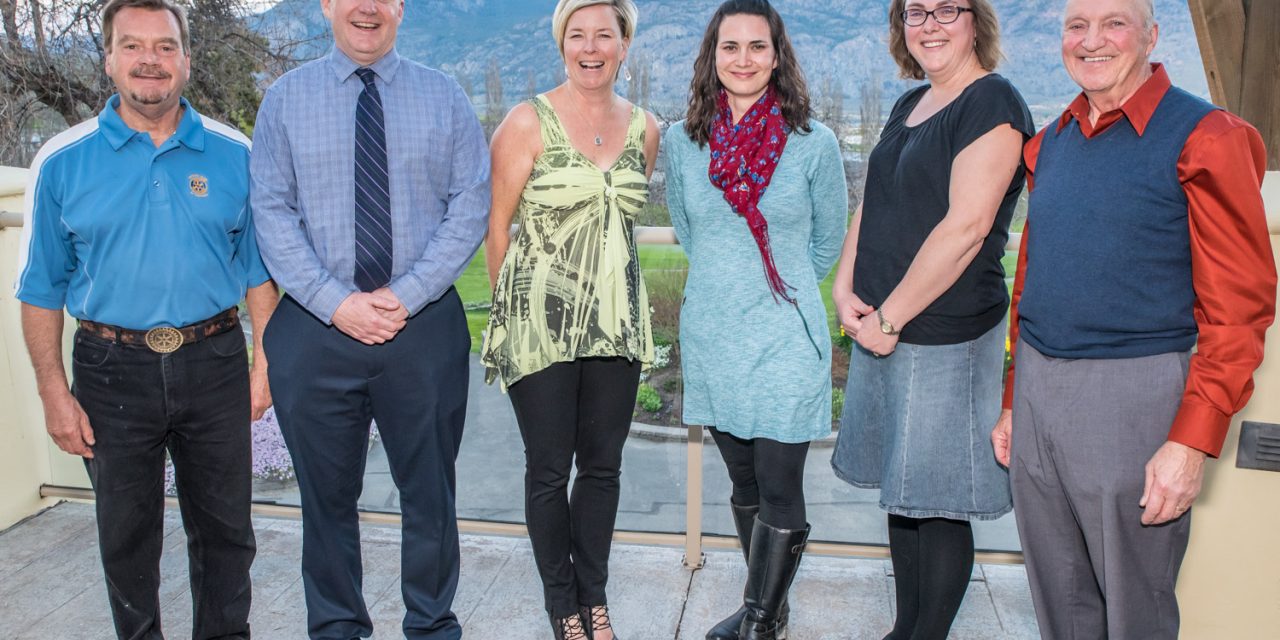
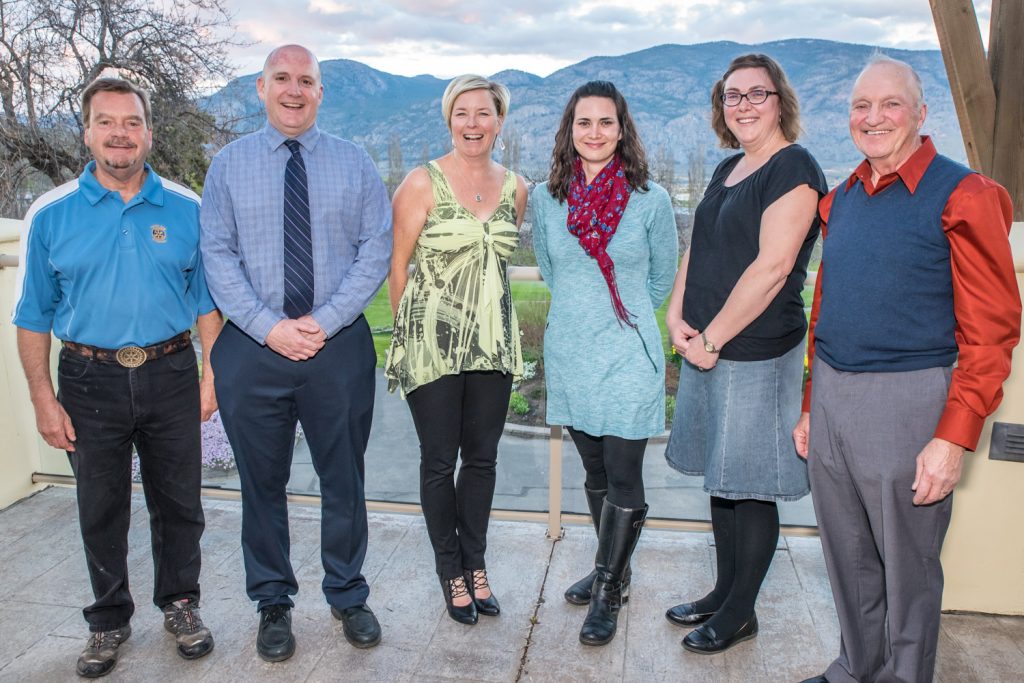
Pictured from left are Brian Rawlings, president of the Rotary Club of Osoyoos; Dave Foster, principal of OSE; Sandy Summers, a Rotarian who accepted funding on behalf of Desert Sun Counselling and Resource Centre and Better at Home; Danielle Higginson, PAC treasurer; Amy Robinson, PAC president; and Harold Cox, the Rotarian who is spearheading the Save a Rhino project with his wife Audrie. (Richard McGuire photo)
Plans to create a nature park playground at Osoyoos Elementary School (OSE) received a big boost last week thanks to a $28,000 donation from the Rotary Club of Osoyoos.
The donation was the largest among several community grants announced by the service club at a reception last Thursday.
Among other contributions Rotary is making to community organizations are $2,000 to Desert Sun Counselling and Resource Centre and Better at Home and $2,000 to the Okanagan Regional Library.
The club is also making a multi-year $30,000 contribution to the South Okanagan Similkameen Medical Foundation for equipment at the new patient tower at Penticton Regional Hospital.
That commitment was announced last year.
The club also contributes bursaries for Osoyoos Coyotes’ hockey players and scholarships at Osoyoos Secondary School.
Guests at the reception saw a sample of a backpack that the club plans to provide to game wardens in Kruger National Park in South Africa to help them catch rhinoceros poachers.
The Camelbak packs, which cost $300, allow trackers to carry water, enabling them to stay in the field longer to deter poachers who kill rhinos for their horns.
The Osoyoos Rotarians hope to inspire other Rotary Clubs to contribute to the project.
Rotarian Chris Bromage, a musician who performs under the name End of Empire, raised money for one of the packs Saturday night in a concert at Jojo’s Café.
On hand to recognize the contribution for OSE’s nature park playground were Principal Dave Foster, Parent Advisory Council (PAC) Chair Amy Robinson, and PAC Treasurer Danielle Higginson.
The project will be built in the lower playground to the north of the Osoyoos Splash Park and it is intended to give children a less structured play space incorporating logs, rocks and other natural features.
“We’re ready for them to play again,” said Robinson. “We want children to be able to use their imaginations. We don’t want them to go out to the structure and be it a slide or a bar and be told how to play. We want them to be able to arrive at the logs or stones and rocks and natural elements and be able to have creative play.”
The project is still in early planning stages, but the PAC hopes to have it in place by September.
Although it allows a freer form of play, reminiscent of generations past, it still must meet safety standards, said Robinson.
Such playgrounds now exist in other parts of Canada, including the Lower Mainland.
Foster said one of the goals is to try to reduce the amount of time children spend glued to the glowing screens of electronics.
“We don’t want kids playing video games or watching TV,” he said. “We want them to be out in the playground and being active. That, I think, is a huge part of it. If they get excited about logs and rocks and different structures like that and put the screens away, that’s what we want.”
When Higginson thanked the Rotarians for their contribution to the playground project, she told them, “It’s going to be beautiful and one-of-a-kind in the area.”
Accepting the contribution on behalf of Desert Sun Counselling and Resource Centre was Sandy Summers, who is also a Rotarian.
She gave an overview of the numerous programs that Desert Sun provides, including running a safe house shelter for women leaving abusive situations, providing men’s and women’s counselling, a community kitchen to teach food skills and a literacy program.
Part of the grant is earmarked for Better at Home, a program that helps seniors remain in their own homes longer by providing them with transportation and light housekeeping.
Rotarian Harold Cox, who is spearheading the Save a Rhino campaign with his wife Audrie, explained the importance of the Camelbak packs.
Currently, the packs the tracker teams use only allow them to stay in the field for two days before they must return for supplies. The poachers know this and they wait for the teams to leave before killing the rhinos to sell their horns on the black market.
Rhino horn is sold in China and Vietnam, where it is believed to have medicinal properties, including as an aphrodisiac. There is no scientific basis for its medicinal properties.
“They are losing three to four rhinos every day,” said Cox. “These trackers or field officers do their very best and they’re passionate about trying to stop it and look after the animals.”
Cox said the goal is to provide 20 packs to them and the tracking teams will report back on their effectiveness.
RICHARD McGUIRE
Osoyoos Times