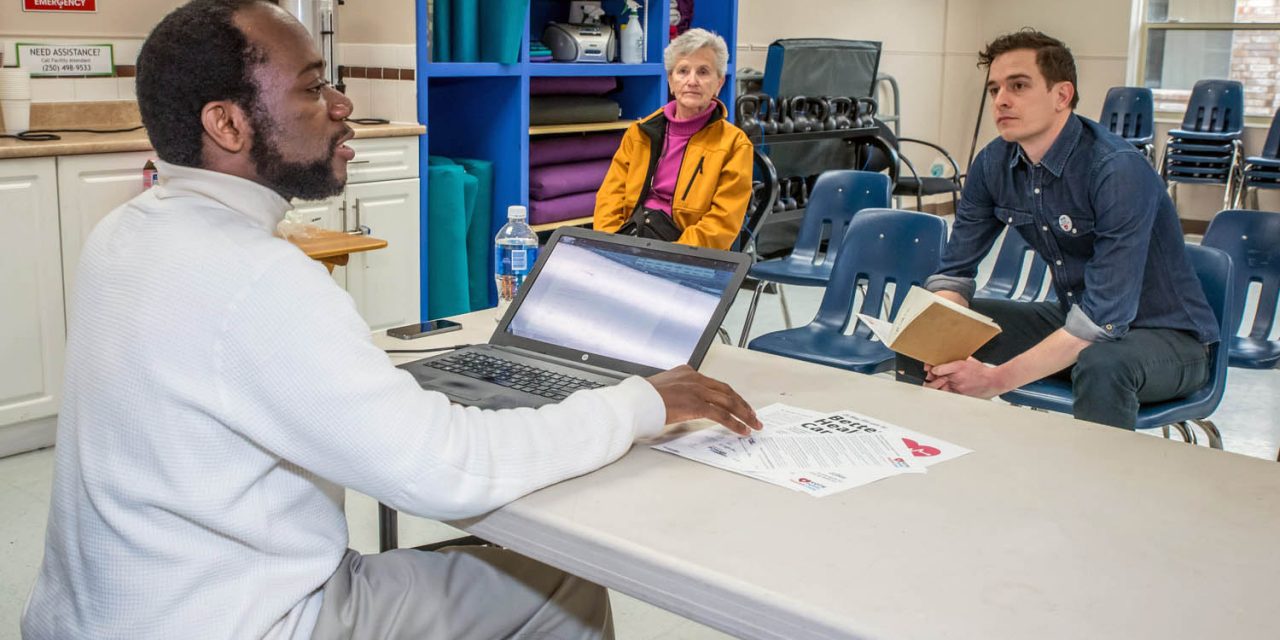
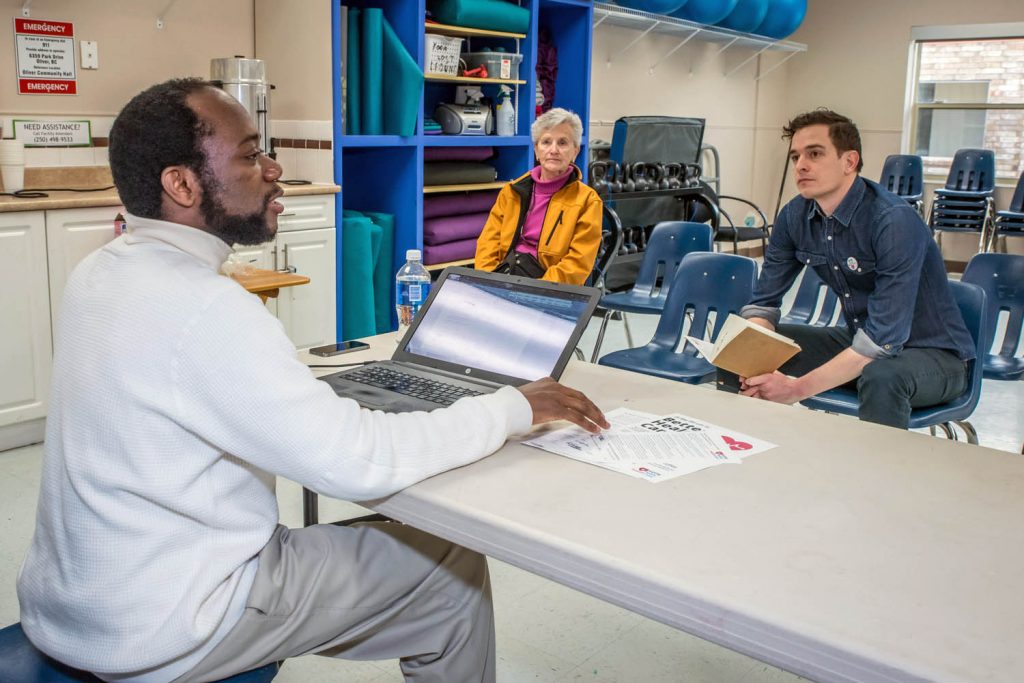
Ismael Traore, the organizer for BC Health Coalition in the Okanagan, led a discussion of health issues on Saturday at the Oliver Community Centre. Attendance was low as the event wasn’t well publicized, but those attending had a lively discussion. Listening are Oliver resident Dawn Landau and Vancouver-based organizer Adam Friesen. (Richard McGuire photo)
The low attendance at a forum in Oliver to discuss healthcare on Saturday probably wasn’t due to lack of interest.
Rather, organizers from the BC Health Coalition acknowledged the meeting at the community centre wasn’t well promoted.
The three Oliver residents who turned out, however, all offered personal experiences and insights on a healthcare system that some believe is failing British Columbians.
“You’re the core group,” organizer Ismael Traore told the three. “It always starts small and then it gets bigger and bigger.”
The BC Health Coalition will be doing a similar information session on Tuesday, April 4 from 5:30 p.m. to 8:30 p.m. at the Osoyoos Seniors’ Centre.
Vernon-based Traore is the Okanagan organizer for the non-partisan, non-profit BC Health Coalition, which campaigns during elections to raise the profile of healthcare issues and encourage people who care about them to get out and vote.
In the 2015 federal election, the group sent door-to-door canvassers into South Okanagan-West Kootenay, which they considered to be a swing riding. And they’ll be doing the same this provincial election in Boundary-Similkameen.
“Boundary-Similkameen is going to be an especially close race,” the group said on its poster.
Traore is completing his PhD in sociology at McMaster University in Hamilton, Ont. and is specializing in health issues. But he fell in love with the Okanagan and settled in Vernon two years ago.
He was accompanied by Adam Friesen, an organizer based in Vancouver, who is also campaigning on Vancouver Island.
The group is focusing on five key health issues, but the two primary ones are improving surgery wait times and eliminating MSP (Medical Services Plan) premiums.
The Oliver residents attending the forum know very well about surgical wait times.
Dawn Landau said she was on a wait list for a hip replacement for two years and ended up travelling to Kelowna because she couldn’t get the operation in Penticton.
“A two-year wait is a long time to have to wait for surgery,” said Landau.
Linda Unwin, a former nurse who attended with her husband Bill, also knew first-hand about surgical wait times.
“I waited over a year and a half for knee surgery to be able to walk because both my knees collapsed,” Unwin said. “I spent over a year in bed until I finally got my knee surgery. We need to speak up and be heard.”
The Unwins have another medical problem all too common in the South Okanagan – lack of a family doctor.
Until December 2015, the longtime Oliver residents had “a great family doctor.” But when he retired, most of his patients were left high and dry.
“We’ve been without a doctor now for almost a year and a half,” said Unwin. “It’s been very difficult because you can’t go to the emergency here to get a prescription refill. It’s not a walk-in clinic and they make you feel unwelcome if you do stuff like that.”
So the Unwins go to Penticton, where they also can’t get a family doctor, and they get prescriptions filled at a walk-in clinic.
Unwin is also upset that South Okanagan General Hospital (SOGH) where she worked as a nurse over a decade ago is reducing beds to only the 18 that are funded.
She buttonholed MLA Linda Larson, who showed up and left before the meeting began, to express her concerns.
She’s skeptical of Larson’s view that the hospital only needs 18 beds.
Traore pointed out that B.C.’s record is close to the worst in Canada for dealing with surgical wait times. He also spoke about the urban-rural divide in providing medical services, which leave rural areas short.
“I think health authorities are not focusing as much on the needs of small communities,” said Traore.
On surgical wait times, Traore cited numbers that tell a story of success and failures between the provinces. Saskatchewan does the best, while B.C. is usually around the worst.
Using a six-month recommended timeframe for surgeries, Saskatchewan had a record of 100 per cent of hip replacements performed within the six-month period.
Newfoundland and Labrador had a success rate of 94 per cent, while B.C.’s success rate was only 61 per cent.
Knee replacements showed a similar pattern.
Saskatchewan has a 99 per cent success rate, Newfoundland and Labrador was at 87 per cent, followed closely by Ontario at 86 per cent. B.C. was only 47 per cent, which Traore suggested is a failing grade.
Cataract surgeries reflect the same provincial disparities. Hip fracture repairs and waits for radiation therapy to treat cancer are also a problem, he said.
What’s more, he said, B.C.’s wait-time record has been getting worse over the years for most of these surgeries – in 2010, the success rate for hip replacements in six months was 87 per cent, but in 2015 it had fallen to 61 per cent.
Traore said he personally believes that attributing these problems to an aging population is “scapegoating.”
He also rejects the notion that there aren’t enough trained specialists, saying instead there is an “employment crisis” due to lack of funding.
“There are a lot of new specialist surgeons who are either underemployed or unemployed today because there are not enough jobs,” he said. “Even though there is a need for surgeons, there are not enough hospital spaces where we can hire surgeons.”
RICHARD McGUIRE
Osoyoos Times
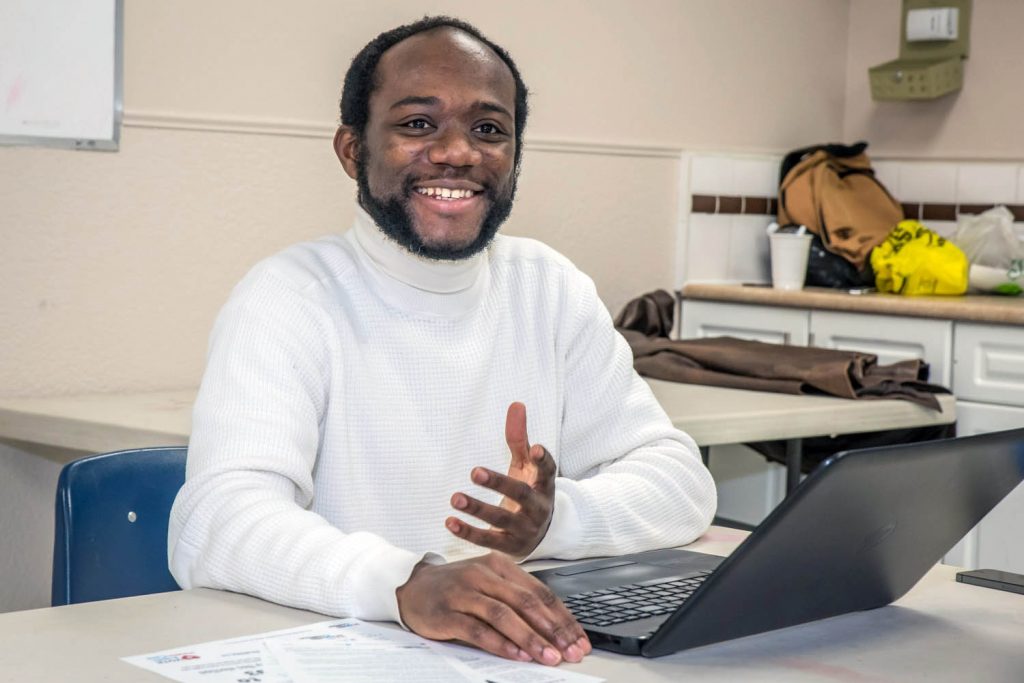
Ismael Traore, the organizer for BC Health Coalition in the Okanagan, led a discussion of health issues on Saturday at the Oliver Community Centre. Attendance was low as the event wasn’t well publicized, but those attending had a lively discussion. (Richard McGuire photo)