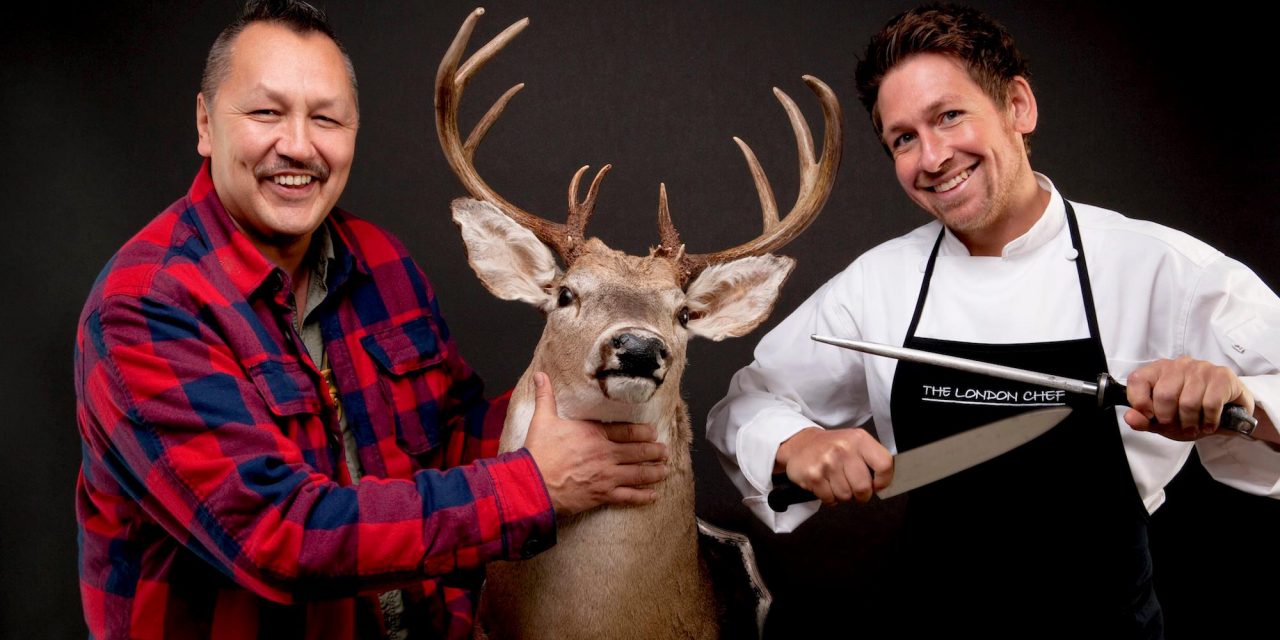
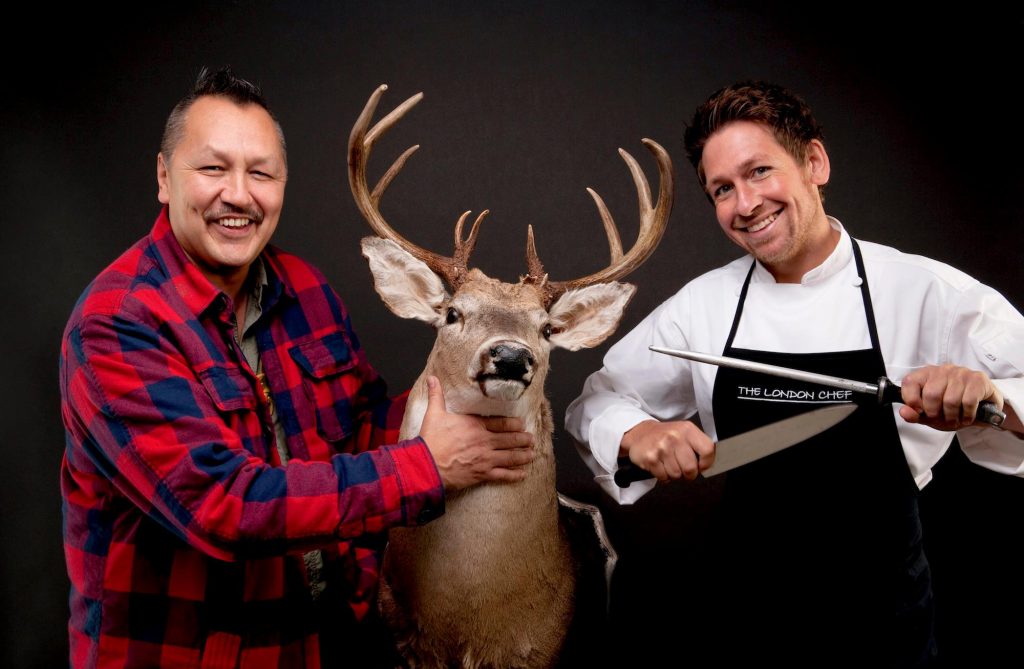
Bush cook Art Napoleon (left) and classically trained British chef Dan Hayes teamed up to compare styles in the television program Moose Meat and Marmalade, which airs on the APTN. (Contributed photo)
By teaming an Aboriginal Canadian bush cook with a classically trained British chef, the TV program Moose Meat and Marmalade juxtaposes two very different styles of cooking. And in preparation for the show’s second season, the cooking duo popped into Osoyoos over the summer to record an episode at Spirit Ridge at Nk’Mip Resort.
The concept for the show was conceived by Art Napoleon, also know as the bush cook. His methods of preparing food employ employ very little precision, and the success of his meals rely heavily on the elements of nature.
When Napoleon was younger, he had aspirations of writing sketch comedy. One of his ideas was a program that would feature his style of cooking in the wild, which audiences would find satirical compared to traditional cooking shows.
However, there’s nothing facetious about the Moose Meat and Marmalade, and Napoleon’s job is to find a natural environment where he can demonstrate his preferred method of cooking.
“I’m a bush cook,” he said, adding that he Napoleon grew up on Saulteau First Nations, north of Chetwynd. “A whole different monster – nothing like a conventional kitchen. I was raised cooking on fire. Every summer my family meals were prepared outside in a smokehouse, always over a fire.”
Asked what his favourite moose dish is, “There are so many that are right up there,” he replied. “Moose tongue soup is a real delicacy, and moose nose as well – just boil the snot out of it.”
He said moose is considered a sacred food and is often designated for special feasts, and elders get first pick at the choice parts.
“And it’s hard to go wrong with ribs. Slow cooked over an open fire – and that can be any type of rib – elk, moose, deer, bison,” he said. “With the fat dripping off the ribs and into the ashes, and you can hear that little sizzle, that beats any other way of cooking.”
His concept for the show came to fruition last year and the first season was successful enough to warrant a second. Producers were intrigued by the idea from the beginning, but they wanted to augment it and partner Napoleon with a cook whose methods are opposite of his.
It wasn’t hard to find him the right partner. Napoleon was working on a kids TV program when he first made the pitch, on a set that was being catered by chef Dan Hayes.
“He was interested in hunting, culture and he was new to Canada,” Napoleon said.
Hayes was immediately intrigued by Napoleon’s idea. The two then went out in the bush to make a promo video and “everything clicked.” The promo garnered much interest in the industry, and the Aboriginal Peoples Television Network agreed to invest in the show.
To guarantee good programming, Hayes’ style of upscale cooking is in sharp contrast to Napoleon’s primitive methods.
“Our styles are very, very different. We’re worlds apart,” Napoleon said. “They don’t call it hunting in Europe, they call it shooting. It’s all organized; cultivated; all artificial. Birds are raised to be shot. They’re not fully wild, they’re bred and raised on acres just to be shot.”
Napoleon said Hayes is book smart, and became very familiar with all of his country’s rules and regulations around hunting through study.
“He not so good at improvising though. He’s got a decent shot, but nowhere near close to me.”
Because shooting game is subject to stiffer regulations in the United Kingdom, the country’s wild animals seem to be prospering, Napoleon said.
“Surprisingly there’s lots of game. There were five or six varieties of deer and they’re everywhere; no shortage. And all kinds of game birds.”
He said that owners of large private properties in the UK tend to keep patches of forest growing wild, and that greatly benefits wildlife.
“It would be nice to see our farms with islands of forest left there for animals.”
But whatever side of the Atlantic Ocean they’re on, and whether they’re scouring the woods or garnishing an elaborate dish in a commercial kitchen – they rarely see eye-to-eye.
“If you want conflict watch an episode. We always argue,” he said. “But at the end of the day we always go for a run together. It’s once the cameras are rolling, something happens where we start bickering and arguing, we’re like the odd couple.”
In addition to the South Okanagan, this upcoming season features locations in England, Scotland, Ontario, another location in the province’s Interior and two shoots on Vancouver Island. And depending on which scenarios they’re up against, Napoleon and Hayes rotate the leadership role.
“(Hayes) leads half the episodes, I lead the other half. When I lead we’re hunting and foraging. When he led a little bit of British hunting, I was there to poke fun at him and question his methods. He probably doesn’t think I can show him much, but when it comes to the woods and cooking on fire, I think he realized he does have a lot to learn.”
Napoleon said his takeaway was from the shoot in Osoyoos was that, “There’s a lot going on there, traditionally and in a modern sense.”
“I knew lots of people there, and I knew people would be able to take us out hunting and foraging, and restaurants nearby. The fella who took us out hunting wanted to go in the wideners near Penticton, so we kind of expanded it to be a South Okanagan episode. It was more spread out than most shoots, we had to move the camp a lot. Shooting each episode is a unique adventure that take on its own flavour; meeting new people and cooking in new kitchens.”
Season two just aired its first episode earlier last week through APTN, and full episodes of season one can be viewed on aptn.ca
DAN WALTON
Regional Reporter